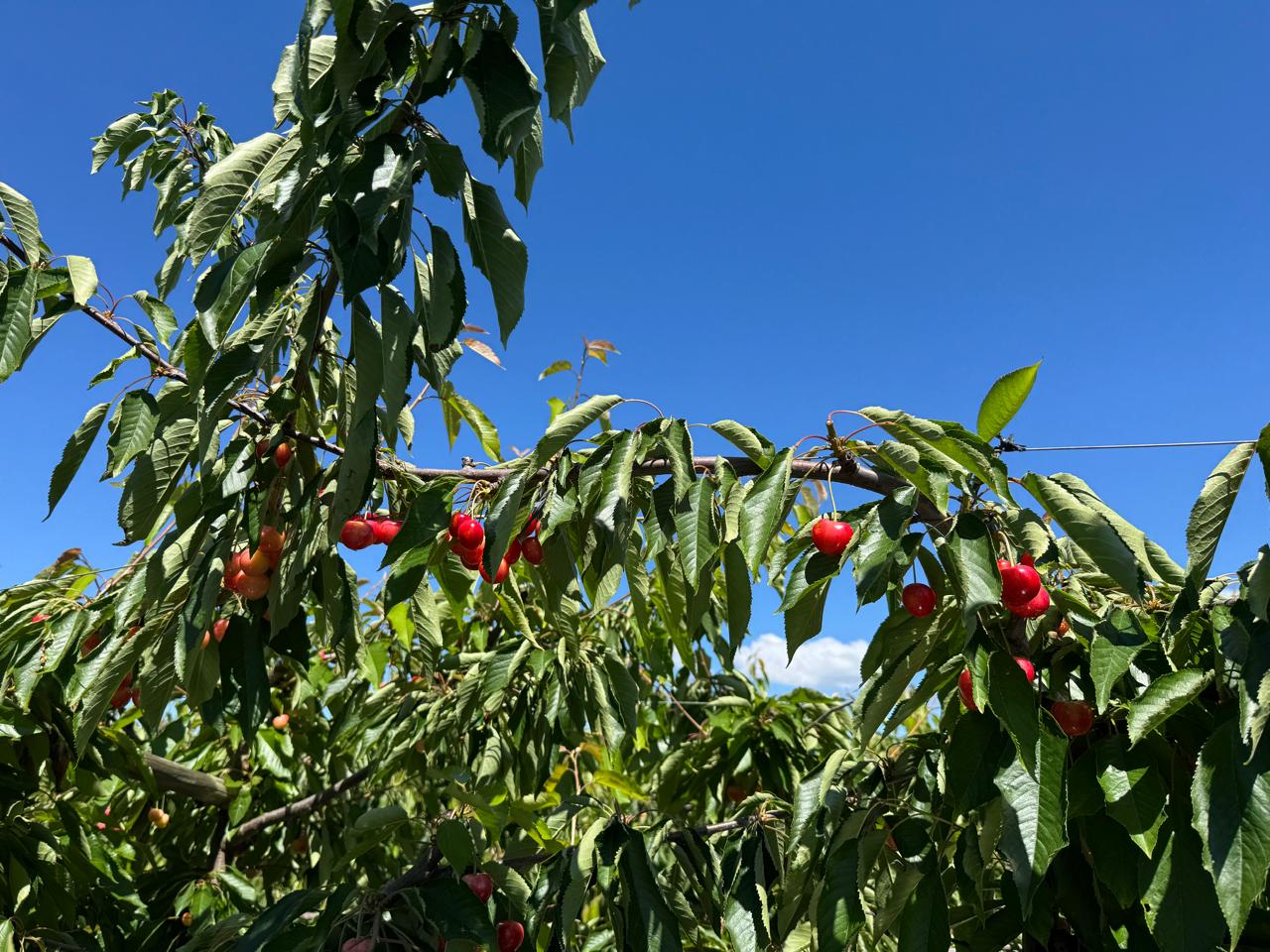

Like other temperate-climate fruit trees, cherry trees have specific thermal requirements during various stages of their growth and development cycle to achieve profitable yields.
First, the winter chill requirement must be met to ensure normal bud break and flowering. Once 70% of the chill requirement—which varies by variety—has been satisfied, rising temperatures trigger the deacclimation process (associated with a loss of frost tolerance) and stimulate growth and development.
In cherry trees, growth development and activation respond linearly to thermal accumulation; higher temperatures lead to faster hydration and increased metabolic activity. This results in greater consumption of carbohydrates—initially drawn from nutritional reserves, and subsequently from photoassimilates produced by the leaves.
This year, the chill requirements for most cherry varieties grown in northern Patagonia were met by July 31. A total of 1,100 “chill units”—or the equivalent of 57 “chill pulses”—were accumulated. Ambient humidity and periods of rainfall ensured consistent chill accumulation across the various zones of the region. Subsequent heat accumulation is significant not only for determining the timing of flowering but also for influencing pollination, fruit set, and the three distinct phases of fruit growth.
The heat requirement to reach full bloom is also specific to each variety; however, research indicates that, following sufficient winter chill, the heat accumulation threshold often exceeds 8,000 Growing Degree Hours (GDH). This season, full bloom for early-ripening cherry varieties (such as ‘Royal D.’ and ‘Nimba’) occurred between September 18 and 22, while for later-ripening varieties (such as ‘Lapins’, ‘Santina’, ‘Sweet H’, and ‘Regina’), it took place between September 25 and 29.
Fruit development can be described in three phases. Phase I covers the first 20 days following full bloom and is characterized by rapid cell division within the mesocarp. This phase is 90% regulated by air temperature; higher temperatures lead to increased rates of cell division and a greater potential fruit size. Furthermore, it has been shown that these early stages of development are critical for the synthesis of cuticular compounds, which are linked to the incidence of fruit cracking at maturity.
Phase II is marked by a cessation in fruit growth, the onset of embryonic seed development, and the subsequent hardening of the pit (stone).
Finally, Phase III is characterized by cell elongation and the beginning of color change, driven by the synthesis of pigments (carotenoids and anthocyanins) and sugars, as well as the degradation of organic acids. During this phase, temperatures regulate the synthesis of photoassimilates; these, in combination with soil moisture and the plant’s nutritional status, determine the final size of the fruit.
This season, optimal temperatures were recorded during the first 10 days following full bloom for early-ripening varieties, which favored pollination, fruit set, and the initial phase of fruit growth. For late-blooming varieties, however, conditions were not favorable during the first 15 days of the cell division phase.
The frequency of rainy periods resulted in a significant reduction in incident global radiation; in physiological terms, this led to a corresponding decrease in photosynthetically active radiation (PAR). The combination of lower ambient temperatures and reduced solar radiation lowers the photosynthetic rate in fruit trees, thereby decreasing the production of photoassimilates. This scenario can have a greater impact on late-blooming varieties in terms of yield (fruit set and fruit size).
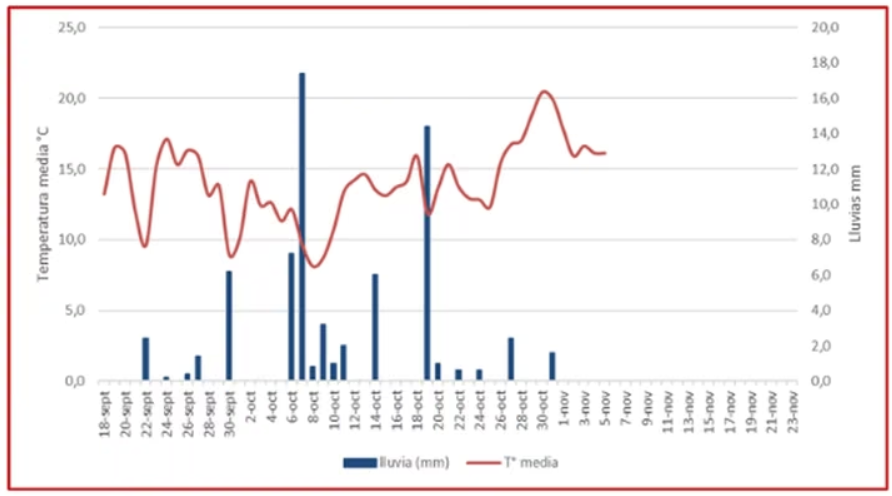
Heat accumulation following the flowering period has been lower than in previous seasons. Local experts indicate that this situation delays the harvest date. As of November 5th, the cumulative heat—measured from September 18th (the date of full bloom for early varieties)—stands at 200 GDD (base temperature 10°C). According to experts in Chile, a cumulative total of over 300 GDD is typically required for the fruit to reach maturity.
The start of the harvest is generally determined when the fruit attains the appropriate color and meets specific thresholds for each variety—such as firmness, sugar content, and tolerance to damage—all of which are key factors in maintaining quality. A major quality issue affecting production during the harvest period is “cracking” (splitting) caused by rainfall. In recent years, efforts have been made to develop technologies to prevent or mitigate this problem.
The phenomenon of rapid growth—and the resulting tension on the fruit’s cuticle—is more pronounced in early-harvest varieties, making them more susceptible to cracking and other related types of damage. The use of protective covers has proven to be one of the most effective technologies for reducing cracking; however, this approach requires adjustments to other management practices, such as ensuring adequate calcium nutrition and proper irrigation management.
Additionally, tools are employed to dry the fruit—such as the use of air-blast machines (turbines) or helicopters—as harvest time approaches. Current climatic conditions present certain challenges, primarily due to unpredictable rainfall patterns combined with periods of strong winds and high temperatures.
Cherry harvest logistics are complex; beyond determining the maturity indices required to begin picking, one must also account for the time elapsed between harvest and cooling. Locally, it is specified that this interval should not exceed four hours. Immediate cooling of the fruit is crucial for maintaining post-harvest quality, as it lowers the respiration rate and reduces dehydration—particularly of the peduncle (stem)—thereby extending the fruit’s shelf life.
In the irrigated valleys of northern Patagonia, the cherry harvest is about to begin. Weather forecasts for the coming days—starting Monday, November 9—predict high temperatures (exceeding 30°C) and moderate to strong winds between Wednesday and Thursday. These sunny days and rising temperatures will accelerate the growth and development of the fruit over the next few days.
Source: Más Producción