
Rain-induced splitting—or “cracking”—remains one of the most economically significant physiological disorders in cherry (Prunus avium L.) production, particularly when rainfall coincides with the final stages of fruit growth and ripening. Its impact extends beyond the direct loss of export-quality fruit; it also compromises the integrity of the epidermis, the overall condition of the fruit, and its subsequent performance during harvest, packing, and storage.
The 2026–2027 season has proven particularly challenging from a climatic perspective, with rainfall occurring during the spring and growing concerns regarding the potential for further precipitation as harvest approaches.
Given this scenario, it is crucial to review and proactively plan management strategies aimed at reducing the incidence of cracking—especially since, once the damage has occurred, the chances of the fruit recovering are virtually nil. Therefore, the focus should not merely be on reacting to a rain forecast, but rather on understanding the fruit’s susceptibility in advance and preparing the orchard to withstand such events.
The manifestation of cracking depends on the interplay of several factors, including the cultivar’s genetic traits, the fruit’s developmental stage, the properties of the cuticle and epidermis, fruit size, the accumulation of soluble solids, environmental conditions, and the duration of contact with water (Correia et al., 2018). Consequently, the total amount of rainfall alone cannot explain the final severity of the damage; one must also consider the physiological state of the fruit at the time the rain occurs.
As the fruit matures, it continues to expand, its sugar concentration increases, and structural changes take place on its surface. These conditions can progressively increase susceptibility to cracking, which is why rainfall of similar magnitude can lead to different responses across varieties, orchards, harvest dates, and even among individual fruits of the same cultivar (Balbontín et al., 2013).
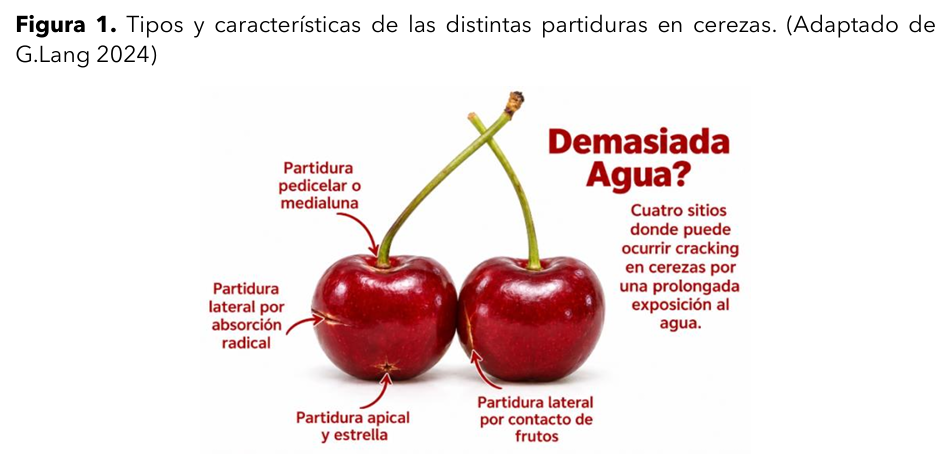
- Description of cracks
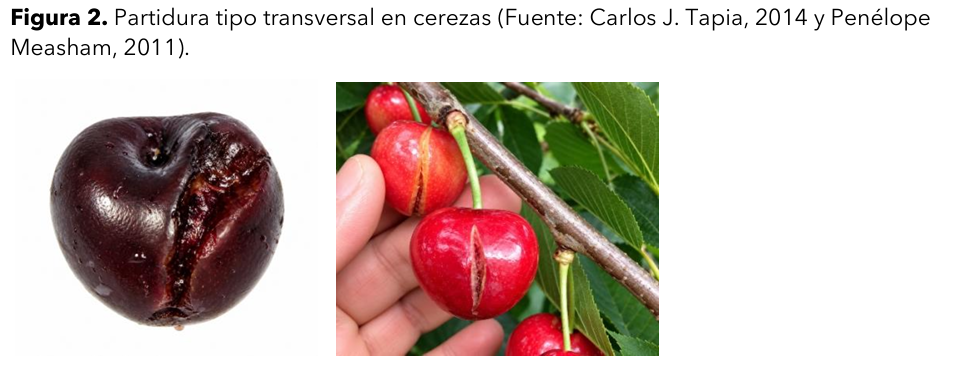
- Transverse cracking: Cracking characterized by fissures on the “cheeks” of the fruit, regardless of their length, width, depth, or position (Figure 2). This type of cracking is primarily caused by rapid water absorption through the root system and by contact between fruits.
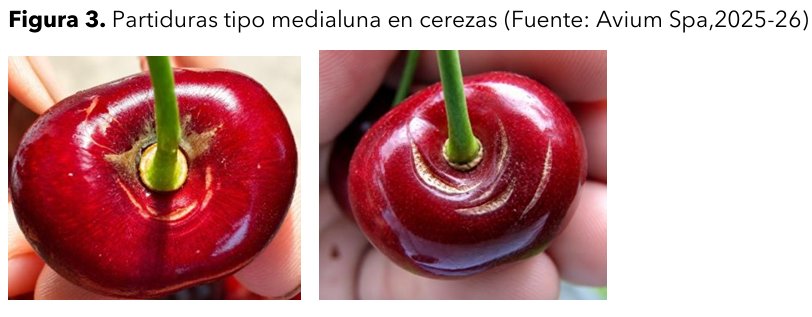
- Crescent-shaped cracking: Fissures that develop in the area where the pedicel (stem) attaches to the fruit, mainly due to water accumulation (Figure 3). These cracks are categorized based on the extent of their circumference, which indicates their severity: less than (mild) or greater than (severe) one-quarter of the circumference of the pedicel attachment zone.
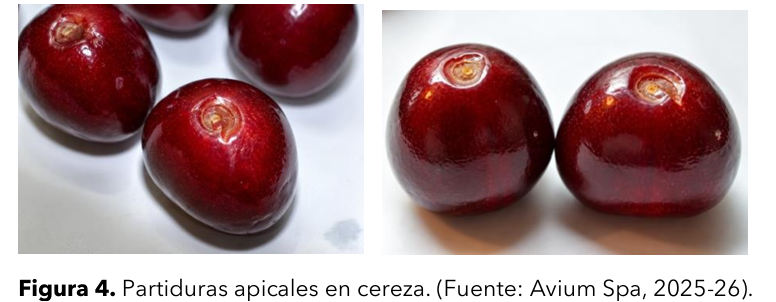
- Apical cracking: Fissures that form in the apical (tip) region of the fruit, appearing as a contour or concentric ring around the point of pistil attachment (Figure 4). This type of damage likely occurs because this area is a site of higher sugar accumulation.
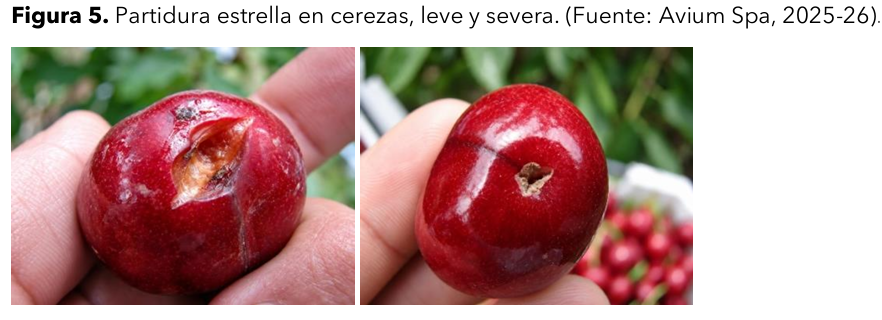
- Star-shaped cracking: Severe cracks that occur directly at the point of pistil attachment (Figure 5). These are generally found in varieties where this characteristic is more pronounced, as well as in larger-sized fruits.
- Why does fruit cracking occur?
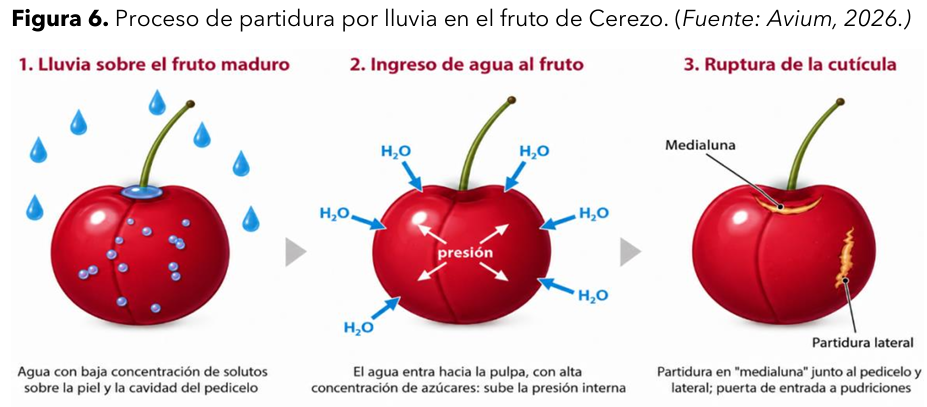
Rain-induced cracking is a multifactorial phenomenon that typically manifests when the fruit is in an advanced stage of development and coincides with periods of surface wetting. Its intensity depends on the interaction between the fruit’s maturity stage, cultivar, size, the condition of the cuticle, the presence of micro-fissures, the duration of surface wetness, and environmental conditions. • Period of greatest sensitivity: susceptibility increases from the onset of color change and throughout stage III of fruit development—a phase characterized by rapid cell expansion, an increase in soluble solids, and structural changes in the cuticle and epidermis. As the fruit grows in size, its surface is subjected to greater tension, which can lead to the formation of micro-cracks that diminish the barrier function of the cuticle.
During cherry development, the expansion of the fruit’s surface area does not necessarily occur at the same rate as the accumulation of cuticular material. In the early stages of growth, there is a higher rate of cuticle deposition, whereas, in later stages, the fruit’s surface area continues to expand with a proportionally smaller incorporation of cuticular material.
As a result, the cuticle is spread over an increasingly large surface area, which raises the mechanical tension on this barrier and promotes the gradual development of micro-cracks—particularly during the later stages of fruit development and maturation (Knoche et al., 2004; Peschel et al., 2007).
- Localized water entry: During a rain event, water remains on the fruit’s surface and can accumulate, especially in areas such as the pedicel cavity. Water primarily enters through regions with higher permeability, residual stomata, scars, or existing micro-cracks on the surface.
- Loss of tissue integrity: Localized water absorption causes the epidermal and subepidermal cells to expand. When the deformation capacity of these tissues is exceeded, the micro-cracks develop into visible fractures, resulting in various types of cracking.
- Duration: It is not just the total amount of rainfall that matters. The length of time the fruit remains wet, as well as the proportion of the fruit’s surface covered by water, are critical factors in the progression of damage. For this reason, rainfall of similar magnitude can lead to vastly different outcomes depending on the orchard or the variety.
Rain acts as the trigger, but the severity of the damage is determined by the fruit’s level of susceptibility at that specific moment.
- Summary of management practices
Managing fruit cracking requires an integrated approach, involving actions taken before, during, and after a rainfall event. Before the event, the goal is to reduce the fruit’s susceptibility; this includes ensuring the fruit surface is protected and applying a saturation irrigation 48 hours prior to the rain, which helps prevent a sudden, rapid uptake of water by the roots.
During the rainfall, strategies can be employed to limit water entry or to alter the conditions under which water comes into contact with the fruit’s surface. Once the event has concluded, the duration of fruit wetness should be reduced as quickly as possible, as the length of time the fruit remains in contact with water is closely linked to the progression of damage.
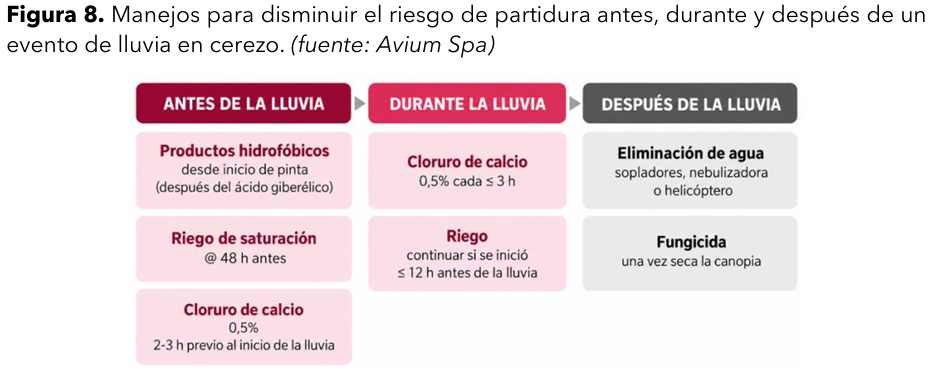
Within this approach, the use of hydrophobic products, irrigation management, calcium chloride applications, and the removal of water following an event should be viewed as complementary tools. The effectiveness of each will depend on the variety, stage of maturity, condition of the fruit, and the timing of application.
Bibliographic References
- Balbontín, C., Ayala, H., Bastías, R. M., Tapia, G., Ellena, M., Torres, C., Yuri, J. A., Quero-García, J., Ríos, J. C., & Silva, H. (2013). Cracking in sweet cherries: A comprehensive review from a physiological, molecular, and genomic perspective. Chilean Journal of Agricultural Research.
- Christensen, J. V. (1972). Cracking in cherries: III. Determination of cracking susceptibility. Acta Agriculturae Scandinavica.
- Correia, S., Schouten, R., Silva, A. P., & Gonçalves, B. (2018). Sweet cherry fruit cracking mechanisms and prevention strategies: A review. Scientia Horticulturae.
- Knoche, M., Beyer, M., Peschel, S., Oparlakov, B., & Bukovac, M. J. (2004). Changes in strain and deposition of cuticle in developing sweet cherry fruit. Physiologia Plantarum.
- Peschel, S., Franke, R., Schreiber, L., & Knoche, M. (2007). Composition of the cuticle of developing sweet cherry fruit. Phytochemistry.