
In simple technical terms, fruit set is the process by which a flower, after being successfully pollinated and fertilized, continues its development until it becomes a growing fruit. In cherry (Prunus avium L.), this process is conditioned by multiple reproductive, environmental, and physiological factors, so a high flower supply does not necessarily guarantee high fruit set or final production.
For a flower to develop into fruit, the following factors must coincide: pollen viability, compatibility between varieties—especially when they are incompatible in pollination—stigma receptivity, pollen germination, pollen tube growth, and ovule functional longevity. Added to this are the climatic conditions during flowering, pollinator activity, the nutritional status of the orchard, and the overall physiological condition of the plant.
Consider that the morphological basis for adequate fruit set is built from the previous season, during the processes of floral induction and differentiation.
In species of the genus Prunus, the development of reproductive structures begins months before flowering, is partially halted during winter dormancy, and is reactivated prior to anthesis. For this reason, the floral potential of a season is strongly influenced by the condition of the tree during the post-harvest period, the accumulation of carbon and nitrogen reserves, the health of the foliage, and the orchard’s water and nutrient management.
During winter, the accumulation of cold allows for progress in breaking dormancy and promotes more orderly budbreak and flowering. When accumulated chilling is insufficient or of poor quality, more extended flowering periods, less synchronization between varieties, and a greater dispersion of phenological stages can occur, affecting pollination and fertilization efficiency.
Once flowering begins, a highly sensitive stage commences in which the pollen must reach the stigma, germinate, develop the pollen tube through the style, and reach a still-viable ovule. This process occurs within a limited window known as the Effective Pollination Period (EPP), which corresponds to the time available for a flower to be successfully pollinated and fertilized.
In simplified terms, the EPP depends on the ovule’s longevity and the time required for the pollen tube to reach it. Temperature strongly modifies this relationship; low temperatures can extend ovule viability but reduce pollen tube growth, while high temperatures can accelerate pollen tube development but also shorten stigma receptivity and ovule longevity.
In turn, ambient relative humidity also plays a role. While this factor is rarely discussed, studies and practical experience have shown that relative humidity below 30% creates adverse conditions for this process. Furthermore, synchronicity must exist between a receptive flower, compatible pollen, pollen tube growth, and ovule viability.
At this point, varietal compatibility is fundamental, since many commercial cherry varieties exhibit self-incompatibility and require compatible pollen from another variety. A genetically compatible pollinator, but one that blooms at a different time than the main variety, may have a limited contribution if it does not coincide with the effective window of floral receptivity.
The cherry tree is primarily an entomophilous species for pollen dispersal, so it depends heavily on insects for pollen transfer between flowers. In commercial orchards, the European honeybee (Apis mellifera) plays a central role, although recent studies in Chile have also highlighted the complementary contribution of wild flower visitors to cherry fruit set.
From a practical standpoint, it’s not just the number of hives per hectare that matters, but also the existence of favorable environmental conditions for bee flight. Low temperatures, rain, wind, or low radiation can restrict pollinator activity, even when there is an adequate supply of hives.
As an agroclimatic indicator, Avium considers favorable conditions for bee flight to be temperatures above 15°C and solar radiation above 300 W m⁻², allowing for the estimation of windows of greatest potential pollinator activity during flowering. In recent years, when comparing data on bee flight hours (24 hours + >15°C + >300 W m⁻²), it is believed that the flowering week should exceed 25 hours of bee flight. Under unfavorable conditions, solar radiation is the key factor in this indicator, being more influential than temperature in real-world scenarios.
Growth regulators as support tools
Given this multifactorial scenario, growth regulators and biostimulants become relevant as complementary tools to support fruit set and retention. Its objective is not to replace adequate pollination, varietal compatibility, or orchard conditions, but rather to promote physiological processes that increase the likelihood of a viable flower being fertilized and that the newly set fruit sustains its development until harvest.
Within these strategies, active ingredients or hormonal groups associated with ethylene synthesis inhibitors, auxins, gibberellins, cytokinins, and brassinosteroids can participate in processes related to reproductive metabolism, ovary development, cell division, initial fruit growth, and regulation of fruit retention.
Auxins and gibberellins play a key role in the initiation of fruit development after fertilization, while cytokinins are associated with cell division and the activity of young tissues. Brassinosteroids, for their part, have been described as growth regulators involved in floral development, metabolism, antioxidant response, hormonal interaction, and processes associated with fruit yield and quality, always acting in conjunction with the dominant phytohormone in the various processes.
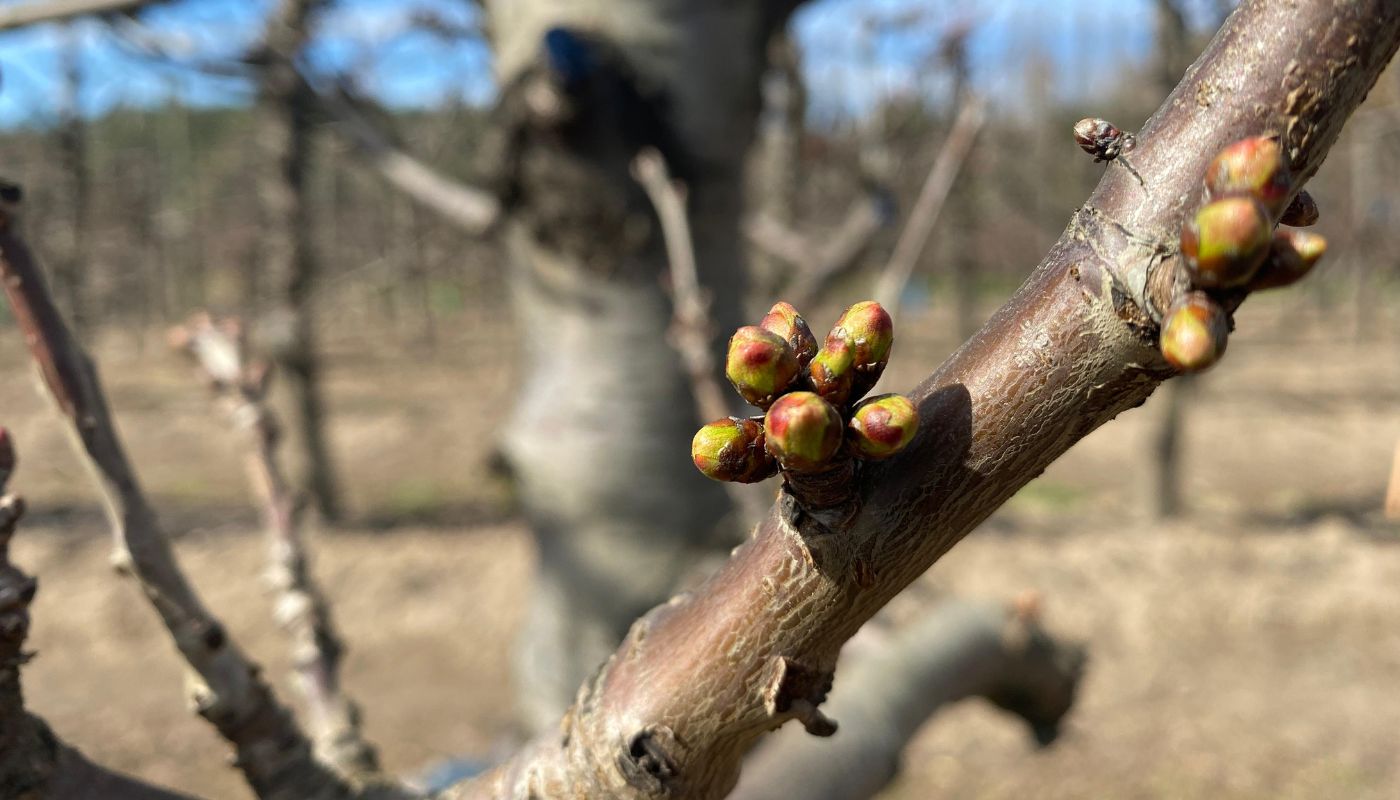
In practical terms, applications aimed at improving fruit set are usually concentrated in early phenological stages, from bud formation to full bloom. At this time, the plant is in a phase of high metabolic demand, where the flower must maintain its functionality, complete fertilization, and begin initial fruit development. Under conditions of heat stress, low radiation, nutritional imbalances, or uneven flowering, these tools can help improve the physiological condition of reproductive tissues and support initial fruit retention.
There are also biostimulants based on seaweed extracts, amino acids, organic compounds, plant metabolites, or other bioactive ingredients that can act indirectly on fruit set. Their effects may be related to increased metabolic activity, improved antioxidant response, nutritional support, hormonal regulation, or tolerance to abiotic stress.
In cherry trees, recent reviews indicate that biostimulants can modulate processes such as carbon and nitrogen metabolism, photosynthetic activity, antioxidant defense, water relations, and hormonal activity such as auxins, cytokinins, and gibberellins.
However, it is important to avoid generalizations. The response to growth regulators and biostimulants depends on the active ingredient, concentration, application timing, variety, rootstock, flower load, orchard condition, and environment during flowering. Therefore, these strategies should be evaluated as support tools within a program that integrates all aspects involved in the fruit set process. It is essential to understand that they are part of a broader strategy to address pollination problems, lack of chilling, low bee activity, or management deficiencies. These strategies must, without a doubt, consider the technical recommendations for use specified on each product’s label.
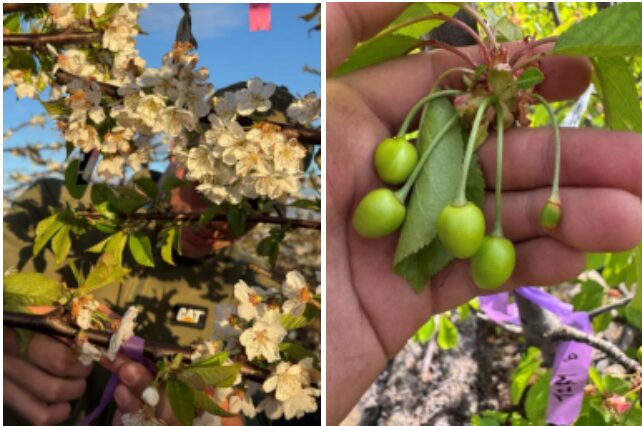
To correctly interpret the response each season, measurement is fundamental. A simple and useful tool is monitoring initial and final fruit set. To do this, representative trees from the plot can be selected and homogeneous branches marked. At full bloom, the initial number of flowers is counted, and then, approximately 20 to 25 days after full bloom, a new fruit count is performed to estimate the initial fruit set (Figure 1).
Figure 1. Flower count at full bloom and fruit count 20 to 25 days after full bloom.
Subsequently, before harvest, it allows observation of fruit retention and estimation of final fruit set. This distinction is important, as initial fruit set provides information on the success of pollination and fertilization, while final fruit set allows evaluation of the plant’s capacity to support the initially established fruit.
From a production standpoint, under conditions of greater climatic variability, fruit set in sweet cherry must be addressed from a holistic perspective of the reproductive cycle, rather than focusing on a single tool to improve fruit set.
The challenge is to identify which stage of the process is limiting: cold, flowering, varietal synchrony, pollination, bee activity, floral viability, stress, or initial fruit retention. Only from this diagnosis will it be possible to define strategies that effectively increase the probability of transforming a flower into a fruit and sustaining a load in accordance with the productive potential of each orchard.
Bibliography
- Fadón, E., Rodrigo, J., & Herrero, M. (2019). Flower bud development and winter dormancy in sweet cherry. Acta Horticulturee.
- Measham, P. F., Quentin, A. G., & MacNair, N. (2014). Climate, winter chill, and decision making in sweet cherry production. HortScience, 49(3), 254–259. https://doi.org/10.21273/HORTSCI.49.3.254
- Sanzol, J., & Herrero, M. (2001). The “effective pollination period” in fruit trees. Scientia Hortícolae, 90(1–2), 1–17. https://doi.org/10.1016/S0304-4238(00)00252-1 • Wang, L., Zhang, L., Ma, C., Xu, W., Zhong, Y., Li, K., & Wang, S. (2016). Impact of chilling accumulation and hydrogen cyanamide on floral organ development of sweet cherry in a warm region. Journal of Integrative Agriculture. https://doi.org/10.1016/S2095- 3119(16)61341-2
- Zhang, L., Ferguson, L., & Whiting, M. D. (2018). Temperature effects on pistil viability and fruit set in sweet cherry. Scientia Hortícolae, 241, 8–17. https://doi.org/10.1016/j.scientea.2018.06.039