
Founder and CEO Sergey Vardanyan, a tech entrepreneur who came home from the United States, runs the company together with his family, who are the other shareholders. Just before this summer’s first real harvest, the Russian border closed, yet not a single kilo was lost. Vardanyan explains how early varieties, their own cold chain and full control over the product help him take on Turkey and Uzbekistan.
From tech startup to cherry orchard
Sergey Vardanyan was born in Armenia, studied in the UK and spent eight years in the United States. He returned in 2022 after selling a startup. “I had free capital, and I decided to invest it into agriculture and learn from ground zero,” he says. His reasons were moral and financial. “When I invest, it should be environmentally friendly, do no harm, and create benefit. And of course, the mathematics made sense.” The government subsidises interest on agricultural loans and allows five years before repayment of the principal starts, about the time a cherry tree needs to mature.
Assembling 80 hectares
After independence, Armenia privatised farmland in tiny lots. Vardanyan negotiated with many sellers and bought a public part at auction. Within a year he had 80 hectares. The orchard lies in the Ararat Valley, in the Armavir region, at about 1,000 meters. “The combination of the water from Akhuryan public reservoir, 2,700 hours of sunshine and unique terroir combined with the latest AI-driven technological solutions is the secret behind the fantastic taste of Naughty cherries,” Vardanyan says.
Early Italian varieties
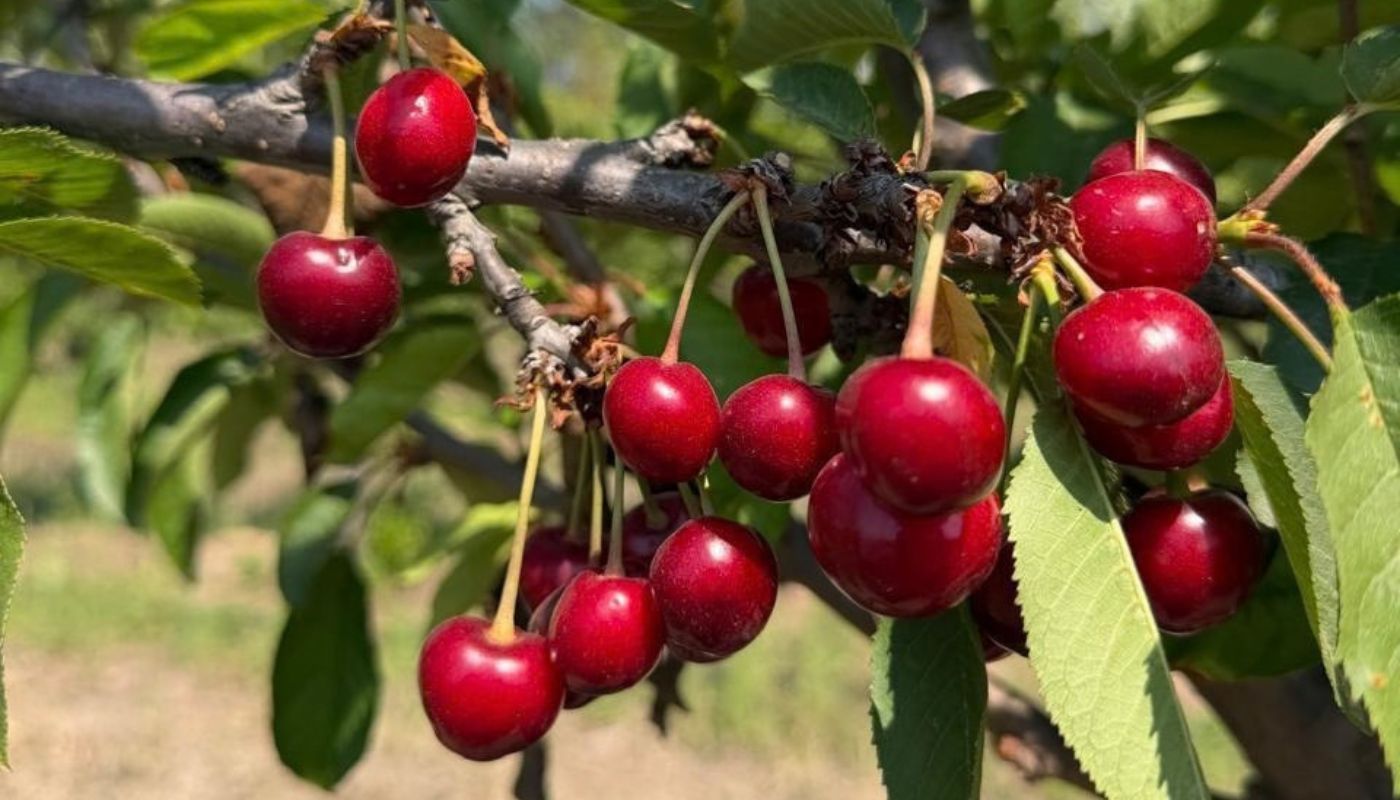
He planted early-ripening Italian varieties: Carmen, Sweet Gabriel and Sweet Lorenz. Most Armenian orchards grow later ones, such as Kordia and Regina. The reason is labour. “Cherries have to be handpicked, and workers are scarce in Armenia. With early varieties, I am not competing with other orchards for the same pickers.”
He had no buyers when he planted. “My idea was that if I have a good product, I will be able to sell it.” Size was the priority. “You may have tonnes and tonnes of cherries, but if your caliber is low, the economy does not work.” Half of the fruit measures 28 to 34 millimetres and half 24 to 28. “The Italian varieties seem to like our Armenian sun and our Armenian water.”
Traditional Armenian cherries are no rivals. “They have a bigger stone, and are not fit for long transportation. Ours have a smaller stone, a firm skin and more edible flesh. They behave exceptionally well during automated sorting and packaging, which provides a longer shelf life.”
Fighting the frost
Frost during blossom is his main agronomic fear. “Am I afraid of the frost? Yes.” This year, when a cold night was forecast, he flooded the orchard. “Water on the soil evaporates and creates warmth. It increased the temperature by one and a half to two degrees. Neighbouring plots got the frost, and we did not.”
Naughty Orchards has used heaters, fans and sprinkling. “We put sensors 30 meters high. The temperature above was the same as below, so fans would not help on our flat land.” Sprinkling has its own risk: “If your pump stops halfway through, the damage is worse than without it.”
A first harvest and 350 pickers
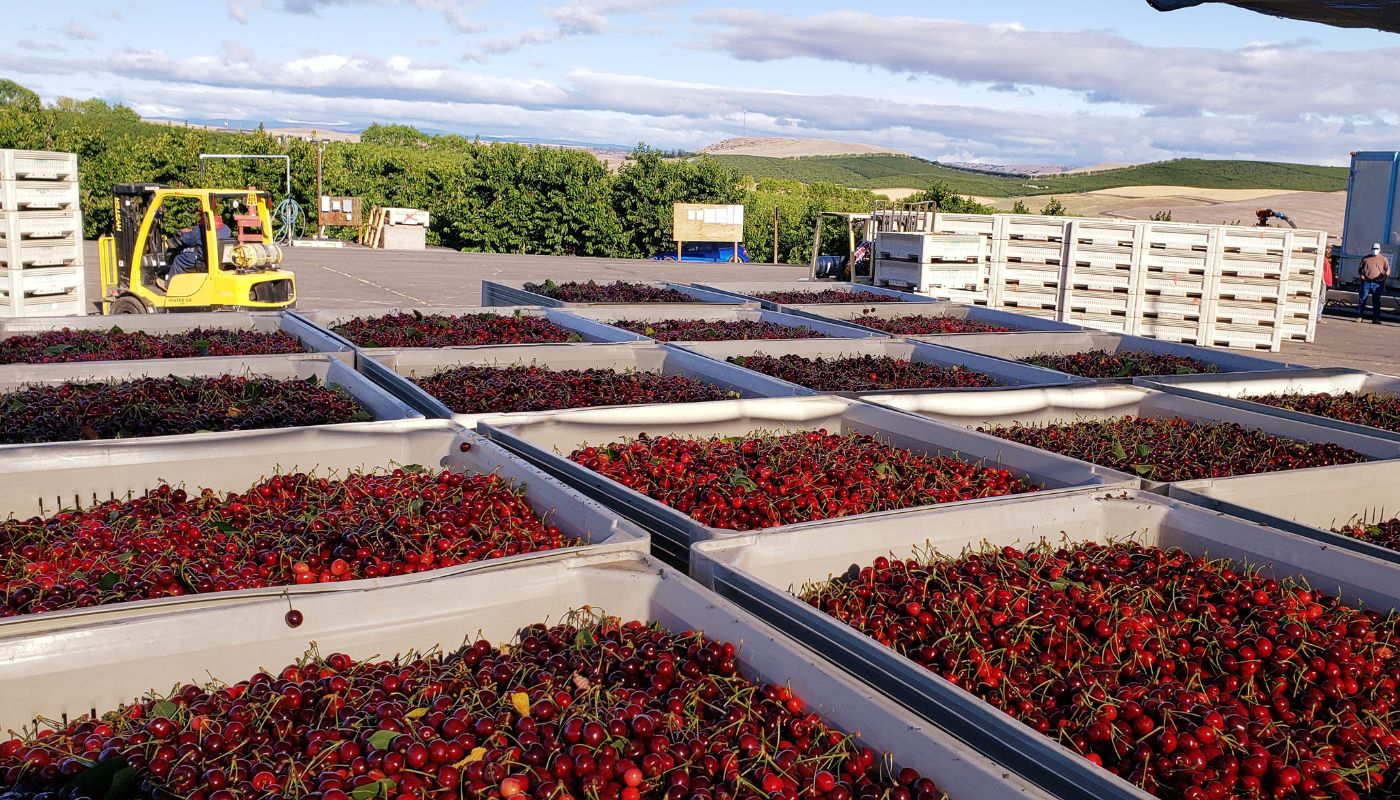
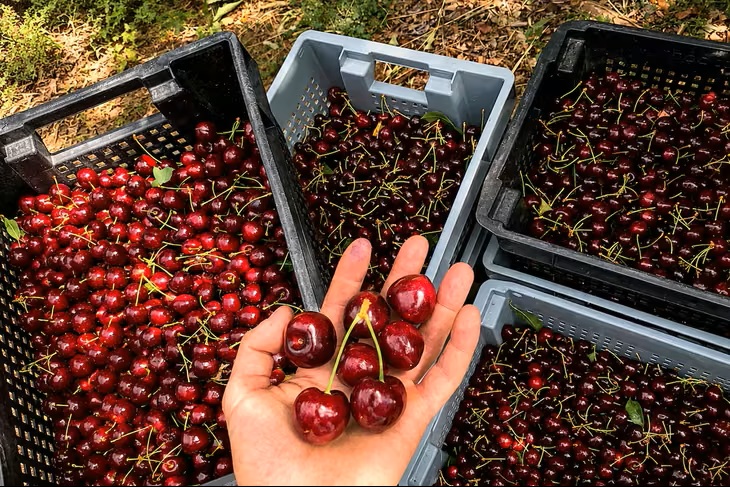
Last year, the trees produced only 20 to 30 tons. This summer brought the first real harvest, and picking ran from 15 June to 15 July. Normally, the harvest runs from early June to the third week of June, but this year the weather shifted the season. At the peak, 350 people worked in the orchard. Next year he will need at least 600. “In a normal season, apricots and peaches are not yet ripe, so workers are available. And because cherries are a more expensive fruit, we can allow ourselves to overpay for the workforce.” He may also recruit among the Indian workers now living in Armenia. Some 20 people work there year-round.
Russia closes, others open
Vardanyan had agreements with large Russian supermarket chains. “When we started picking, the border was already closed. That was quite a challenging time. But we adapted, and we did not spoil one kilo of fruit.” The cherries went to Ukraine, Iraq (a new market), Georgia and Armenian supermarkets. “We had not even considered the local market, but the chains took 25 to 30 percent of our crop.” Despite low prices everywhere this year, the company almost broke even operationally. “The results are very promising. Next year we hope to double or even triple the harvest.”
Competing with Turkey and Uzbekistan
Because the cherries ripen early, Naughty Orchards’ direct rivals are the Uzbek and Turkish growers. The company’s strength is that they control the whole chain. “A Turkish trader has already paid the grower, so he has a minimum price. We are vertically integrated. This is our product, and we know our minimum cost. Even in a bad market we can lower our price, even sell at zero profit, and stay competitive.” Labour helps too: “Our operating cost per hectare is about half of what European colleagues spend.”
Cooled within two hours
Vardanyan names four selling points: AI-powered grading, GlobalG.A.P. certification, being able to satisfy all packaging requirements, and the cold chain. “Immediately after picking, the cherries go through a hydro cooler, with water at 0.5 degrees Celsius. Then they go into grading and cold storage.” With an unbroken chain through transport and the shop, they keep for about a month.
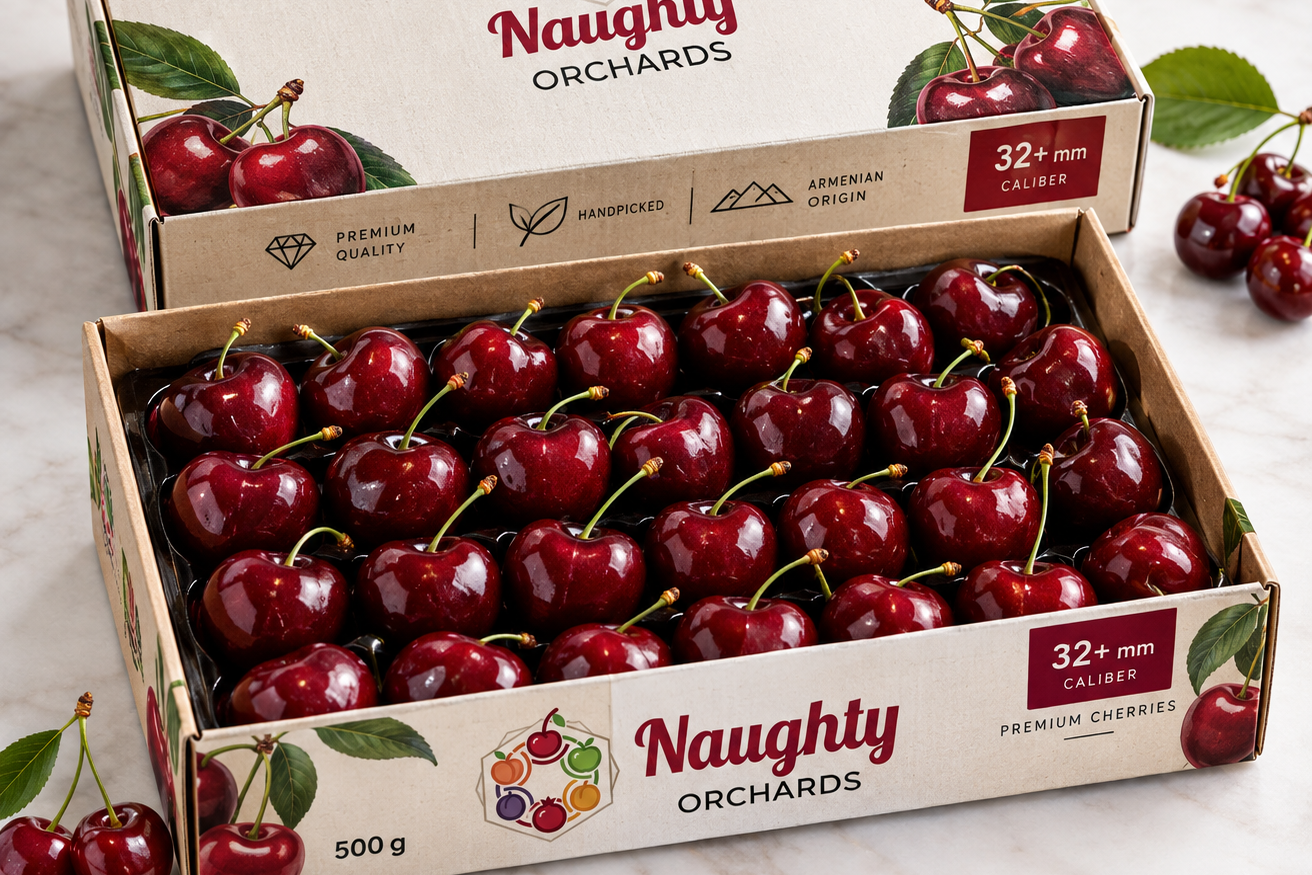
“We can offer loose boxes, 500-gram punnets, top-sealed or clamshells, 2- or 5-kilogram cardboard boxes and 5-kilogram plastic boxes. Whatever the customer wants, we are able to provide. We are now building our own 8,000 square metre state-of-the-art logistics center with hydro cooling, grading, packing and cold storage facilities.”
From 600 to 2,000 tons
At full maturity, Vardanyan hopes to achieve 15 tons per hectare. “On 80 hectares, that is 1,200 tons in about four weeks. With the 40 hectares of our sister company, we hope for 2,000 tons.” Next year he expects 600 to 700 tons. “Armenia’s total cherry export in 2026 was about 2,000 tons. It is expected that by 2030 this number will grow to 6,000, so our orchard could one day supply a third of it. That national number will even grow, because other orchards of the same age have not reached their potential yet,” he foresees.
The sister company also grows apricots (50 hectares), plums (12 ha), apples (50 ha) and pomegranates (10 ha). Autumn fruit follows the early crops, keeping volumes flowing all year. For now, Vardanyan does not plan to buy from other growers. “I cannot jeopardize quality, because I do not know what treatment a random grower uses. But if someone has the same protocols and GlobalG.A.P., why not?”
The Gulf, Europe and a naughty turtle
Vardanyan’s next target is the Middle East, notably the UAE, Saudi Arabia and Qatar. “The GDP per capita is high, and they can pay for good quality.” Armenia’s free trade agreement with the UAE helps.
Europe is harder. “We are new, so the big chains do not know us yet. They need time to learn our quality and see that we can deliver the quantities they want.”
The brand name has a personal origin. “Long ago I used to DJ, and my nickname was Naughty Turtle. I kept it.” He agrees that marketing matters for a young fruit-growing country. “The market is very new, maybe four or five years old, so we use the latest technology and varieties. With cheaper labour and good marketing, I think we will be in good hands.”
Source: Fresh Plaza