
The fruit sector, a pillar of the economy in countries like Chile, which has experienced sustained growth in recent decades1, faces the pressing need to optimize its processes to ensure profitability and sustainability. Protecting crops against pests and diseases represents a significant cost component and is often a source of environmental concern due to the use of plant protection products.2
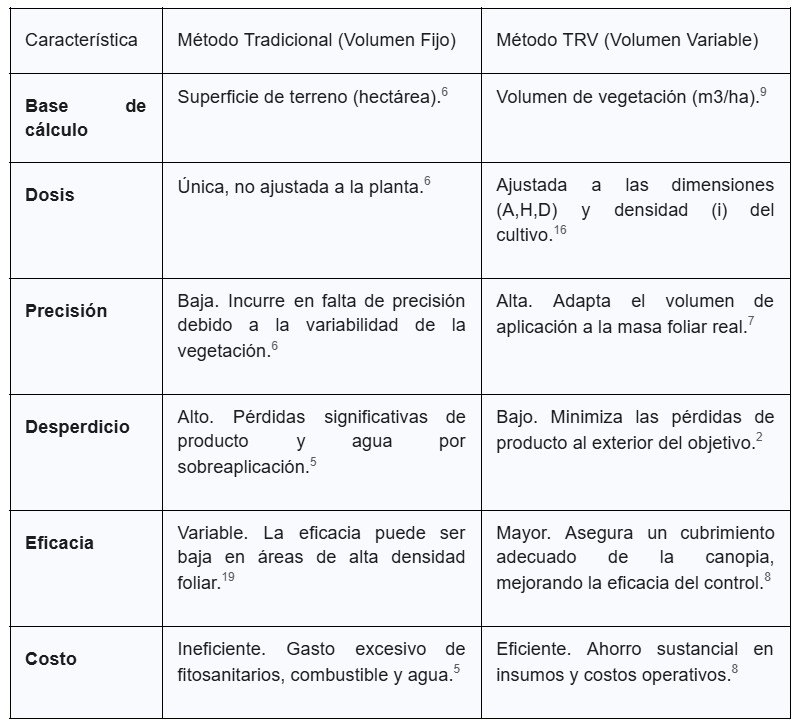
Historically, the application of these products has been carried out under a fixed volume per hectare (L/ha) scheme, a practice often based on general industry recommendations or the product label.4 This approach, while functional in some cases, lacks precision.6 A young orchard or one with sparse foliage receives the same amount of product as a mature, dense orchard, inevitably leading to over-application in the former and potential exudation in the latter. This lack of adaptation to the variability of vegetation within a single plantation generates considerable product waste, higher costs, and greater loss of spray solution outside the intended treatment area.7
In response to this problem, precision agriculture has developed methodologies that allow the dose to be adjusted to the volume of vegetation present in the field.7 The Volume of Tree Rows (VFF) method has become the most widely used tool worldwide for this purpose.10 This report explores in depth the relationship between the biophysical concept of the Leaf Area Index (LAI) and the practical application of the VFF method, demonstrating how their integration allows for precise and optimized dosing.
Conceptual Foundations: Understanding Target Vegetation
The application of plant protection products to tree crops must consider the amount and density of the surface area that needs to be covered and protected.8 To achieve this, it is essential to define and quantify the vegetation mass. Two fundamental concepts emerge for this purpose: the Leaf Area Index (LAI) and the Tree Row Volume (TRV).
Leaf Area Index (LAI): A Quantitative Measure of Foliage
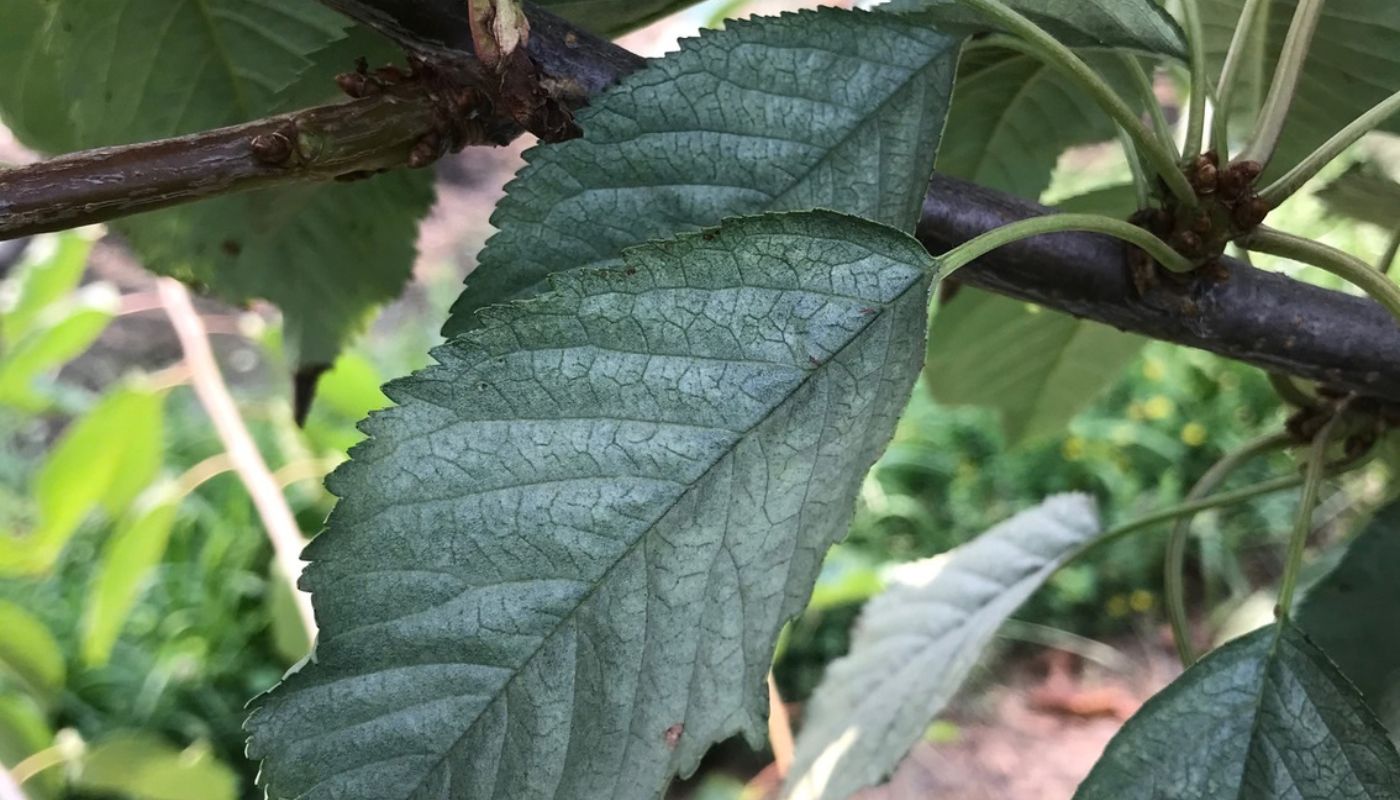
The Leaf Area Index (LAI) is a dimensionless parameter that quantifies the amount of leaf biomass in a crop. 11 It is defined as the total area of the upper surface of the leaves per unit area of ground directly beneath the plant. 12 Because it is a ratio of areas (square meters of leaf per square meter of soil), LAI is dimensionless. 11 It is a single value, a statistical snapshot of a canopy at a given moment, providing important information about growth patterns and crop productivity.11
LAI can be measured using various methods, each with its own advantages and limitations. Destructive methods, while offering the greatest accuracy, are laborious and impractical for large-scale assessments, as they involve the physical harvesting of leaves for direct measurement.13 Therefore, the following methods have been developed:
Indirect optical methods that take advantage of the relationship between light intercepted by the canopy and leaf density. These methods are based on Beer’s Law and quantify light penetration through the foliage.11 The most common techniques include
hemispherical photography, which uses fisheye lenses to image the canopy and estimate the gap fraction for calculating the LAI12, and the use of
ceptometers (such as the LP-80), which measure photosynthetically active radiation (PAR) above and below the canopy.11 For estimation over large areas,
remote sensing using satellite imagery (such as Landsat) is also used to obtain vegetation indices such as NDVI (Normalized Difference Vegetation Index), which has a proven relationship with the LAI.13 Despite the existence of these methods, the difficulty in estimating the LAI practically in the field remains one of their main weaknesses.10
Multispectral drones have been reported to estimate the LAI in fruit trees using orthomosaics calibrated in reflectance (R, G, Red-edge, NIR bands), from which spectral indices (NDRE, GNDVI, OSAVI, etc.) are calculated and, in many studies, complemented with 3D canopy textures or metrics. This approach has achieved high accuracies (R² ≈ 0.80–0.90; RPD > 2) in apple, pear, citrus, and kiwi, showing that the combination of vegetative and texture/structure indices allows for reliable mapping of the LAI at the block or individual tree level.
Tree Row Volume (TRV): A Practical and Geometric Approach
Tree Row Volume (TRV) emerged as a practical methodology to overcome the complexity of measuring LAI (Lead Area Index). This method simplifies the tree canopy to a three-dimensional geometric volume, assuming that the tree row behaves like a “box” of a specific volume.15 TRV uses this volume as a starting point to define the spray volume to be used in an application.10
The formula for calculating TRV per hectare is as follows:
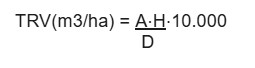
Where the variables are defined as follows15:
A: Width or thickness of the tree row (meters).
H: Height of the tree row (meters).
D: Distance between tree rows (meters).
10,000: Constant representing the number of square meters in one hectare.
The advantage of this method lies in the fact that variables A, H, and D are physical parameters of the plantation that can be easily and directly measured in the field, making it an accessible tool for farmers.16 TRV essentially provides a numerical value for the volume of vegetation present in one hectare.9
The essential relationship: The link between LAI and TRV for seeding rates
Although TRV offers a practical simplification of canopy volume, it is not sufficient on its own for completely accurate seeding. An inherent limitation of the methodology is that it ignores foliage density.7 Two rows of trees with identical geometric dimensions (same height, width, and row spacing) can have significantly different foliage densities due to factors such as variety, age, or pruning management. This actual leaf density, which is what is quantified by the LAI, critically affects the penetration of spray droplets into the tree canopy and their retention capacity.7
The fundamental connection between the LAI (the biophysical reality) and the TRV (the geometric simplification) is established through the leaf density adjustment index (i).16 This index is a correction factor applied to the TRV to compensate for differences in foliage density.16 The value of i typically ranges from 0.7 to 1.0 and is determined based on the vegetation structure. A low value (0.7) is assigned to very open or young trees, where light penetrates easily, while a high value (1.0) is used for extremely large and dense trees.16 This index represents a conceptual bridge, as it translates leaf density, a concept analogous to the LAI, into a numerical factor that adjusts the row volume.
Once the TRV has been calculated and the adjustment index i has been determined, the required application volume (Q) can be obtained using the following formula16:
Q(L/ha)=TRV(m3/ha)⋅Va(L/m3)⋅i
Where Va is the liquid volume factor per unit volume of tree (L/m3), which is a value recommended by the plant protection product manufacturer. This factor can vary depending on the type of product (systemic, contact, etc.) and the pest being controlled.17 For high-volume applications, a value of 0.09 L/m³ has been adjusted and validated in studies.16
This method, by integrating the three-dimensional volume of the crop with its foliage density, allows for much more precise dosing than the traditional fixed-volume approach, since the amount of spray solution is directly adapted to the amount of foliage that actually needs to be treated.8
Practical Guide: From Theory to Application in the Orchard
The practical application of the TRV methodology goes beyond simple calculation. It requires a series of specific steps and field validation to ensure the effectiveness of the application.
Step-by-step calculation example
Consider an orchard with the following dimensions:
Width or thickness of the tree row (A): 2.5 meters
Height of the tree row (H): 2.7 meters
Distance between rows (D): 4.3 meters
Foliage density assessment: Moderately dense, corresponding to an adjustment index (i) of 0.85.
Plant protection product: A systemic product will be used with a recommended liquid volume factor (Va) of 0.0705 L/m³ of foliage.17
Step 1: Calculating TRV
The TRV formula is used to determine the canopy volume per hectare.
TRV = 4.3 * 2.5 * 2.7 * 10,000 = 15,697.7 m³/ha
Step 2: Calculation of the Required Application Volume (Q)
Now, the TRV is adjusted using the leaf density index (i) and the liquid volume factor (Va) to obtain the final spray volume per hectare:
Q = 15,697.7 m³/ha * 0.0705 L/m³ * 0.85 = 939.4 L/ha
This result of 939.4 L/ha is significantly different from a generic recommendation of, for example, 1,500 L/ha or 500 L/ha, highlighting the importance of adapting the dose to the specific crop conditions.4
The Critical Role of Equipment Calibration
The accurate calculation of the application volume (Q) is only the first half of the process. The second, and no less important, step is to ensure that the spraying equipment (commonly a hydropneumatic sprayer in orchards) is correctly calibrated to accurately apply that volume uniformly across the canopy.5 Failure to do so negates the benefits of the TRV method.5
Calibration involves adjusting several operating variables:16
Forward speed (V): The tractor speed should be constant and appropriate for the terrain conditions, generally between 5 and 6 km/h.16 Higher speeds reduce the amount of spray solution per hectare for a given flow rate.17
Working pressure (P): Pressure determines the nozzle flow rate16 Each nozzle model has a recommended operating pressure within a broad range of 6 to 16 bar for optimal performance.
Nozzle selection: The nozzle type should be chosen so that, at the desired pressure and forward speed, the total nozzle flow rate (Qt) generates the calculated application volume.16 Air-injected nozzles, for example, reduce drift and improve penetration by producing larger droplets.16
Finally, the application quality should be verified in the field. A common method is the use of water-sensitive papers, which are placed on different parts of the tree canopy to assess the size, number of particles, and distribution of the product.19 This step is essential to validate whether the equipment calibration and calculated dosage are achieving the desired coverage, especially in the inner and upper areas of the tree, which are the most difficult to reach.15
Analysis of the benefits and challenges of implementing TRV
Adopting the TRV methodology, instead of the traditional fixed-volume method, represents a significant advance in precision agriculture, with direct implications for profitability and sustainability.
Economic savings and environmental benefits
Cost reduction: Applying a dose adjusted to the crop’s leaf mass prevents over-application, resulting in direct savings on the cost of plant protection products, a high-value input.8 Additionally, applying a smaller volume of water, made possible by optimization, reduces the number of trips to refill the sprayer tank. This not only saves time, but also fuel and reduces equipment wear, increasing labor productivity.5
Improved efficacy: By ensuring that the product is applied properly and evenly across the leaf surface, pest and disease control is improved.19 Over-application in low-density areas is minimized, and under-application in high-density areas is avoided, contributing to more effective biological control.21
Reduced environmental impact: Precise application minimizes the amount of product lost off-target, reducing soil and surface water contamination.2 This approach aligns with international guidelines that seek to reduce the risks associated with pesticide exposure.3
Challenges and Limitations of Adoption
Despite the clear benefits, implementing the TRV methodology is not without its challenges. The main barrier is cultural inertia; many farmers resist changing practices that, although inefficient, have “worked” for years, and often prefer to “leave the paper soaked” to ensure supposedly good coverage.5
Adopting TRV requires a change in mindset and greater professionalism.5 Accurate measurement of tree dimensions and assessment of leaf density are essential, and although they can be performed with simple tools, they require a trained operator. Calibrating the equipment, adjusting the nozzle speed and flow rate to apply the exact volume, is a technical process that demands knowledge and meticulousness.5 Although general agricultural training programs exist, specific training in TRV methodology and precision equipment calibration is not widely available or standardized.22
In the long term, emerging technologies such as variable rate spraying (VRA) systems that use onboard sensors, like LiDAR, promise to take precision a step further.2 These systems can scan the canopy in real time to adapt the application not only to the row volume but also to geometric and density variations within it. However, the TRV method, with its solid theoretical basis and relative simplicity, remains the fundamental link in the transition from conventional to precision agriculture.
Conclusions and Recommendations
The relationship between Leaf Area Index (LAI) and water volume for crop protection applications is intrinsic and vital for efficient crop protection. LAI, as a true measure of leaf surface area, is the ideal parameter for adjusting application rates, while Tree Row Volume (TRV) is a practical methodology that allows for the accessible quantification of this objective. The leaf density adjustment index (i) is the conceptual and methodological element that completes the process, allowing the geometric calculation of TRV to reflect the foliage density (analogous to LAI) of the crop at a given time.
Implementing the TRV methodology offers significant benefits, including a substantial reduction in crop protection costs, improved pest control efficacy, and a reduced environmental impact by minimizing waste.
Fruit industry professionals are advised to:
-Adopt the TRV methodology as the standard for applying plant protection products.
-Train operators and technicians in measuring TRV variables and in the correct calibration of spraying equipment.
-Use field verification with water-sensitive paper to validate that the calculated volume is being applied effectively to the target area.
-Recognize that the investment in time and knowledge for applying this methodology translates into a direct return through cost reduction and greater sustainability of the production system.
Literature cited
1. The fruit sector in Chile – CONICYT, accessed August 25, 2025, https://www.conicyt.cl/documentos/dri/ue/Frutic_Fruit_BD.pdf
2. Success stories in Precision Agriculture: Variable application of plant protection products in fruit crops and vineyards – Asesores, accessed August 25, 2025, https://asesoresaragon.org/download-doc/477728
3. Reducing the risk of exposure to pesticides | Integrated Production and Pest Management Program in Africa | Food and Agriculture Organization of the United Nations, accessed August 25, 2025, https://www.fao.org/agriculture/ippm/activities/pesticide-risk-reduction/es/
4. Calculation of plant protection products part 2 (spray volume and product dose), accessed August 25, 2025, https://www.youtube.com/watch?v=oS0mQC6cl9Q
5. A smaller application volume allows for lower doses of plant protection products – Redagrícola, accessed August 25, 2025, https://redagricola.com/menor-volumen-aplicacion-permite-bajar-las-dosis-fitosanitarios/
6. Spraying technique according to vegetative volume (VVV) – Asesores, accessed August 25, 2025, https://asesoresaragon.org/post/tecnica-de-atomizacion-segun-volumen-vegetativo-(trv)-440418
7. Success stories in Precision Agriculture: Variable application of plant protection products in fruit crops and vineyards – Interempresas, accessed August 25, 2025, https://www.interempresas.net/Agricola/Articulos/571855-Casos-exito-Agricultura-Precision-Aplicacion-variable-productos-fitosanitarios-cultivos.html
8. Vida Rural Magazine, ISSN: 1133-8938, accessed August 25, 2025, https://www.mapa.gob.es/ministerio/pags/Biblioteca/Revistas/pdf_Vrural%2FVrural_2012_341_64_70.pdf
9. DETERMINATION OF APPLICATION VOLUME | | UPV – YouTube, accessed August 25, 2025, https://www.youtube.com/watch?v=BtXL9zewynE
10. DRAFT PROJECT: INTEGRATED PRODUCTION OF NAVEL ORANGES AND PEACHES FOR FRESH CONSUMPTION – Agroconsultas Online, accessed August 25, 2025, https://aws.agroconsultasonline.com/ticket.html/TRV%20una%20herramienta%20para%20dosificar.doc?op=d&ticket_id=6114&evento_id=12594
11. The Complete Researcher’s Guide to the Leaf Area Index (LAI) – METER Group, accessed August 25, 2025, https://metergroup.com/es/education-guides/the-researchers-complete-guide-to-leaf-area-index-lai/
12. Part XV. Leaf Area Index Measurement, accessed August 25, 2025, https://www.miteco.gob.es/content/dam/miteco/es/biodiversidad/temas/inventarios-nacionales/Oct2023_Parte%20XV%20%C3%8Dndice%20de%20%C3%81rea%20Foliar.pdf
13. Validation of the leaf area index (LAI) from remote sensors with direct measurements in the San Francisco Reserve (RSF) – UNL, accessed August 25, 2025, https://dspace.unl.edu.ec/jspui/handle/123456789/5054
14. ACCUPAR LP-80 Ceptometer: PAR radiation measurement and LAI estimation in vegetation cover – myj sensorials, accessed August 25, 2025, https://myj-sensores.com/es/registradores/5721-ceptometro-accupar-lp-80-medicion-de-radiacion-par-y-estimacion-del-lai-en-cubiertas-vegetales.html
15. Regulation of spraying equipment – Academic Repository – University of Chile, accessed August 25, 2025, https://repositorio.uchile.cl/bitstream/handle/2250/151132/Regulacion-de-equipos-pulverizadores.pdf?sequence=1
16. Recommendations for applications in fruit trees with hydropneumatic sprayers – GUB.UY, accessed August 25, 2025 https://www.gub.uy/ministerio-ambiente/sites/ministerio-ambiente/files/documentos/publicaciones/Cartilla_Recomendaciones_para_aplicaciones_fruticolas%281%29_compressed.pdf
17. Atomization Technique According to Vegetative Volume (VVV) – Top Ozono, accessed August 25, 2025, https://topozono.com/MegaArchivos/Tecnicas%20de%20atomizacion%20segun%20volumen%20vegetativo%20(T.R.V.).pdf
18. Calibration of Atomizing Equipment for the Application of Hydrogen Cyanamide and Dormancy Breakers (RD) – Smartcherry, accessed August 25, 2025, https://smartcherry.cl/manejos-agronomicos/rompedores-de-dormancia/calibracion-de-equipos-atomizadores-para-aplicacion-de-cianamida-hidrogenada-y-rompedores-de-dormancia-rd/
19. How to determine the application volume in fruit trees using hydropneumatic sprayers? – PortalFruticola.com, accessed August 25, 2025, https://www.portalfruticola.com/noticias/2021/03/18/como-determinar-el-volumen-de-aplicacion-en-frutales-utilizando-pulverizadores-hidroneumaticos/
20. How to Reduce Costs in Agriculture – Robustec, accessed August 25, 2025, https://www.robustec.ind.br/es/blog/como-reducir-costos-en-la-agricultura/
21. DOSAFRUT, Dosage Adjustment System for Fruit Orchard Treatments – Phytoma Spain, accessed August 25, 2025, https://www.phytoma.com/images/maquinaria.pdf
22. Agriculture Course [Free and Certified] – Edutin Academy, accessed August 25, 2025, https://edutin.com/curso-de-agricultura
23. Training – CENTA, accessed August 25, 2025, https://www.centa.gob.sv/servicios/capacitaciones/