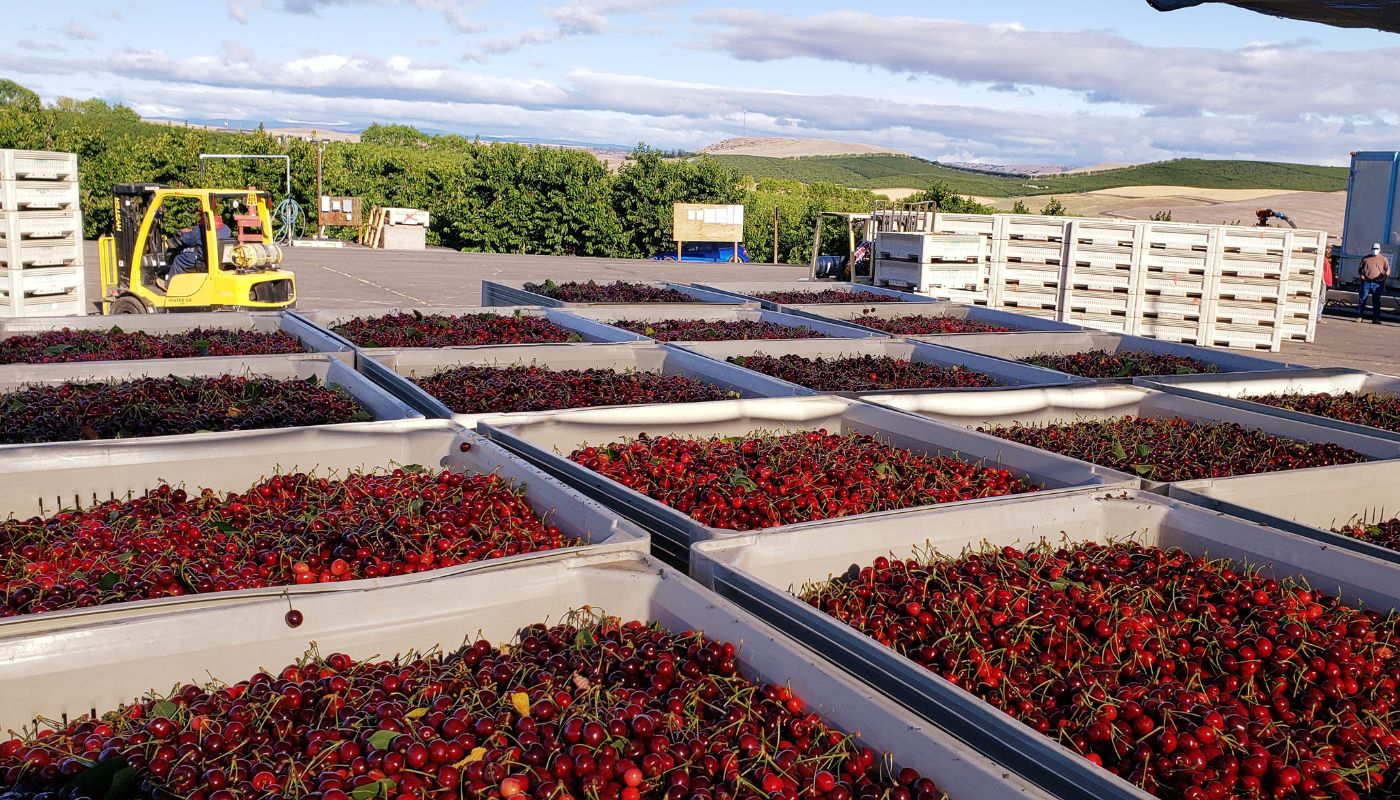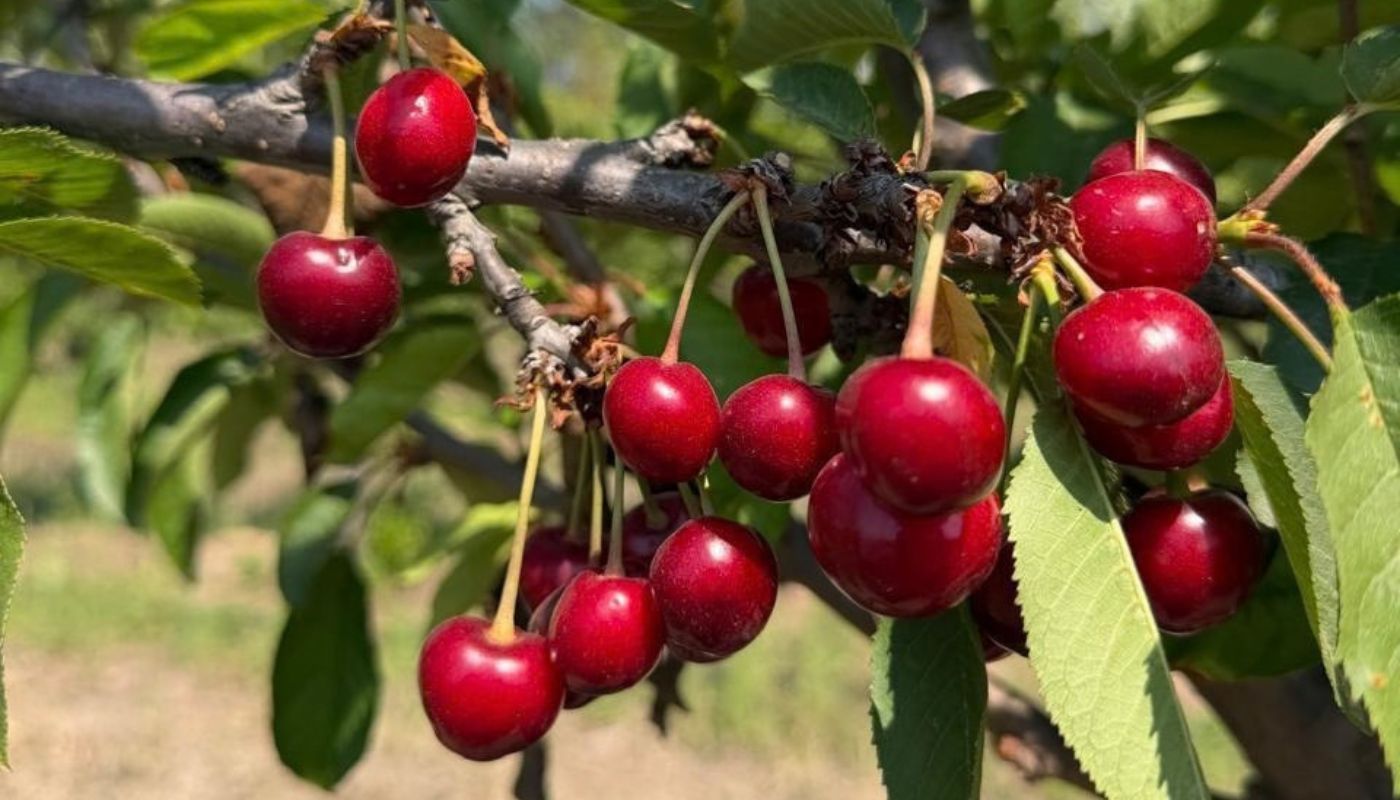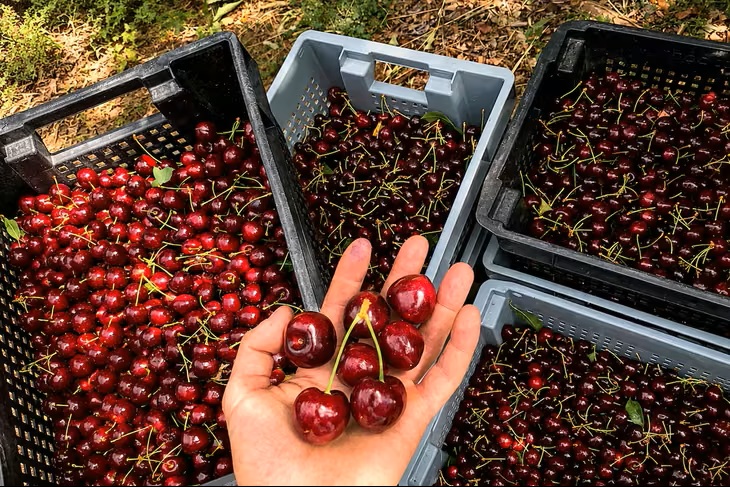

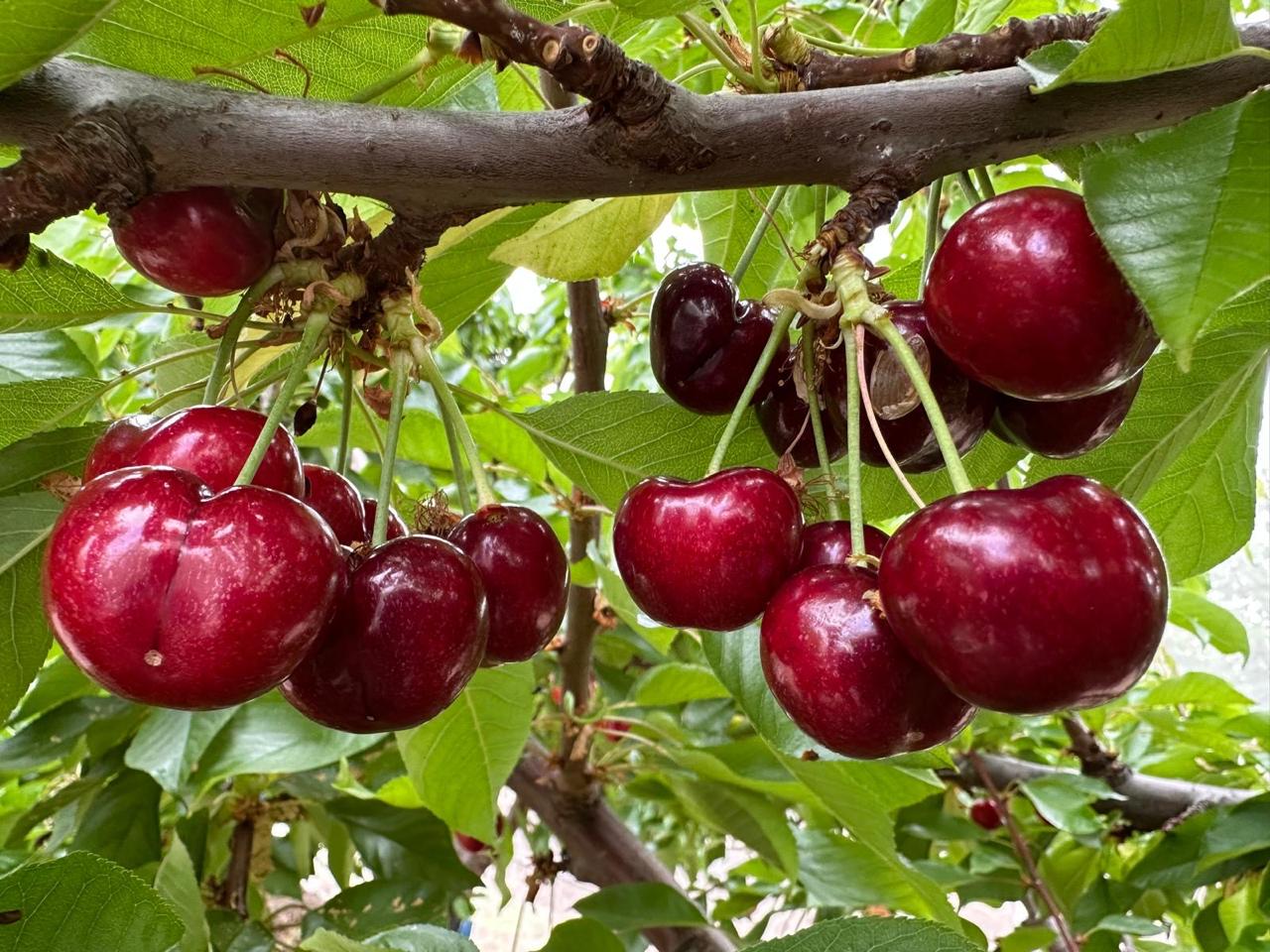
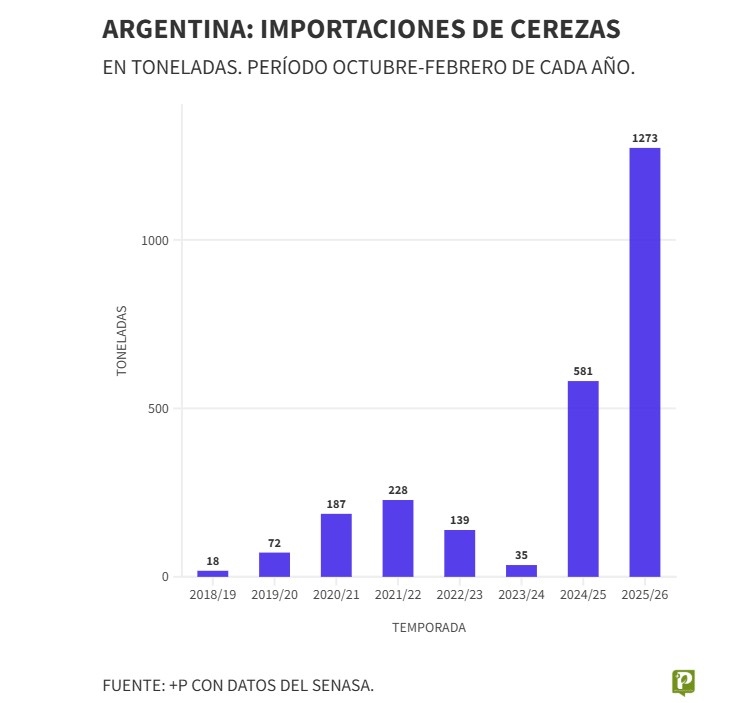
The 2025/2026 cherry season will be remembered as a true turning point for the Argentine market. This is not only due to the challenging international context and the adverse weather conditions that affected local production, but fundamentally because of a key statistic that marks a clear before and after: between October 2025 and February 2026, imports totaled 1,273 tons, the highest volume ever recorded by Argentina.
This figure, which could still increase slightly once the March data is finalized, represents a year-on-year growth of 120% and a jump of over 360% compared to the average of the last five years. Statistically speaking, this is a significant shift. In structural terms, it raises profound questions about the future of the business.
There is an additional element that amplifies the magnitude of the phenomenon: 100% of the imported volume came from a single source, Chile. Understanding what is happening in the Argentine market necessarily requires understanding the transformation—and the oversupply crisis—that the world’s leading exporter in the Southern Hemisphere is currently experiencing.
The background: Chilean structural expansion
The season began in October of last year under a scenario that already foreshadowed tensions. Chile had been consolidating an aggressive policy of expanding cherry cultivation. New plantations, the incorporation of high-yield genetics, and improvements in logistics and post-harvest technology fueled sustained production growth.
The result was a record harvest that encountered unexpected limitations in destination markets, just as had happened the previous season. Over the last decade, Chilean growth has been heavily driven by Asian demand, particularly from China, where cherries have positioned themselves as a premium product associated with celebrations and gifts. However, this season again revealed signs of saturation: larger stocks, increasing competition, and logistical pressures that impacted prices.
Europe and the United States also showed no capacity to absorb such significant increases in supply. The consequence was a drop in prices in the main destinations and an urgent need to diversify markets. In this trade realignment, Latin America gained prominence, and Argentina emerged as one of the many key markets to test. The increase in Chilean shipments to the Argentine market exceeded 100% in just one year. This explains the record 1,273 tons imported so far this season.
The Argentine cherry market has a distinctive characteristic: it is niche. Unlike mass-consumption fruits, cherries are concentrated in high-purchasing-power segments, with greater penetration in large urban centers and a strong presence at specific times of year.
In this context, the arrival of more than a thousand additional tons seemed, initially, a direct threat to price equilibrium. Economic logic would suggest that such a marked expansion of supply in a relatively small market should put downward pressure on prices. However, the collapse did not occur. And to understand why, it is necessary to consider another determining factor of this season: increased demand.
The impact of hail in Patagonia
Argentine production, concentrated in the Patagonian region, experienced a climatically challenging season. Severe rain and hail storms affected large areas of northern Patagonia, especially in the provinces of Río Negro and Neuquén.
The damage not only reduced volumes but also affected the quality of some of the fruit. A significant proportion of the production originally destined for export had to be redirected to the domestic market because it did not meet the standards required by foreign buyers.
This generated a particular phenomenon: the domestic market simultaneously received more local fruit—which could not be exported—and the record volume coming from Chile. In theory, a double increase in supply. Nevertheless, price behavior showed remarkable resilience.
Statistics from the Central Market of Buenos Aires (MCBA), where approximately 30% of the cherries traded in the country are sold, allow for a more precise observation of the market dynamics.
During October, November, and December of 2025, wholesale and retail prices were higher than those recorded during the same period of the 2024/2025 season. For several weeks during the last quarter of last year, wholesale prices exceeded US$10 per kilo, equivalent to approximately 14,000 pesos per kilo at the reference wholesale exchange rate.
In January and February, prices stabilized compared to the previous season, ranging between $5 and $7 per kilo. Even so, on average, prices in dollars were slightly higher than in the previous cycle. This is key: the market absorbed larger volumes without negatively impacting producer profitability.
The logic of the ABC1 segment
The explanation lies, in part, in the nature of the cherry consumer in Argentina. This consumer base is largely comprised of members of the ABC1 segment, with high purchasing power and reduced sensitivity to price variations when quality is maintained.
Cherries are perceived as a premium product, associated with freshness, distinctive flavor, and marked seasonality. When the fruit maintains firmness, size, and appearance, consumers accept higher prices. This season, both imported and local fruit maintained acceptable standards on store shelves. This consistency allowed the product to maintain its positioning and prevented destructive price competition.
Furthermore, the increased availability of fruit generated greater visibility at points of sale and stimulated a moderate expansion of demand within the same socioeconomic segment. It wasn’t a mass market, but rather an expansion of consumption in a niche that responded positively.
A fragile balance going forward
While the 2025/2026 season can be considered balanced in terms of prices and profitability, the future scenario is cause for concern. Chile projects exports of approximately 135 million boxes for the next season, equivalent to more than 650,000 tons. The comparison with Argentina is telling: in an optimal year, the country could reach around 8,000 exportable tons.
The scale gap is enormous. For Chile, redirecting a small percentage of its production to Argentina represents a marginal move. For the Argentine market, that same volume could profoundly alter the internal balance. If the structural oversupply in Chile consolidates and traditional markets continue to show absorption limits, Latin America—and particularly Argentina—could receive larger influxes in the coming seasons. Therein lies the main concern of the local sector.
Paradoxically, the difference in scale can also work in Argentina’s favor. The country doesn’t compete on volume, but it can compete on quality and market segmentation. Argentine cherries, produced under the unique agro-climatic conditions of Patagonia, are renowned for their firmness and organoleptic characteristics. The smaller scale allows for commercial flexibility: placing small volumes in specific niches, providing personalized attention to buyers, and building high-value-added business relationships.
While Chile needs large markets to absorb its massive production, Argentina can focus on selective destinations where competition is less intense and prices more attractive. The strategic key will be to deepen this differentiation and avoid direct competition based solely on price.
The upcoming season under scrutiny
With most of Argentina’s production already sold and no major activity expected in March, the focus is shifting to the next season. If Chile does indeed increase its supply to projected levels, the regional market could face greater strain. Argentina must decide whether to strengthen its presence in the domestic market—where it demonstrated resilience this year—or redouble its efforts to open new niches abroad.
Recent experience offers a clear lesson: record imports did not cause the collapse many feared. The combination of adverse weather that limited local exportable supply, consistent quality on store shelves, and active premium demand allowed prices to remain stable. But this balance might not automatically repeat itself if conditions change.
The 1,273 tons imported between October and February represent much more than a number. They signal that the Argentine market is now part of the regional strategic landscape for cherries. The 120% year-on-year growth and the 360% jump compared to the five-year average show that the flow can escalate rapidly when international conditions are favorable.
The fundamental question is whether this phenomenon will be remembered as an exceptional episode resulting from a record Chilean harvest or as the beginning of a new era of greater regional integration and sustained competition.
For now, the 2025/2026 season leaves a unique balance sheet: record imports, firm prices, preserved profitability, and a clear warning for the future. In a business where global scale is concentrated in a few players and where logistics and quality define success, Argentina must rely on its main strength: differentiation.
The record is now part of the statistics. What happens in the coming seasons will determine whether it was a passing anomaly or the beginning of a structural transformation in the Argentine cherry market.
Source: Más Producción