

Dormancy in cherry trees is a period of physiological inactivity that occurs during the winter months, when climatic conditions are no longer favorable for active plant growth. During this period, the tree reduces its metabolic activity and the growth of new shoots temporarily stops.
Dormancy is crucial for the survival of temperate fruit trees, as it allows them to withstand low temperatures and other stressors typical of winter.
In this context, April is the most important month in the transition between post-harvest and dormancy, although the first sign that the plant should begin preparing to “sleep” occurs at the beginning of summer, with the shortening of the photoperiod.
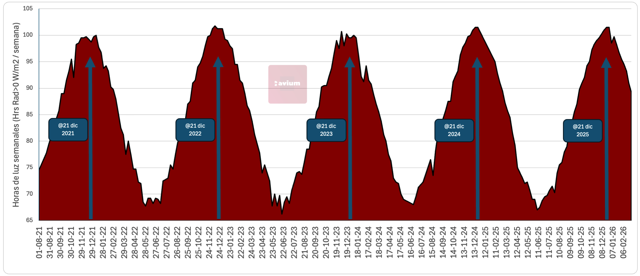
Figure 1 graphically presents the photoperiod dynamics for central Chile. During each season, the days gradually lengthen until approaching December 21, when weekly daylight hours can reach 102, equivalent to an average of 14.5 hours of daylight per day.
From that point on, day length begins to gradually decrease until June, before increasing again, repeating a nearly sinusoidal seasonal pattern each year, determined by latitude. From an agronomic perspective, this progressive reduction in daylight hours is one of the first environmental signals the plant perceives to begin preparing for dormancy.
Figure 1. Photoperiod dynamics over the last 5 seasons in the Curicó area (Hours with radiation > 0 W/m²/week).
Source: Avium 2026.
This photoperiod signal causes annual plants, which normally grow until mid-December and develop over approximately 70 days, to exhibit lignified basal sections. This influences the onset of floral induction; in addition, the plant enters a process of accumulating reserves, changing sap flow, and preparing for dormancy.
When and how does dormancy begin?
The start of this dormant period usually coincides with the first days of May. The main indicator of a successful entry into dormancy is that, around May 1st, the plants have approximately 50% leaf fall (yellow leaves = leaf fall). On that date, the chilling hour (CH) count begins, a monitoring process that is carried out for three months, theoretically and statistically ending on July 31st.
It should be noted that, in agroclimatically normal years, June, largely representing end-dormancy, is the most relevant month in terms of CH accumulation. However, each season teaches us that a more detailed analysis of yield rates is necessary, and historical comparisons should never be overlooked. For example, the 2025-2026 season did not have a bad June; however, the low accumulation in May negatively impacted some varieties in certain areas.
For a successful entry into dormancy, it is also necessary to consider post-harvest practices, understanding this not only as the period immediately following fruit harvesting, but also as a stage of physiological change for the plant. Everything done post-harvest will have repercussions in the following season, including dormancy. The signals given to the plants before dormancy are key for them to understand that they will enter a period of rest and, thus, complete a very important cycle for the species.
It is essential to have completed the recovery programs at the nutritional, soil, and root levels. Foliar corrections should be finalized, taking into account the information provided by the analyses performed at the beginning of the post-harvest period. Furthermore, it is essential to suspend nutritional programs during March, as this sends a clear signal to the plant that it will soon enter dormancy.
During the post-harvest period, more attention should be paid to water distribution than to the amount to be replenished based on evapotranspiration demand. Two of the most important root growth flushes in cherry trees occur during post-harvest; the most significant of these can be recognized by the renewal of at least 70% of the root volume.
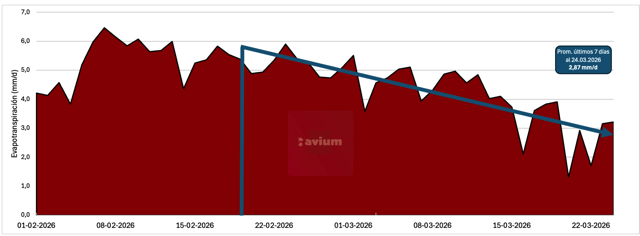
It is important to understand that water demand is not expressed as a function of ambient temperature, but rather of evapotranspiration. Therefore, it’s important to keep in mind that the periods of high temperatures in March or April are not comparable to those of summer, because they occur for shorter periods and, furthermore, minimum temperatures are considerably lower than during the summer. In other words, overall, evapotranspiration is significantly lower (Figure 2).
Another signal that should be given to orchards is the end of the irrigation season, which ideally should end towards the end of March. In soils with lower moisture retention, such as sandy soils or those with a significant presence of stones, the irrigation season can be extended until the first or second week of April.
Figure 2. Evapotranspiration, Central Zone, February 1 to March 24, 2026 (mm/day)
Source: Avium 2026.
Reference evapotranspiration decreases significantly from the third to fourth week of February. Meanwhile, the crop coefficient begins to decline progressively from late February to early March, reaching values close to 0.4–0.6 by the end of March, depending on the specific case. This results in an approximate ETc of 1.15 to 1.7 mm/day.
In turn, water demand must be readjusted in conjunction with precipitation events during this period, which in many cases determines the final irrigation applications of the season.
Another point to consider before the onset of dormancy is the use of soil pits and soil moisture sensors. This provides as much information as possible to inform irrigation decisions and their timing, aiming for lower replenishment thresholds than those used during peak season. The final decision should be based on both soil moisture levels and the plant’s current growth.
End of the Irrigation Season
As mentioned previously, the irrigation season should extend, at most, until the last week of March or the first week of April in orchards with soils that have a lower moisture retention capacity. This signal promotes the start of the lignification process in the wood and fruit centers of the plant, allowing it to better withstand the low winter temperatures and encouraging natural leaf fall.
Should irrigation resume in autumn or winter after a dry winter?
The answer is yes, always guided by a proper assessment of soil moisture levels using soil pits, which can be supplemented with moisture sensors, but never before recognizing physiological dormancy in the plants, that is, at least 50% yellowing of the leaves = leaf fall.
Cold Accumulation
In this fruit species, dormancy is very important for the development and expression of flowers and fruit. During this period, from May 1st to July 31st (default calendar), the plants accumulate the chilling hours necessary to break dormancy. Once the plant reaches the required number of chilling hours (CH), the cherry tree begins to emerge from dormancy and initiates bud break and flowering in spring. Each variety has a specific CH requirement.
Pre-dormancy
Currently, cherry trees are in the pre-dormancy stage, a period from March 15th to April 30th.
What should the orchards show today?
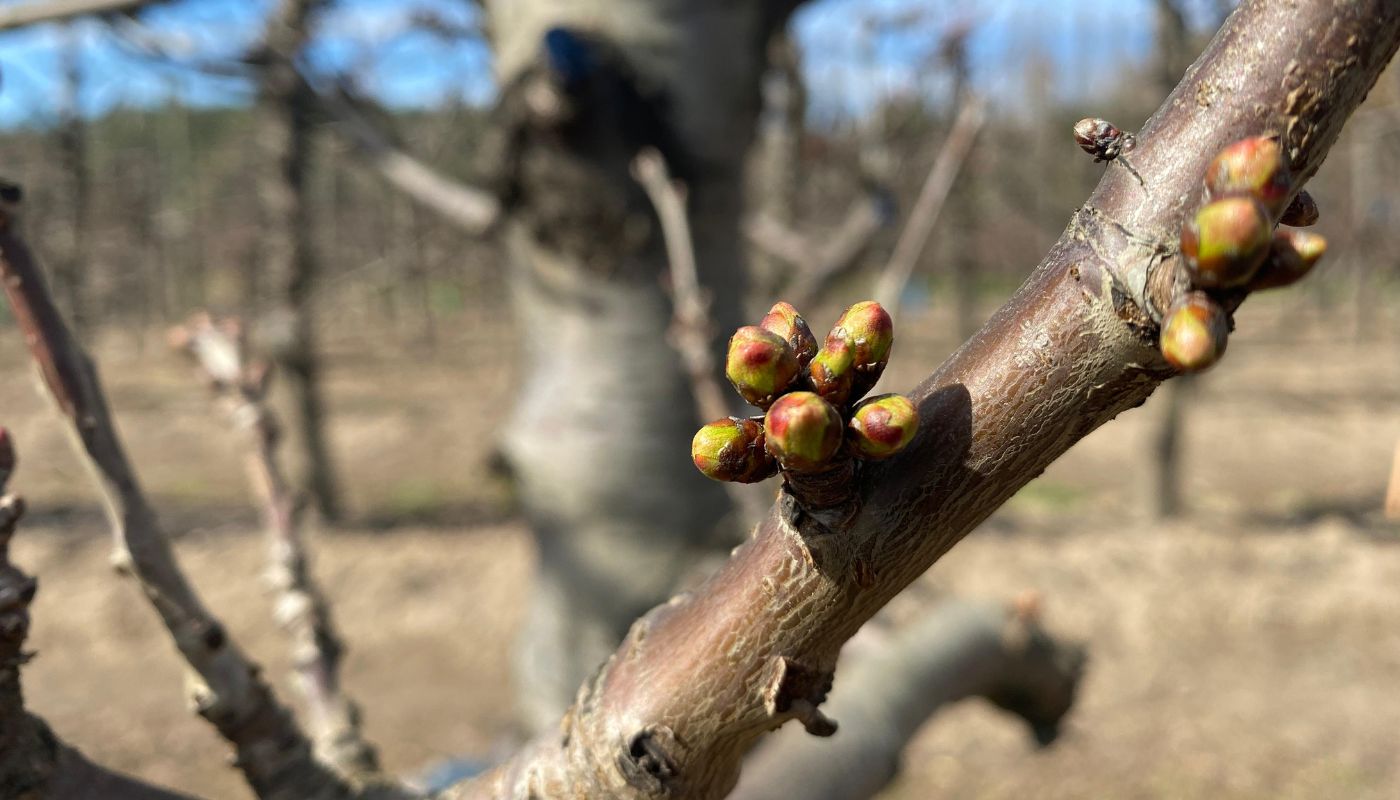
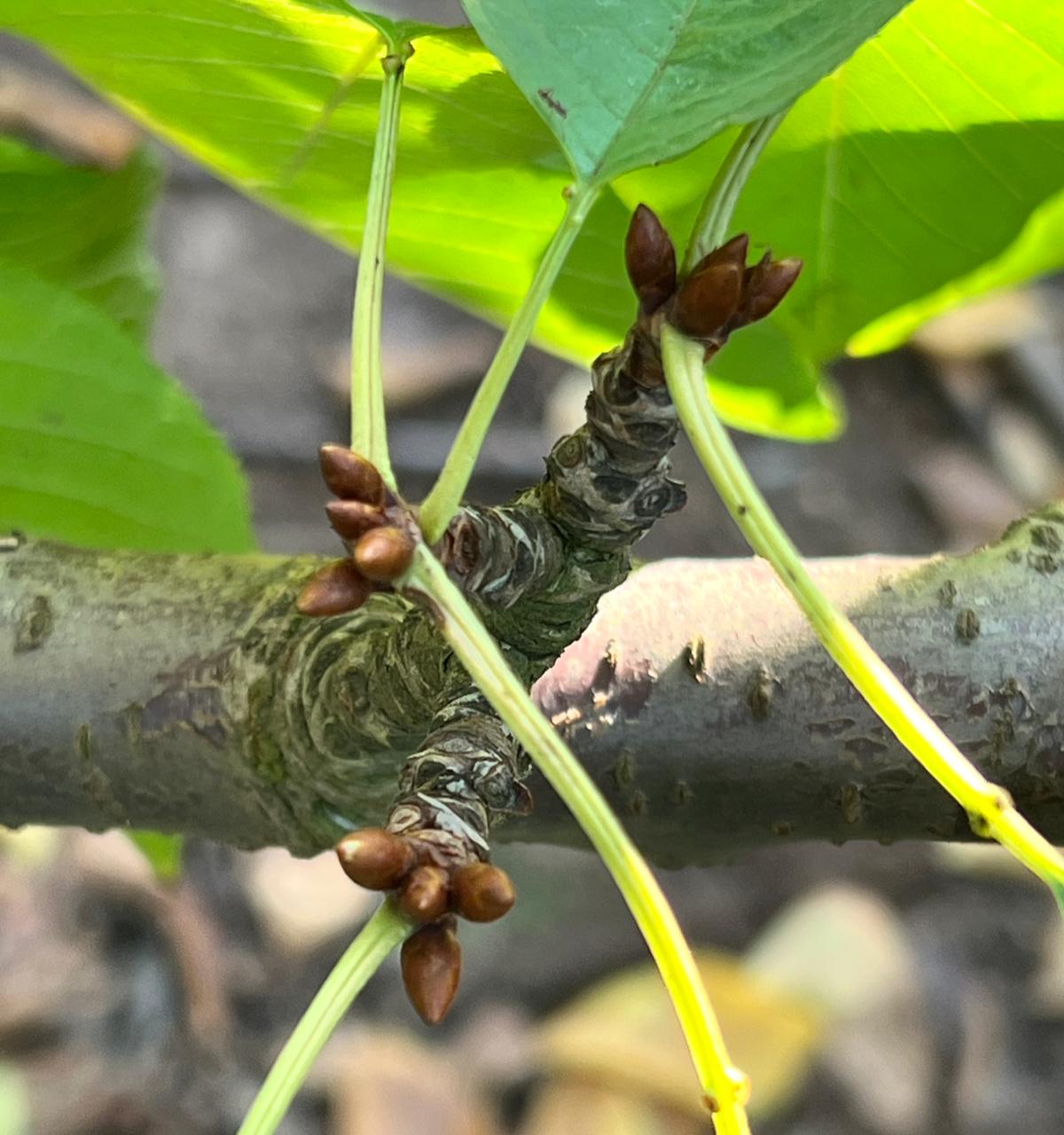
A progressive increase in the percentage of yellow leaves, ideally reaching 50% around May 1st; fruiting centers with well-closed and lignified spurs and branchlet bases, with well-formed bracts.
Image 1. Lignified fruiting centers with well-formed and closed bracts.
Source: Avium 2026.
What shouldn’t you see in the orchard today?
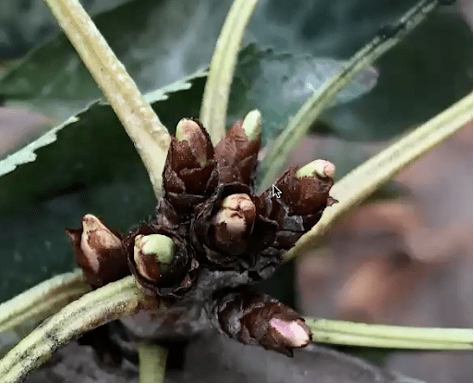
You shouldn’t see open spurs or buds with a significant percentage of green tips or close to opening. This scenario presents a problem from the point of view of productive potential, as it can be affected by early frosts. Furthermore, it can also represent a health risk associated with bacterial canker and wood-decay fungi, such as Cytospora (Image 2).
Image 2. Fruit tree centers with green tips.
Source: Avium 2026.
It is important for cherry farmers and growers to carefully monitor the accumulation of chill hours during the winter, in order to support technical decision-making during the season.