
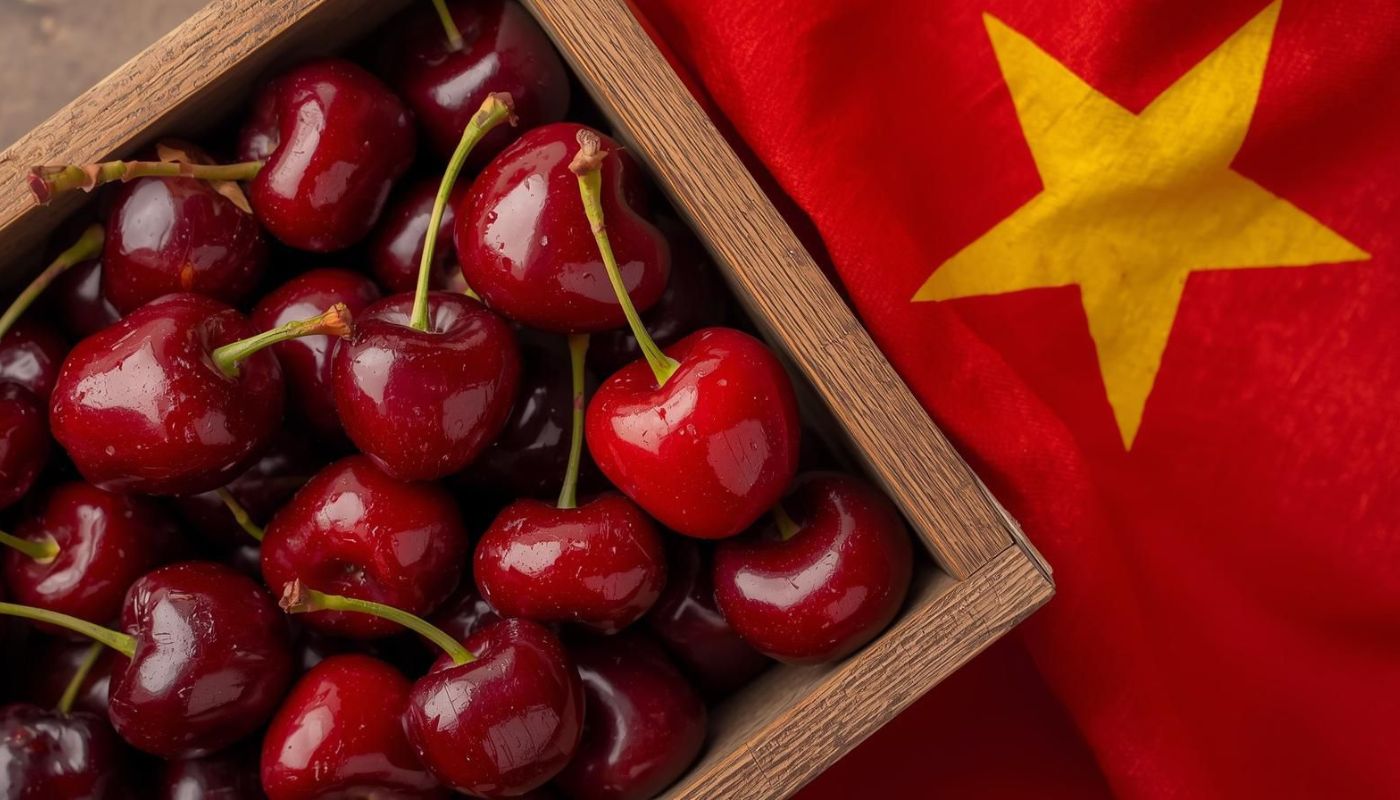
Chile secured more flexible access conditions for its cherries in Vietnam after authorities from both countries agreed to allow the fruit to enter the country without cold treatment and approved the use of the Systems Approach as an export alternative.
The agreement was confirmed during a meeting between the Undersecretary of Agriculture, Francesco Venezian, and the Vice Minister of Agriculture and Environment of Vietnam, Nguyen Hoang Hiep, as part of the Chilean official’s tour of Asia.
The new condition will allow Chilean cherries to reach Vietnam by air or land transport without undergoing the cold treatment that was previously required for these shipments. This is in addition to the possibility of using the Systems Approach, an alternative that was also approved during the bilateral talks.
“We met first thing this morning with the Deputy Minister of Agriculture and Environment, where we had already been discussing how to expedite and manage our option to facilitate cherry exports. Today he gave us the go-ahead, so Chile can export to Vietnam without cold treatment, by air or land. The Systems Approach was also approved as an alternative export method, which will be very beneficial for cherry exporters this season,” explained Undersecretary Venezian.
For Frutas de Chile, the agreement represents a significant change in the conditions for Chilean cherries to access the Vietnamese market. The association emphasized that eliminating cold treatment as the only option will allow for more choices in organizing shipments.
The General Manager of Chilean Fruit, Miguel Canala-Echeverría, stated, “This is a very important development that allows us to advance our presence of cherries in the Vietnamese market. Together with the authorities, we have managed to find a more flexible mechanism that will allow us to enter the market much more effectively. We have secured an alternative for the cold treatment, which is currently a complex requirement, for both air and sea shipments. Therefore, this was part of the strategy agreed upon with the authorities: to open more markets and to obtain better access conditions.”
The agenda also included other Chilean fruits. Venezian raised the need to move forward with phytosanitary approvals for fresh blueberries and kiwis, while also highlighting the quality, health, and safety standards of Chilean production to the Vietnamese authorities.
The Vietnamese market is considered a priority within Southeast Asia due to its economic growth, expanding middle class, and increased consumption of high-value fresh fruits and animal protein.
Vietnam also opens up possibilities for Chilean meats
The bilateral talks also addressed the possibility of advancing the opening of the Vietnamese market to Chilean meats, a process the sector hopes to finalize successfully by the end of the year.
From Chilemeat, its General Manager, Rafael Lecaros, stated: “In Vietnam, as I have heard from the Vietnamese Deputy Minister of Agriculture himself, opening the market to beef, as well as pork and poultry, will be a priority. Therefore, Chilean meats will be present. And in Indonesia, we already have a tour scheduled for next week, when Indonesian inspectors will arrive to certify beef and pork. So we also expect to conclude a very productive trip in Indonesia.”
The agenda will continue with Indonesia, where inspectors are scheduled to arrive to advance the certification process for beef and pork.
Asia Tour Includes Agricultural and Technological Cooperation
In addition to trade and health negotiations, Venezian held meetings with leaders and businesspeople in the Da Nang region: “We met with Vietnamese businesspeople very interested in importing fruit, timber, and wine from Chile. We established connections with our counterparts in Chile and hope to see positive results in the short term. It was a very productive visit, and we hope our agricultural sector will benefit from these agreements,” he added.
The Undersecretary also visited the Vietnam National Agricultural University, where he learned about projects related to biotechnology, smart agriculture, and climate change adaptation. The visit provided an opportunity to explore potential areas of scientific and academic cooperation, technology transfer, and knowledge exchange in innovation, agricultural health, and human capital development.
The visit to Vietnam comes during a special year for bilateral relations, as Chile and Vietnam commemorate 55 years of diplomatic ties. The tour of Asia began in China and will continue in Indonesia, with an agenda that combines market access, sanitary conditions for market entry, and new opportunities for Chilean agri-food exports.
Source: Reporte Agrícola