
Conducted by researchers at Saints Cyril and Methodius University in Skopje, the study evaluated vegetative growth, productivity and fruit quality under the region’s growing conditions, offering orchard planners a long-term comparison rather than a single-season snapshot.
What the study measured
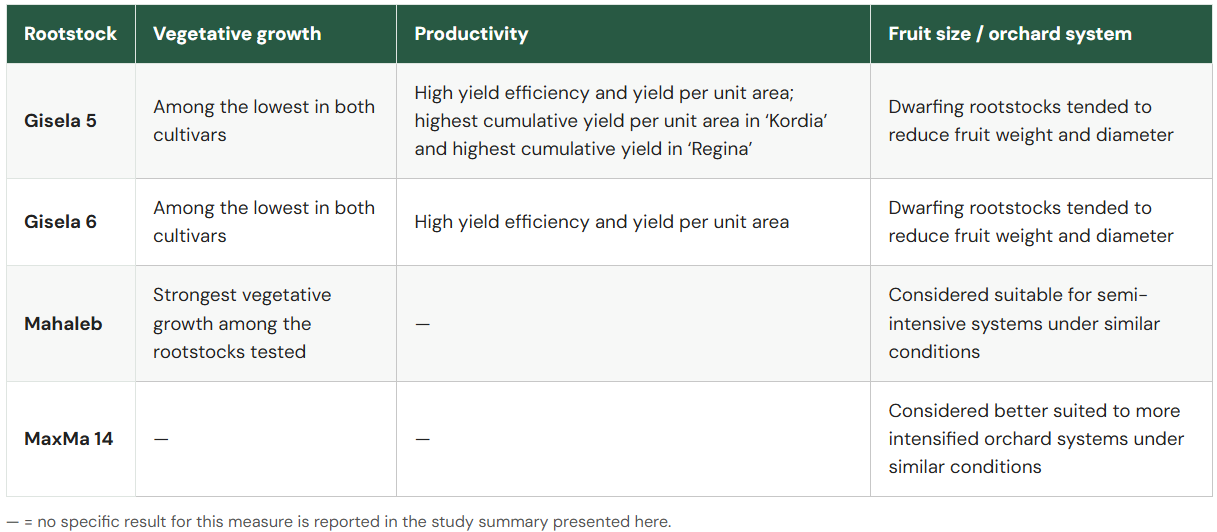
The researchers assessed vegetative growth through annual shoot growth and trunk cross-sectional area, a standard measure of tree size and vigour. Reproductive performance was judged by yield per tree, cumulative yield, yield per unit area and yield efficiency. Fruit quality was assessed through fruit weight, diameter, soluble solids content and titratable acidity. Together, these measures show the trade-off between how much a tree produces and the size and sweetness of its fruit.
Rootstock performance at a glance
The productivity–fruit size trade-off
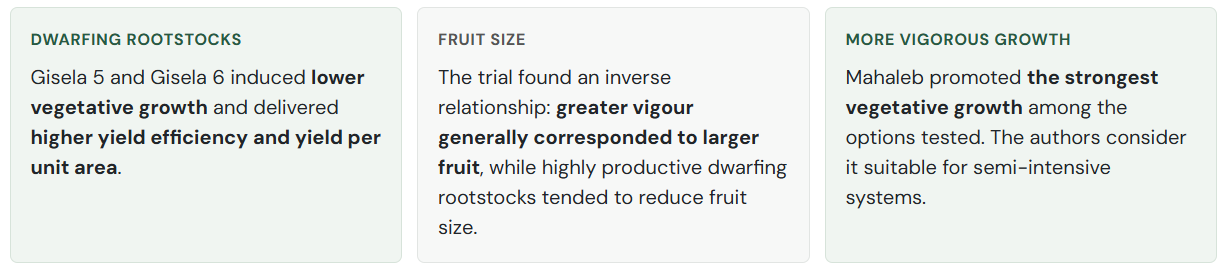
In both ‘Kordia’ and ‘Regina’, Gisela 5 stood out for productivity. Its results across the two cultivars suggest that the effect is rooted in the rootstock itself rather than in one particular scion combination.
Implications for orchard planning
Gisela 5 and Gisela 6 combined high yield efficiency and productivity per unit area with lower fruit weight and diameter. That fruit-size trade-off may limit their suitability where larger fruit is required. The authors consider MaxMa 14 better suited to more intensified orchard systems under conditions similar to those of the trial.
The findings underline a central dilemma in modern sweet cherry production: the rootstocks that make orchards most productive per hectare are not necessarily those that produce the largest fruit.
Because the trial was conducted under the specific conditions of central North Macedonia, the authors frame their recommendations as applying to similar environments. Within that scope, the study’s message is clear: rootstock choice means balancing productivity and fruit quality, according to the goals of each orchard system.
Source: bioengineer.org
Image: Generated by Artificial Intelligence