
In Spain, where sweet cherry plantings cover close to 29,000 hectares and average annual production stands at around 121,000 tonnes, labor already accounts for more than 65% of production costs and can exceed 1,200 hours per hectare per year.
“Reducing that dependence requires, among other things, rethinking orchard architecture, moving sweet cherry toward intensive models with more two-dimensional canopies that allow a greater number of operations to be carried out from the ground and that can progressively incorporate mechanization, digitalization, and even robotics. To move in that direction, however, it is essential to have rootstocks capable of adequately controlling vigor,” says Ignasi Iglesias, Technical Director at Agromillora Group.
“With that goal in mind, we have added the Corette® series to our portfolio, a new rootstock genetics line that Agromillora will present at Fruit Attraction 2026 and that is currently in pre-commercial evaluation across an extensive European network, following several years of trials designed to determine whether the performance originally observed in the United States can be replicated under production conditions that differ considerably in terms of soil and climate.”
“Until now, when we talk about low-vigor genetics for sweet cherry, the international benchmarks are GiSelA® 5 and GiSelA® 6. But in warm areas with calcareous soils and high pH, their performance has limitations, including insufficient vigor and low productivity,” says Iglesias. “That is why the search is now focused on materials that retain the productive advantages of dwarfing rootstocks while offering better adaptation to the conditions typical of southern Europe.”
Five rootstocks derived from genetics developed in the United States
The Corette® series comprises five rootstocks, Cass, Clare, Clinton, Crawford, and Lake, originating from the Michigan State University breeding program and originally selected in various counties in Oregon from different interspecific Prunus crosses. In some cases, the genetic base shares P. cerasus with materials used in reference rootstocks such as GiSelA®. Agromillora holds an exclusive experimental license for this genetics in Europe.
“Results previously obtained in the United States already pointed to low-vigor trees, generally in the GiSelA® 5 range or even below, combined with very rapid cropping onset, high productivity, and good adaptation to high- and ultra-high-density plantings. Some of the materials also showed interesting characteristics under warm conditions and on alkaline or calcareous soils.”
“Nevertheless, before considering commercial development in Europe, Agromillora chose to verify these characteristics directly in the field, importing the plant material from the United States, propagating it in vitro, and then establishing a trial network to observe its performance under different combinations of soil, climate, variety, and training system.”
“Pre-commercial evaluation began in Spain in 2023, with plantings in Mequinenza, Zaragoza; Albalate de Cinca, Huesca; and Cabrero, in the Jerte Valley in Cáceres. Three Italian sites were subsequently added, along with an extensive trial network involving institutes and research centers belonging to EUFRIN, with trials distributed across 18 European countries.”
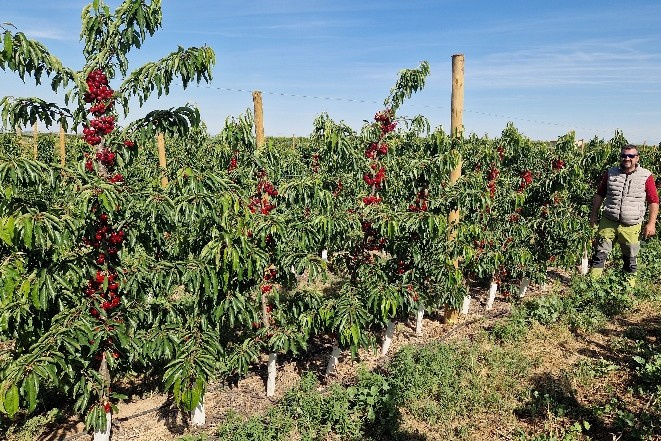
Two-dimensional high-density plantings exceeding 14 tonnes per hectare in year three in the first Spanish trials
The vigor control provided by this type of genetics makes it possible to move away from the traditional spacings associated with large trees and shift toward much narrower systems, with central leaders and canopies that concentrate production in a more accessible fruiting wall, similar to apple or pear.
The European Corette trials are using central leader training systems, with reference spacings of 3 by 0.5 meters and, in certain cases, 3.2 by 0.7 meters, with different varieties selected according to maturity timing and local conditions, including Nimba®, Santina®, Sweet Aryana®, Sweet Sareta®, Regina, Kordia, and Sweet Valina®.
As Iglesias notes, this transformation makes it possible to implement orchards where pruning, thinning, and harvesting can be carried out more efficiently, reducing travel and work at height and creating an architecture that will also be more compatible with mechanized and automated solutions in the future.
The results obtained so far must still be considered preliminary, as the evaluation network remains active. However, the first Spanish trials have confirmed several of the characteristics that had generated interest in this genetics in the United States.
Adaptation observed to date has been satisfactory for some of the rootstocks evaluated, both under the very warm conditions and calcareous soils of the Ebro Valley and on the neutral-pH soils of the Jerte Valley, while rootstock-variety compatibility has been good across all materials studied.
“One of the most striking results relates to early cropping, as yields exceeded 14 tonnes per hectare in year three with varieties such as Sweet Aryana® and Sweet Sareta®, figures that,” according to results available to Agromillora, “had not previously been achieved in comparable trials with GiSelA® 5 or GiSelA® 6 in the Ebro Valley.”
Low vigor also opens up possibilities for protected cherry production
Reduced vigor could also have an application that is beginning to attract interest among some growing companies: sweet cherry cultivation inside greenhouses and other protected structures.
Growing sweet cherry under cover is used primarily to advance the harvest date and access the earliest commercial windows of the season, although a fully protected structure can also provide a defense against some of the risks that most concern growers in the weeks leading up to harvest, including rain-induced cracking and hail damage.
“There are already protected production operations in regions such as Catalonia, Aragon, Valencia, and Alicante, although working with vigorous rootstocks such as Adara makes management inside the structure considerably more difficult and can even require the use of growth regulators. Less vigorous genetics could offer a more agronomically balanced alternative,” says Iglesias.
“Although the vast majority of European sweet cherry is still produced in the open field, reduced-vigor rootstocks could facilitate the crop’s entry into certain protected agriculture projects, particularly where the economic objective is to advance the harvest and protect fruit whose value can be extraordinarily high in the first weeks of the marketing season. For this reason, the potential adaptation of Corette® to greenhouse production is one of the areas of interest being studied.”
The next major challenge: growing cherries with ever less winter chill
There is another challenge, however, that could profoundly reshape cherry production over the coming decades: rising temperatures associated with climate change.
“Sweet cherries need to accumulate a certain number of chilling hours during winter to complete their cycle properly. The loss of chilling hours is already becoming a limiting factor in certain producing regions of Chile, Spain, and Italy, and it will likely become increasingly important both in southern Europe and in other fruit-growing areas of the world.”
“Breeding programs have already successfully introduced varieties with lower winter chilling requirements, while work on rootstocks is advancing in the same direction. Agromillora is currently evaluating, together with Ibergen, five sweet cherry pre-selections specifically targeting lower winter chilling requirements, materials currently under study in Spain that will shortly be evaluated in countries such as Brazil, Peru, and Chile.”
“The transformation envisaged for sweet cherry points toward a new concept of the orchard, in which genetics, planting density, tree architecture, crop protection, and climate adaptation will need to evolve together to continue producing high-quality cherries in a scenario of continuous technological change. At Agromillora, we want to accompany this evolution with new rootstock proposals adapted to the needs of the production sector in a climate change scenario.”
Source: Fresh Plaza