
This is the conclusion of a new RaboResearch report, authored by Camila Bonilla Cedrez and Cindy van Rijswick, which analyzes the effects of climate change on the citrus, pome, and stone fruit sectors in Europe.
According to the report, climate change does not necessarily threaten the total fruit supply in Europe, but it is making yields, quality, and harvest dates less predictable. At the same time, changes in temperature and water availability are gradually altering the productive capacity of different regions.
The report notes that the main risks vary depending on the type of fruit. Citrus fruits are particularly vulnerable to heat and water scarcity; pome fruits face the risk of early flowering and late frosts, as well as increased heat stress during the summer; While stone fruits face the structural challenge of decreasing winter chill hours.
Citrus under increased heat and water pressure
European citrus production is particularly vulnerable due to its high concentration in the Mediterranean. Spain accounts for between 55% and 60% of the European Union’s citrus production, followed by Italy, with approximately 20% to 25%, and Greece, with around 10%.
According to data from the Spanish Ministry of Agriculture, Fisheries and Food (MAPA) cited by RaboResearch, Spanish citrus production decreased by more than 10% when comparing the 2023-2025 average with the 2013-2015 period. The report links this trend to greater production volatility and a gradual shift of suitable growing conditions towards more northerly areas.
Exposure to heat has also increased. Many Mediterranean citrus-producing regions currently experience more than 80 to 100 days of heat stress per summer, defined in the study as days with maximum temperatures exceeding 30°C.
Evolution of exposure to heat stress in citrus-producing regions between 1995 and 2023
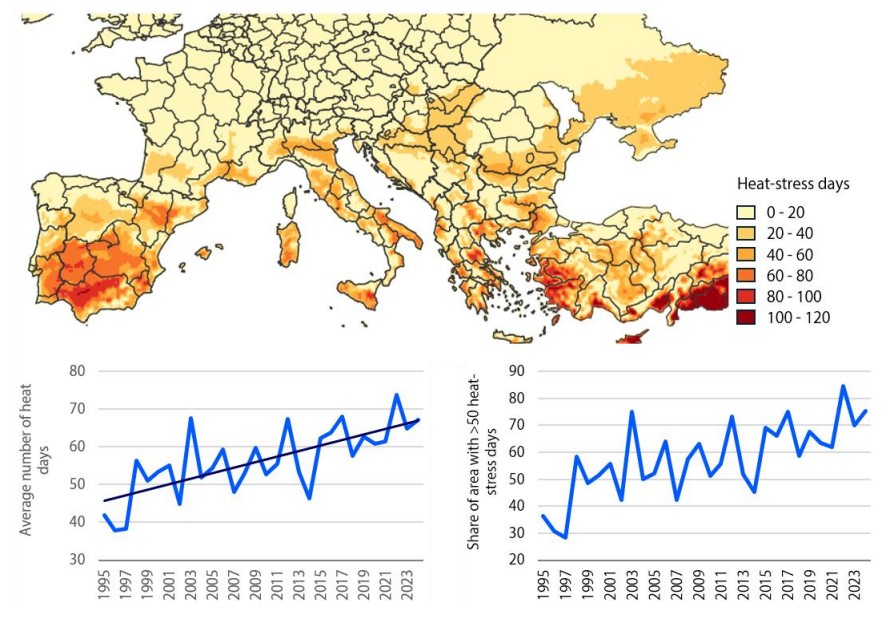
Since the mid-1990s, the regional average for these days has increased by approximately 15 to 20 days. The increase in heat waves raises the risk of sunscald, fruit damage, and premature fruit drop.
This is compounded by more irregular rainfall and longer dry spells, which increase water stress during critical stages such as flowering and fruit development. RaboResearch warns that water stress could intensify by mid-century, especially in southern Europe.
Pome fruits: The risk is no longer just frost
For apples and pears, spring frosts and so-called “false springs” remain one of the main climate risks.
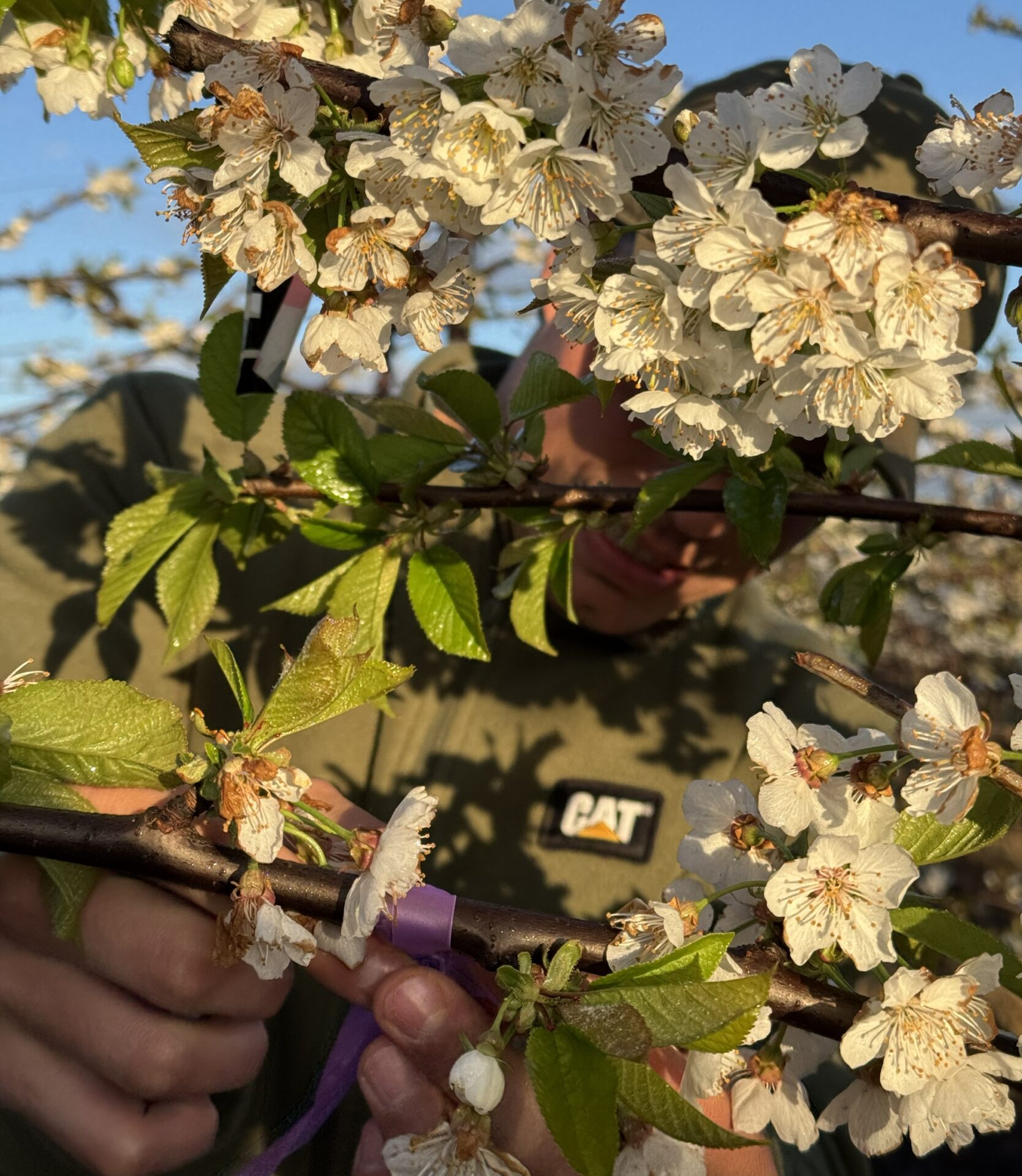
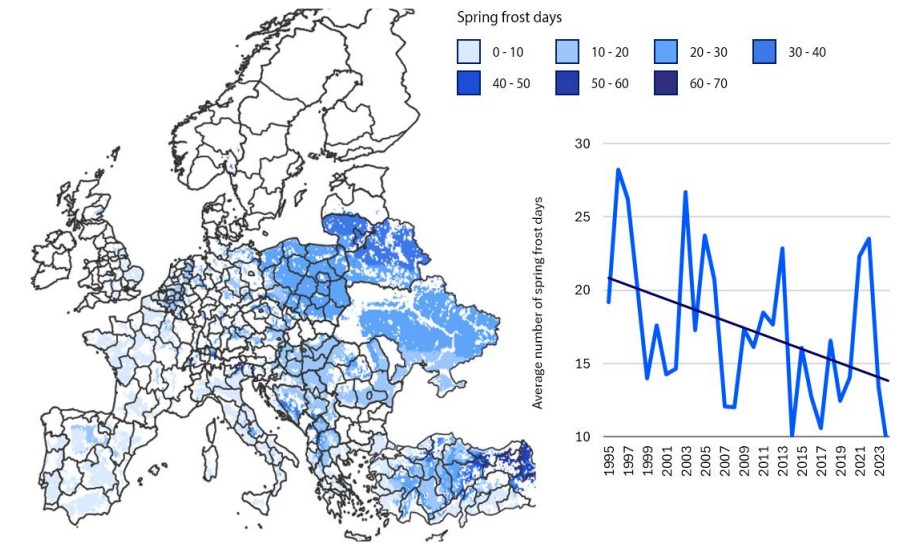
Pome fruit flowering has advanced by 10 to 15 days in recent decades, increasing the likelihood that sensitive developmental stages will coincide with late-season cold spells. RaboResearch highlights that the problem is increasingly related to the timing of frost rather than its frequency.
The effects have already been observed in recent seasons. The frosts of 2021 significantly impacted European pome fruit production and contributed to one of Italy’s smallest pear harvests in 30 years.
However, the report warns that summer risks are becoming increasingly important. High temperatures can reduce fruit size and quality, as well as increase the risk of sunscald.
A study conducted in Spain and Portugal, cited by RaboResearch, estimated that sunscald alone can reduce yields by between 10% and 50%, depending on the climate, variety, and crop management.
For pears, the decrease in winter chill in some regions, especially in Italy, is also becoming a concern, as an insufficient chill period can affect the regularity of flowering and fruit set.
Evolution of spring frosts in pome fruit producing areas between 1995 and 2023
Stone fruits face reduced chill accumulation
For stone fruits, the main climate challenge identified by the report is the decrease in winter chill.
Spain, Italy, and Greece account for more than 90% of the European Union’s peach and nectarine production, while cherry and plum production is more widely distributed, with significant areas in countries such as Poland, Romania, and Hungary.
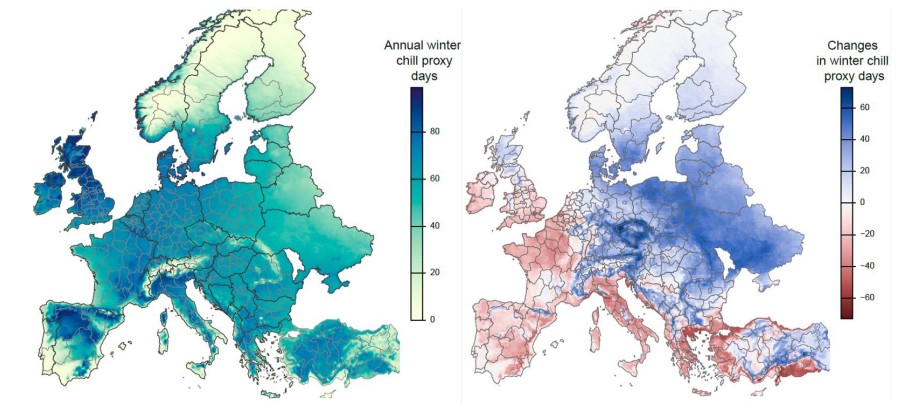
Stone fruit trees require a certain amount of chilling exposure during dormancy to ensure normal bud break, flowering, and fruit set. According to RaboResearch, warmer winters are already reducing chilling accumulation in some areas of southern Europe, and projections point to further decreases by mid-century.
This trend could alter the relative suitability of different regions. While Mediterranean areas have the lowest levels of chilling accumulation, some areas of central and eastern Europe maintain more favorable conditions.
The European fruit-growing map could change
One of the report’s main messages is that climate change is beginning to redraw Europe’s fruit-growing map.
RaboResearch’s analysis projects a general shift in climatic conditions currently associated with major fruit-growing areas from parts of the Mediterranean basin toward cooler, more continental regions of northern and central Europe.
In this way, some areas of Central and Eastern Europe could experience increasingly similar climatic conditions to those of current production zones, while parts of Southern Europe would move away from the historical conditions that have favored fruit growing.
However, Rabobank emphasizes that this does not mean that production will automatically shift from current production zones to new regions.
The availability of water, infrastructure, labor, logistics, technical expertise, varieties, market access, and investment capacity will be equally crucial factors.
The report notes that some areas of Eastern Europe, including Poland, Serbia, and Slovakia, are already attracting investment in modern apple orchards, driven by lower labor costs and opportunities to develop large-scale, protected systems.
Evolution of spring frosts in stone fruit producing areas between 1995 and 2023
Adaptation as a competitiveness factor
Faced with this scenario, RaboResearch argues that climate adaptation is ceasing to be merely a risk mitigation tool and becoming a competitive necessity.
Operational measures include precision irrigation, soil moisture monitoring, frost protection, shade systems, canopy management, sunscald prevention, and post-harvest quality protocols.
In structural terms, the report identifies alternatives such as varietal change, rootstock selection, orchard renewal, crop diversification, and, in certain cases, relocation of production.
Water emerges as one of the main factors behind these decisions. Irrigation can help address drought and heat, as well as being used for frost protection, but at the same time, it increases dependence on a resource whose availability is becoming increasingly uncertain in some regions.
The report also warns that the effects of climate change do not end in the orchard. Heat stress, sunscald, size issues, and diseases can reduce storage capacity and shorten fruit shelf life, increasing the importance of cooling, storage, and post-harvest handling capabilities.
A financial and organizational adaptation gap
For Rabobank, one of the main challenges is not a lack of technology, but rather producers’ ability to implement it.
Access to capital, infrastructure, knowledge, and risk management tools varies considerably among producers. Larger, more diversified companies can spread climate exposure across different crops, regions, and supply windows, while smaller producers are more vulnerable to local events.
Measures such as hail nets, sprinkler systems, and improvements to water infrastructure can protect yields and quality, but they require significant initial investments. Therefore, the economic case is often more favorable for high-value fruits with established brands or those geared toward export.
RaboResearch warns that this situation could widen the gap between producers with greater financial resources and small or older farms that have fewer opportunities or less willingness to invest.
In this context, the report suggests that the main difference in the future may not be between producers exposed and not exposed to climate risk, but between those who can adapt and those who cannot. Climate resilience, it concludes, will progressively become a differentiating factor within European fruit farming.
Source: Portal Frutícola