
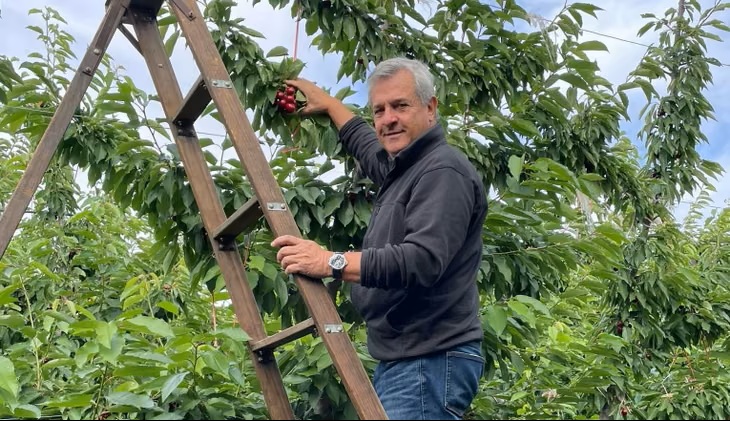
Carlos Enriquez sums it up in a few words: the cherry industry is “an activity with no ceiling.” However, the failure to open new markets, combined with a lack of adequate financing, has led producers to argue that the sector needs to be back on the radar of government officials. For now, his orchards in Vista Alegre, Neuquén, are entering the most delicate days of the season, and everything depends on what happens in the sky. “We’d be happy just to have it stay cloudy,” he admits, referring to the El Niño phenomenon—if it brings rain, the entire harvest could be at risk.
The harvest is running behind schedule. “It’s an abnormal year, due to weather conditions,” the producer explains. A spring that was slow to warm up has shifted the calendar: “We’re starting this Monday—nearly 12 days later than in a typical year.”
It wasn’t a lack of cold weather; the plants accumulated enough chill hours during the winter to reactivate and begin the cycle of budding, flowering, and fruit development. The problem arose later, with “highly erratic” weather.
Rain Can Ruin the Fruit
“The El Niño phenomenon is causing a great deal of concern,” says Enriquez. Forecasts are being monitored constantly. “We are entering a very critical phase—the point where the fruit begins to take on color, elongate, and grow very rapidly.”
At this stage, water is the enemy. “Any rainfall—especially heavy rain—can cause the fruit to split or crack,” he warns. And the damage is irreversible: “It results in a significant loss of quality, making the fruit, in most cases, nearly impossible to sell.” “Those are the rules of the game,” he summarizes. “We are highly dependent on weather conditions.”
Chile faces no tariffs; Argentina pays up to 40%
Another concern is where to sell. “Argentina has always been a closed-off country,” Enriquez points out. “We don’t have free trade agreements, except with a few countries.” He mentions the agreement with the European Union—which has “just been finalized”—but cautions: “These are mature markets that, currently, are not growing.”
The destinations that are growing remain out of reach. “We lack free trade agreements with most countries—such as China, Vietnam, Korea, India, the Middle East, and others—which means we face tariffs.” While some of these countries have approved phytosanitary protocols—meaning Argentine cherries could technically enter without issue—the problem is the cost. “Tariffs for entering these markets can reach 30% to 40%. Consequently, compared to Chile, which enjoys zero-tariff access, we are simply priced out of the competition.”
Even in China, where the tariff is lower, the profit margin is effectively lost at the border. “We face a 10% tariff to export our cherries, and that 10% represents our entire profit margin.”
This is not a new grievance. “We have repeatedly raised this issue with national authorities, yet we have been unable to open up new markets,” he says. What regional economies are asking for, he explains, is access to these destinations on equal terms with their competitors.
A luxury, not a staple
Compounding the lack of trade agreements is a global market that is buying less. “The global economy is moving very slowly,” he describes. Tariffs, higher fuel costs, and a general economic slowdown hit the cherry industry hard. “This is a premium product—not a staple food, but a luxury. When faced with economic constraints, people choose to go without or look for alternatives.”
Scale is also a significant factor. “The greater the volume, the better we can distribute fixed costs.” In terms of volume, the comparison is lopsided: Argentina exports the equivalent of 2% of what Chile exports. “Facing such a major player, it is very difficult to establish a market position for the product.” Even so, he stands by the quality: “Our product is very good. In general, Argentina has excellent conditions for producing cherries.”
VAT refunds take eight months; freight costs are in dollars
“We have no financing,” he says, listing this among the challenges to overcome. He acknowledges that there are no export taxes, but VAT refunds arrive late. “With 30% inflation, if that money is returned to you [by the tax authority, ARCA] at its nominal value eight months later, it creates a financial problem for us.”
He does note an improvement. The refunds “have been getting back on track under this administration,” he admits, recalling the situation in 2022 and 2023: “With inflation over 150%, what we eventually received nine months later was worth next to nothing.” Still, he insists that—even with current inflation levels—waiting so long is “absurd.”
Domestic costs complete the picture. All exports are shipped by air, which first requires transporting goods to Buenos Aires. “Ground freight costs to Buenos Aires are absurd—and they’re charged in dollars.” He speaks of “a distortion,” though he clarifies: “I’m not saying whether the dollar exchange rate is right or wrong.” For him, the math is simple: “If we lack free trade agreements, face tariffs, and see domestic freight or internal costs rising against the dollar, our profitability is obviously hit very hard.”
Jobs for those who don’t work in the oil sector
“The contributions of regional economies are overlooked,” he argues. “Fruit farming involves living things—you have to keep feeding them.”
Every season supports employment. “We are sustaining vital jobs,” he points out. “We provide work for many people—men and women who don’t have the opportunity to work in the oil sector, or who lack the skills or the profile required for that industry.”
Thefts, threats and unanswered complaints
“We have a tremendous insecurity issue, due to the continuous theft of cherries,” he denounces when addressing his daily concerns. It’s not just that they take fruit: “They have stolen more than 4 kilometers of perimeter fences, which we built to have a good presentation in front of our clients from abroad.” Added to that are the threats.
“We have grown tired of making complaints, but there is no one in prison and there are no consequences. So we are really helpless.” He recognizes the support of the provincial Ministry of Security, but sets a limit: “We cannot make 20-meter-high walls so that no one can enter. Justice has to act, because otherwise it will be a revolving door.”
Source: Más Producción