

This practice allows for informed decisions regarding pruning, crop load adjustment, fertilization, and other key tasks to achieve a balance between fruit yield and quality. Below, we detail its technical relevance, the optimal timing, and practical considerations for its implementation in the field.
What is fruit core counting and why is it important?
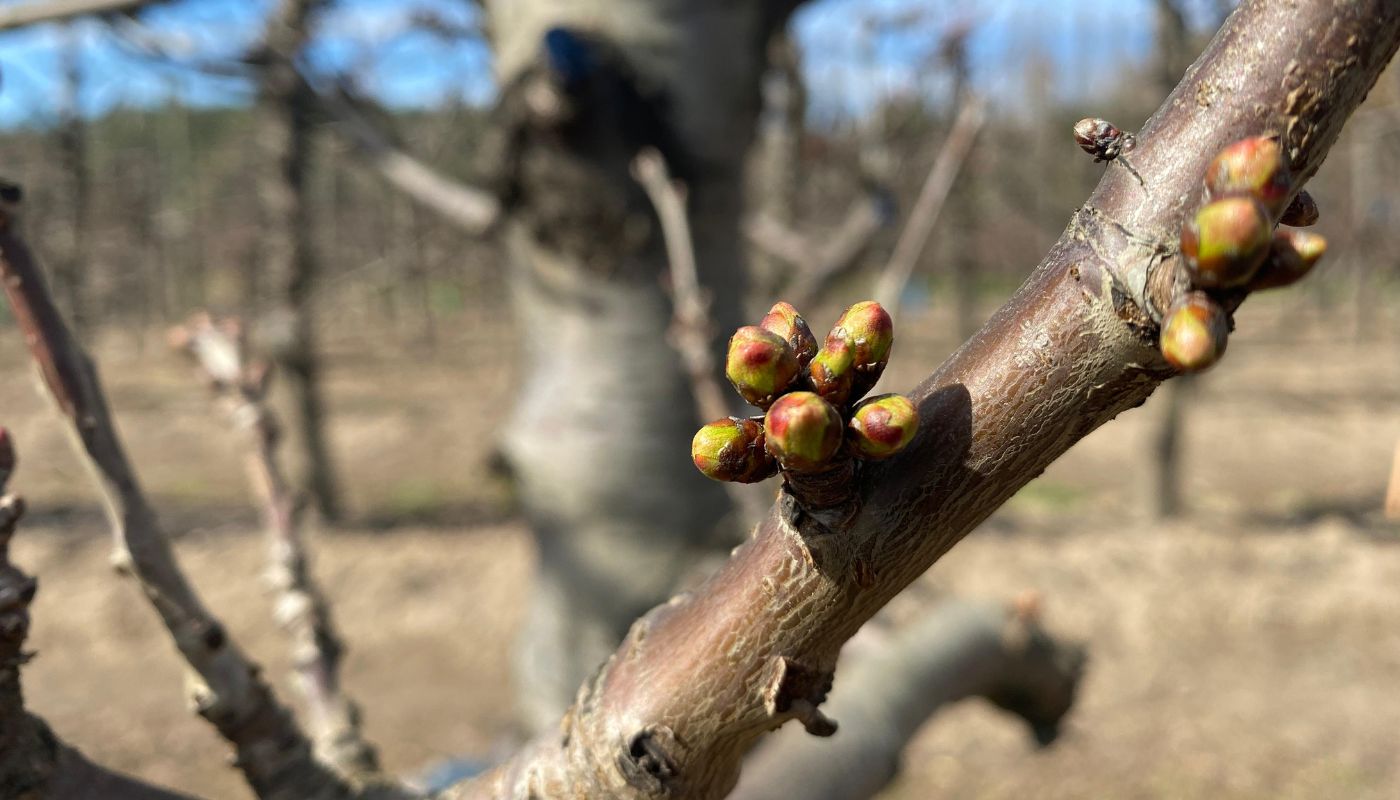
In cherry trees, fruit cores constitute the reproductive units of the tree, as they contain the floral primordia that will give rise to the fruit. Accurately counting these cores allows for an early estimate of the orchard’s productive capacity.
This early diagnosis is essential for strategically adjusting fruit load and planning pruning and thinning, which will directly impact fruit size, firmness, and uniformity—critical factors for crop profitability.
How is the count performed?
The procedure consists of counting the number of one-year-old shoots and twigs (fruit centers) present in a representative sample of trees within the plot. The number of trees to be evaluated is determined based on the homogeneity of the sector. This information, along with bud fertility analysis (average number of flowers per shoot and twig), allows for an estimate of the potential number of flowers per hectare.
The shoots represent the most important reproductive structure, but flower buds can also be found at the base of one-year-old twigs. Their fertility depends largely on the rootstock used, as well as the nutrient balance (carbon/nitrogen ratio). Generally, the most vigorous branches tend to be less fertile, while the smaller ones have a greater number of flower buds.
It is very important to consider the orchard’s fruit set percentage, which varies according to the variety/rootstock combination, climatic conditions, and management, among other factors. This percentage should be compiled for each production unit to obtain a history that will help reduce projection errors.
When is the ideal time to perform the count?
This analysis is typically performed during the dormant stage, in fall and early winter, when the reproductive structures can be easily identified.
Some producers prefer to count earlier to plan pruning in advance, while others wait until after climatic events such as frost to adjust the strategy based on the actual condition of the flower buds.
The timing and method of performing this analysis will depend on multiple factors. For example, in early-season areas, the counting and pruning work tend to begin earlier; Furthermore, orchard size could affect response capacity, with orchards regularly starting with varieties that “guarantee” better fruit set and those with lower fruit set later in winter. Heterogeneous sectors should be identified for differentiated pruning and/or bud thinning.
Practical Applications of Fruit Center Counting
With the data obtained, different pruning intensity levels can be established, with high pruning intensity resulting in a significant reduction in the number of fruit centers, useful for adjusting the crop load in overburdened orchards and/or those with high fruit set. Medium or low intensities can also be found, depending on the projected fertility and overall condition of the orchard.
Additionally, in trees with low vigor, counting can guide practices such as bud thinning to avoid overburdening and improve final size, ensuring better resource distribution and greater expression of productive potential in spring.
Integrating this practice into the crop calendar represents a key step toward more sustainable and technically informed production. Proper execution of this work also improves production efficiency, ensures higher-quality fruit, and increases crop profitability, a key factor for this season.