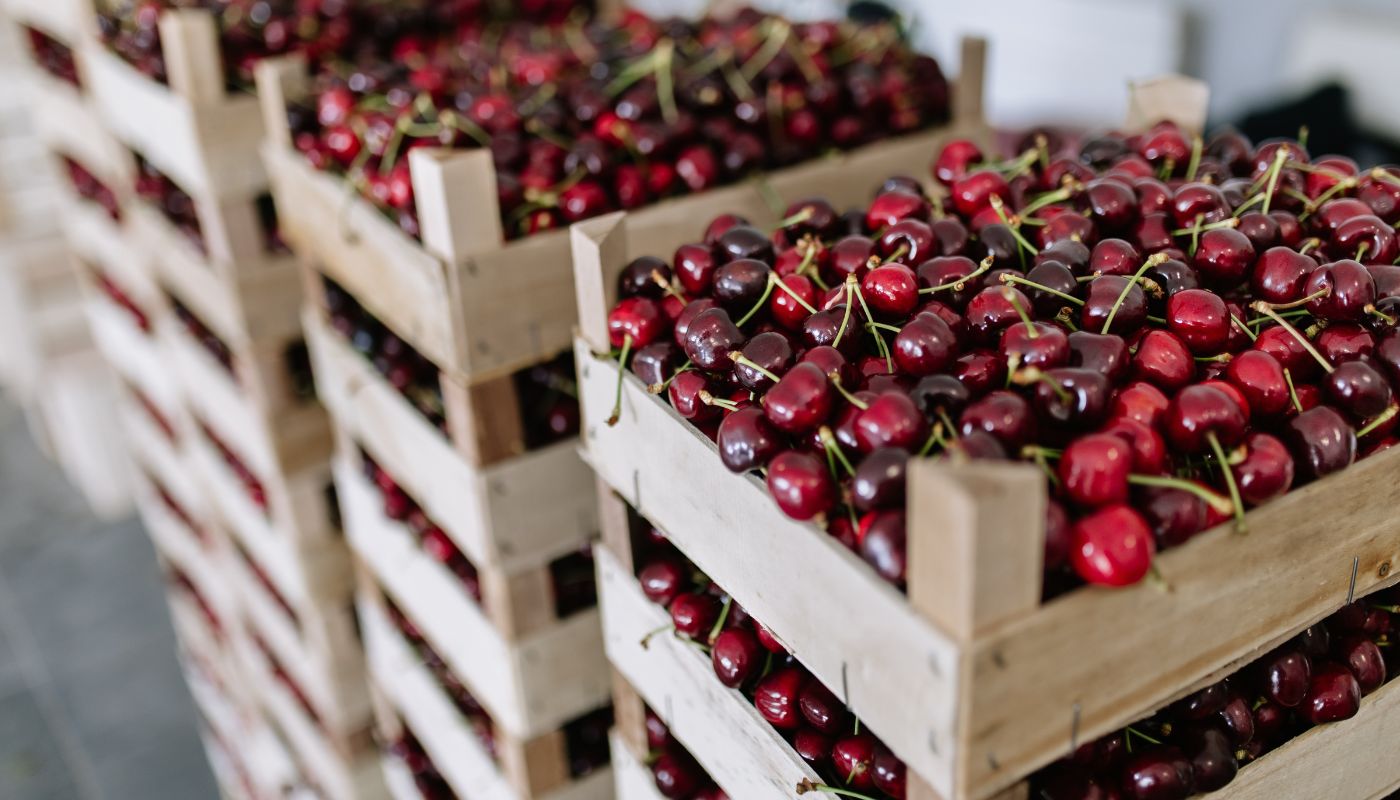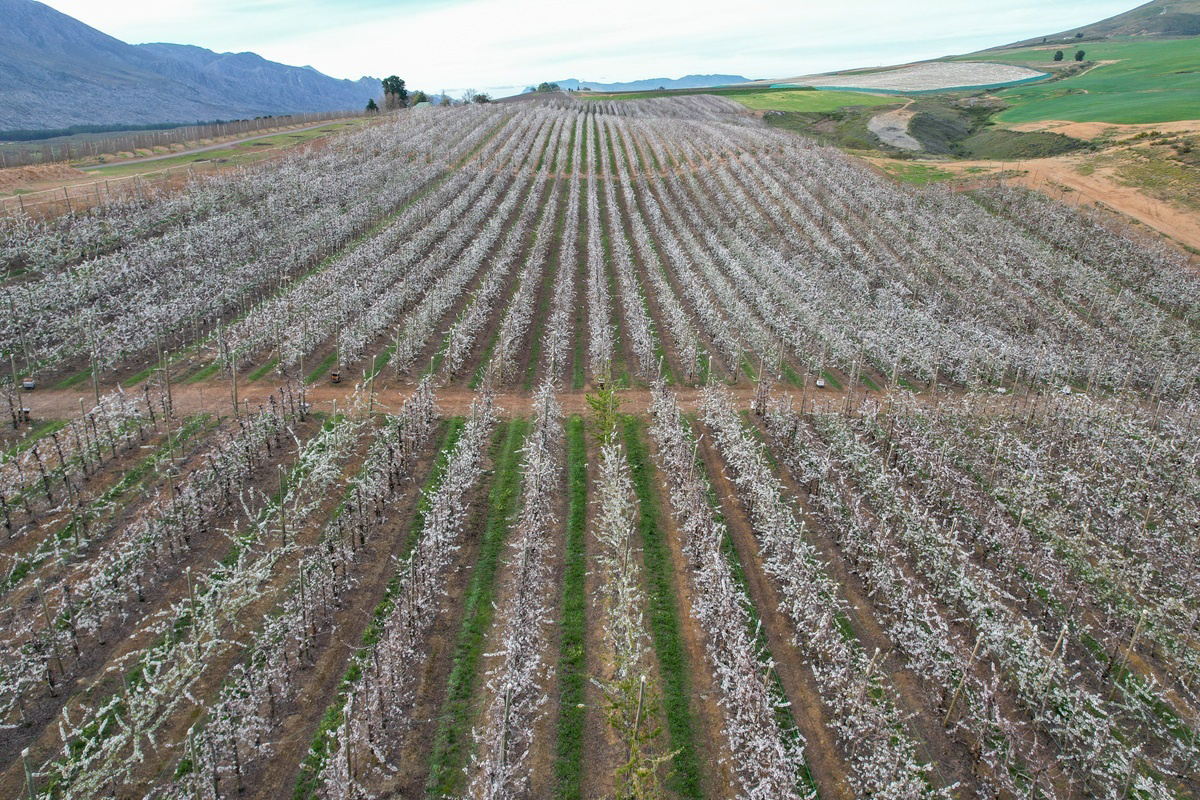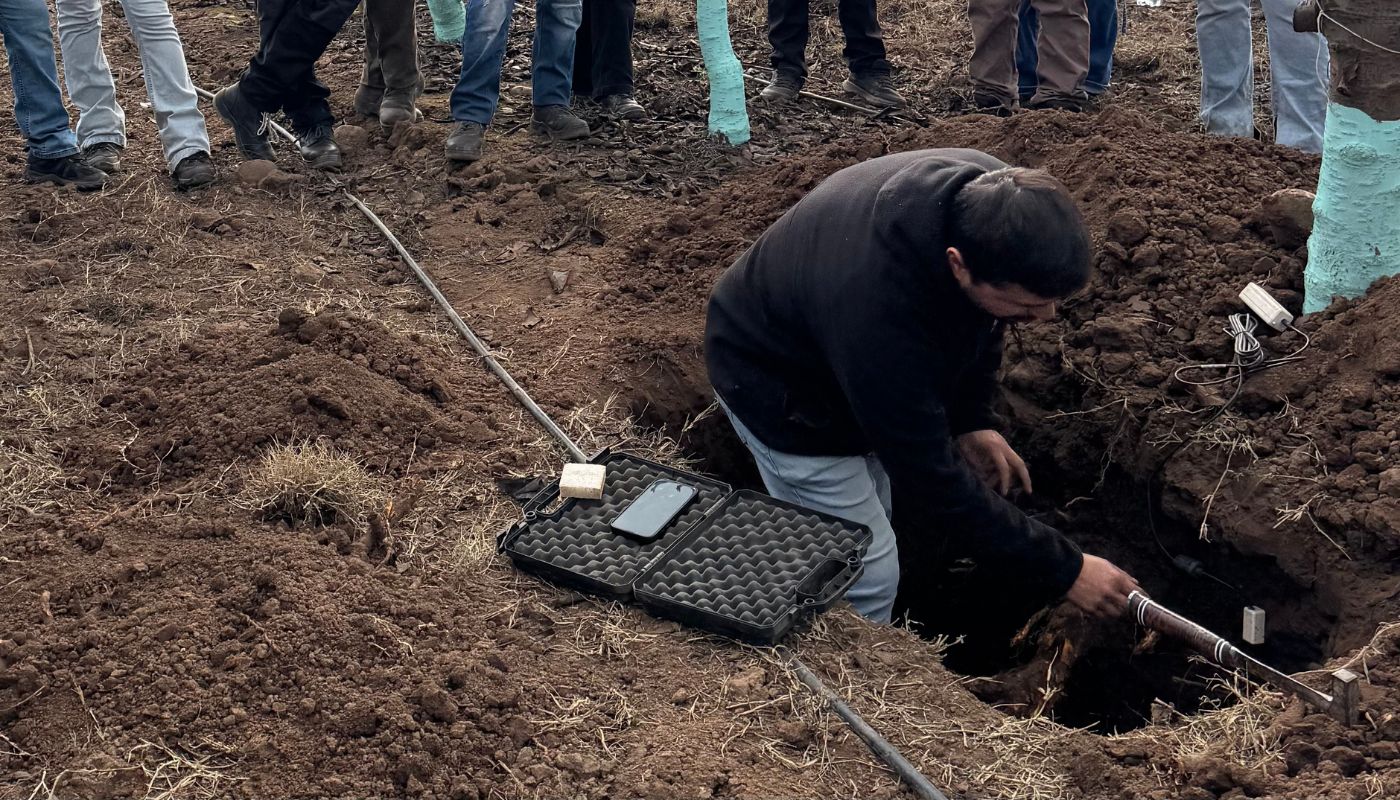

Every spring, the same question arises: the orchard has set fruit, and a decision must be made regarding how much to leave on the trees. In cherry production, overproduction is a greater concern than a lack of fruit (Kulczewski & Tapia, 2020). A tree that carries more fruit than its leaves can support will produce smaller cherries with lower sugar content and a higher rate of culls.
Crop load management is not a single task, but rather a sequence: pruning, bud thinning, blossom thinning, and fruit thinning. This article outlines the criteria used by the Avium technical team for adjusting crop load, incorporating guidelines from the technical committee of the Chilean Fruit Exporters Association’s (Frutas de Chile) Cherry Committee for the 2026–27 season. The core principle is simple: every tool has its optimal timing—the earlier the adjustment is made, the more effective it is and the easier it is to manage.
- Why manage crop load?
When bud analysis reveals more than 18 to 20 healthy floral primordia per fruiting site, the orchard is at risk of overloading (Kulczewski & Tapia, 2020). This overload negatively impacts fruit size and soluble solids (sugar content), though it has less effect on firmness. During the 2017 season—a year with high fruit set—an unthinned Lapins/MaxMa 14 orchard yielded cherries averaging 6.7 g and 15.9 °Brix, compared to 8.2 g and 17.7 °Brix in an orchard where thinning was performed; fruit firmness remained virtually the same in both cases.
The fundamental criterion is the leaf-to-fruit ratio. For cherries, an optimal ratio is considered to be 3 to 5 leaves per fruit—approximately 200 cm² of leaf area per cherry (Tapia, 2018, cited in Tapia & Tapia, 2025). Once fruit set has occurred in the orchard, the only way to improve this ratio is to remove some of the fruit.
- A progressive system: the sooner, the better
A trial conducted on ‘Lapins’ cherries grafted onto ‘MaxMa 14’ rootstock in Curicó compared various thinning tools, all applied with the same thinning intensity (Kulczewski & Tapia, 2020):
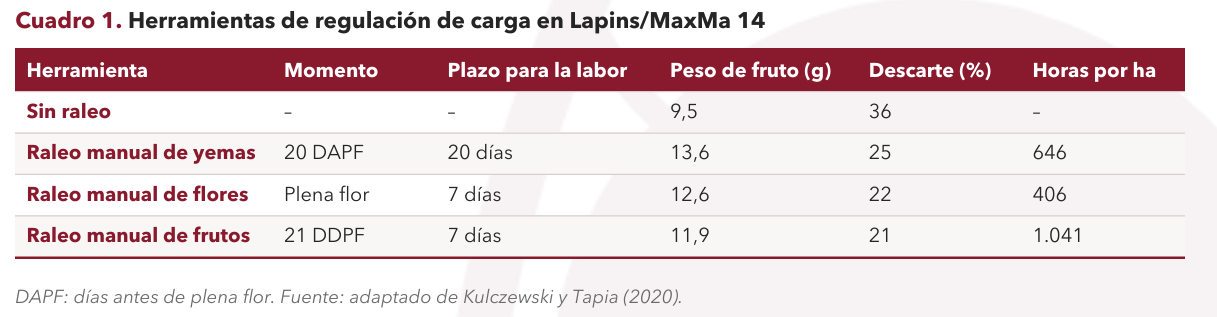
All the tools improved fruit size and reduced the proportion of rejected fruit. Bud thinning proved to be the most effective method; it offers a window of about four weeks and provides the most objective basis for determining thinning intensity. In contrast, blossom thinning and fruit thinning must be completed within a period of no more than 7 days, with fruit thinning requiring the greatest number of labor hours.
For this reason, a progressive thinning approach is recommended:
- More intensive pruning, guided by bud analysis.
- Bud thinning in orchards with high fruit set.
- Blossom thinning in cases where flowering is excessively dense.
- Fruit thinning, used only to correct an unforeseen excess in fruit set.
Since fruit set is unpredictable and the risk of frost is a real possibility, adjustments are made at each stage based on the information available at that time.
3. The window for fruit thinning
When fruit thinning is necessary, the physiology of the fruit dictates the timing. Fruit set can be assessed between 15 and 20 days after full bloom (DAFB), while the hardening of the pit (stone) occurs between 20 and 25 DAFB. Cell division ends around 30 days after full bloom (DAFB); thinning after this point will not restore fruit size, although it may still improve °Brix levels and dry matter content (Tapia & Tapia, 2025).
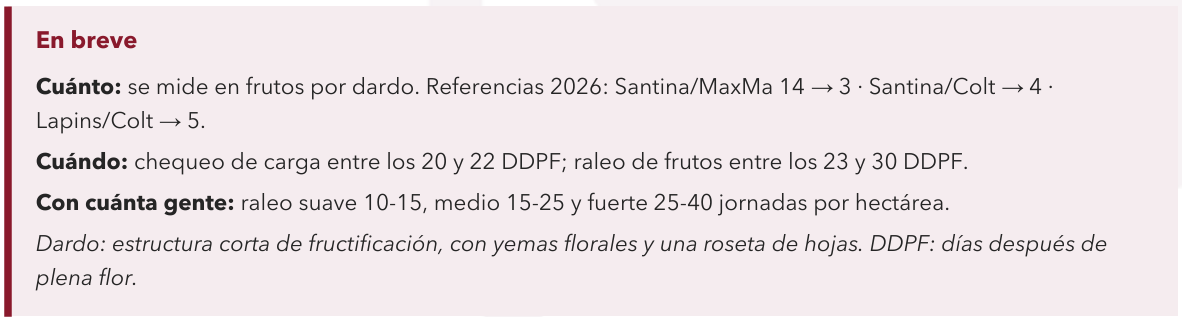
The Cherry Committee’s technical panel recommends assessing the crop load between 20 and 22 DAFB and performing thinning between 23 and 30 DAFB. Thinning earlier means intervening when the fruit has not yet reached its full size potential.
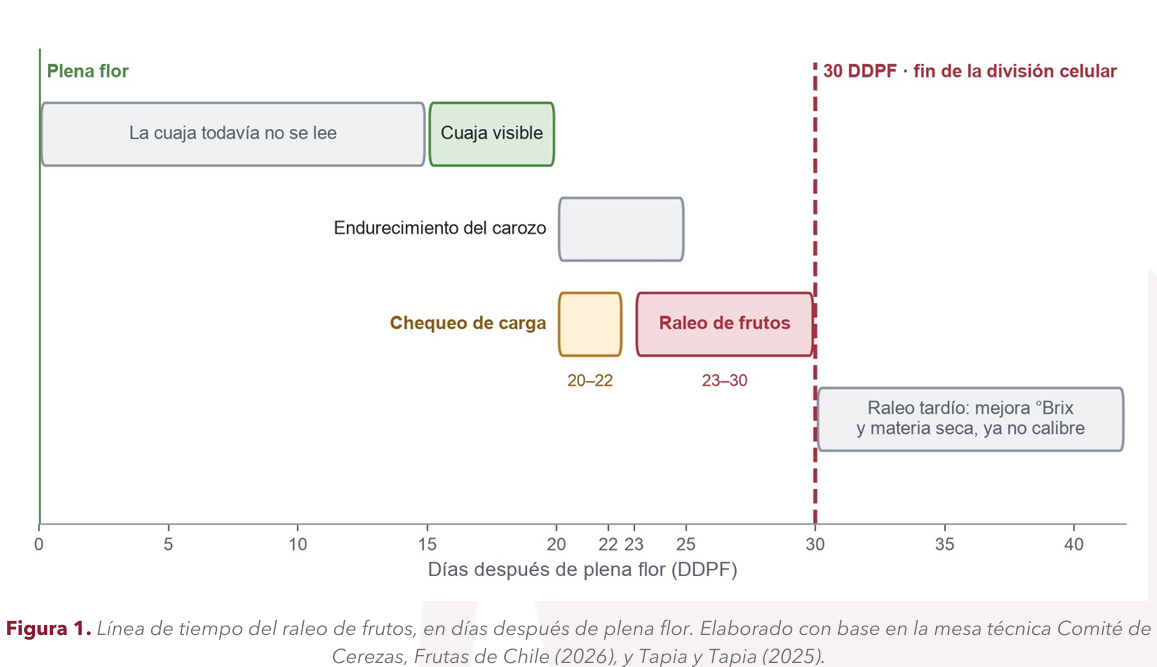
Since this timeframe is measured from full bloom, it is advisable to record that date for each orchard block and variety.
- Determining how much fruit to leave: counting by fruit-bearing spur
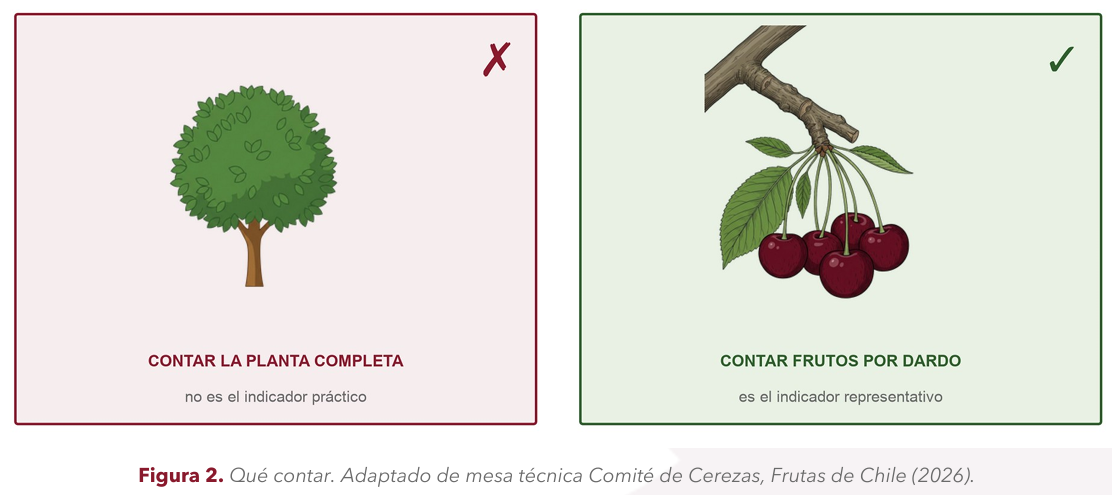
Counting the entire tree is impractical. A more representative metric is the number of fruits per spur, which can be counted quickly and compared against a reference value specific to the variety/rootstock combination.
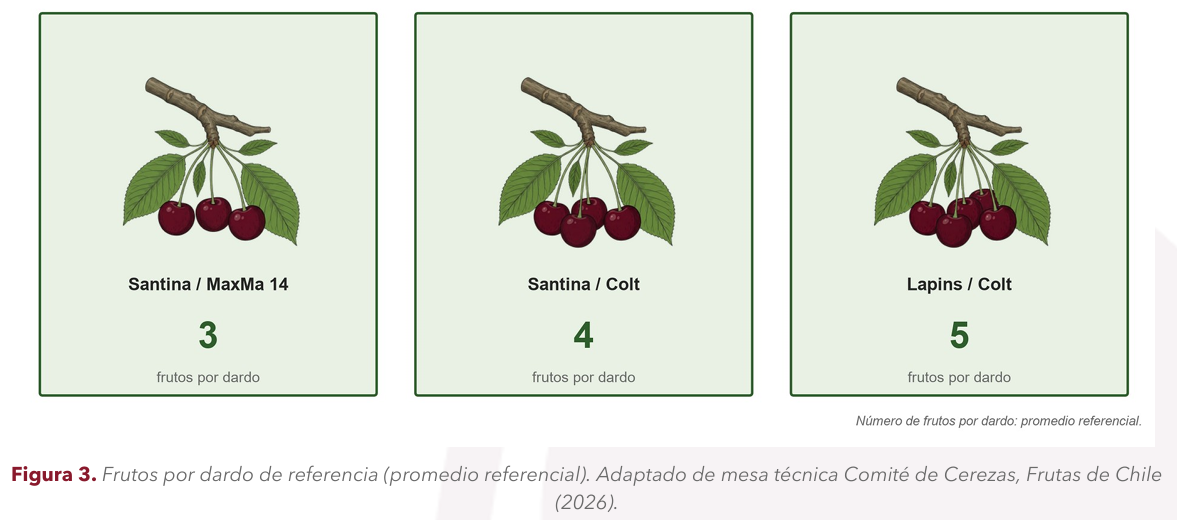
These reference values should be adjusted based on the specific orchard block: in cases of low vigor or damaged foliage, fewer fruits should be left per spur; where vigor is strong, a higher number may be appropriate.

5. Planning intensity and labor requirements
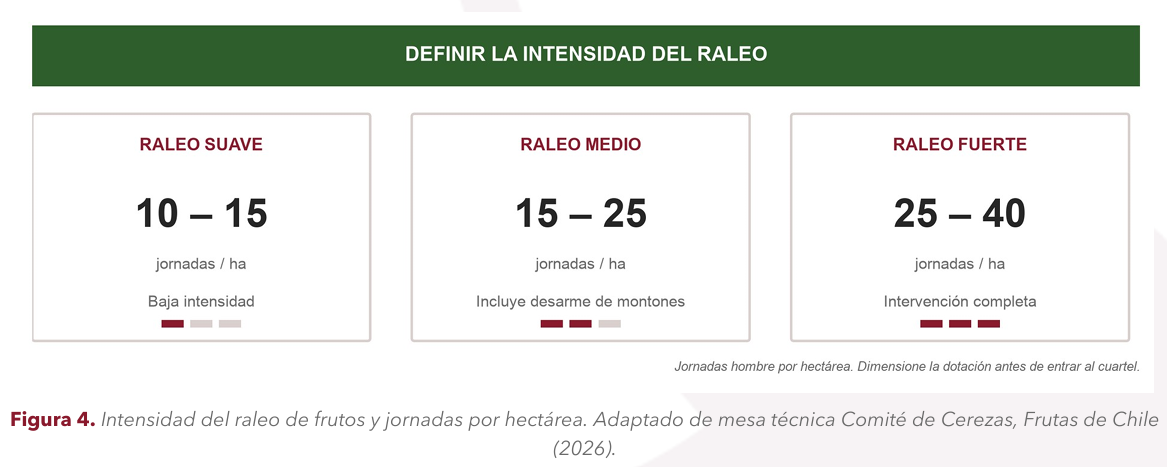
Given an 8-day window, the key factor is the number of workers per day—a figure that should be calculated before full bloom. For example, 20 hectares requiring moderate thinning will need between 300 and 500 man-days, which translates to 38–63 workers per day. If labor is limited, prioritize the blocks with the heaviest crop loads; it is better to perform a moderate thinning within the optimal window than an intensive thinning outside of it.
For trees that have not undergone prior crop-load management, fruit thinning can exceed 1,000 labor-hours per hectare (Table 1). The more the crop load has been managed through pruning and bud thinning, the less intensive the fruit-thinning process will be.
6. Before and after
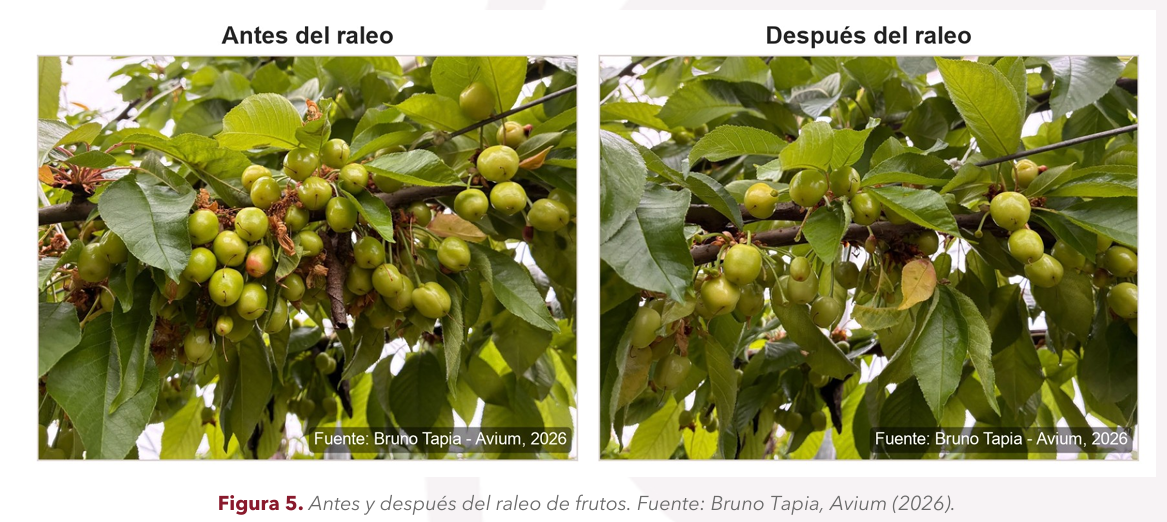
Effective thinning is characterized by three signs: tight clusters are broken up, the largest and best-positioned fruits are retained, and the fruit load is distributed evenly across the fruit-bearing spurs.
- Common mistakes
- Relying entirely on fruit thinning—the most expensive and time-sensitive method.
- Thinning based on a calendar schedule, without analyzing buds or counting fruits per spur.
- Starting the process before 23 days after full bloom (DAFB) or finishing after 30 DAFB.
- Calculating the target fruit load only after the thinning window has already opened.
- Using a single reference point for different fruit varieties and rootstocks.
8. Checklist


Documenting each step and comparing the results against the final harvest allows for the refinement of orchard-specific benchmarks for the following season—ensuring that each thinning tool is used at the optimal time.
References
– Kulczewski, M., & Tapia, C. (2020). Crop load regulation in cherries: a current perspective based on past research. Smartcherry, August 14, 2020. https://smartcherry.cl/planificacion-tareas/raleo-yemas/regulacion-de-carga-en-cerezos-mirada-actual-basada-en-investigacion-del-pasado/
– Technical Committee of the Cherry Committee, Frutas de Chile: J. Casas, W. Masman, P. Donoso, J. Puntí, C. Tapia, B. Mangelsdorff, & F. Borgoño (2026). Crop load adjustment: the right tool at the right time. Technical sheet; design, editing, and photography by Avium SpA.
– Tapia, C., & Tapia, B. (2025). Fruit thinning: a strategy to improve cherry size and quality. Smartcherry, October 3, 2025. https://smartcherry.cl/manejos-agronomicos/raleo-de-frutos/raleo-de-frutos-una-estrategia-para-mejorar-calibre-y-calidad-en-cerezos/
– Tapia, C. (2018). Optimal leaf-to-fruit ratio in cherries, adapted from Lang and Whiting. Cited in Tapia and Tapia (2025).