

According to the agronomist, monitoring, timely applications, and rotation of active ingredients are part of an effective strategy. She emphasized the importance of preventing resistance through the rotation of modes of action.
—Why is it important to control spider mite eggs during the winter? What impact does this strategy have on the season?
The importance of egg control lies in reducing the infestation that this population could generate, which triggers the initial spring infestation. As temperatures rise, the spider mite population grows exponentially. Therefore, winter control is a way to prevent a larger infestation during the period when we will have fruit and when spider mites are most difficult to control.
It is important to be sure that the pest is present before applying an egg treatment. The first step is to monitor and actually observe its presence. Preventative applications are not recommended; they are an unnecessary expense. It is essential to verify that the pest is indeed present.
– Which spider mite species currently pose the greatest challenge to cherry orchards in Chile?
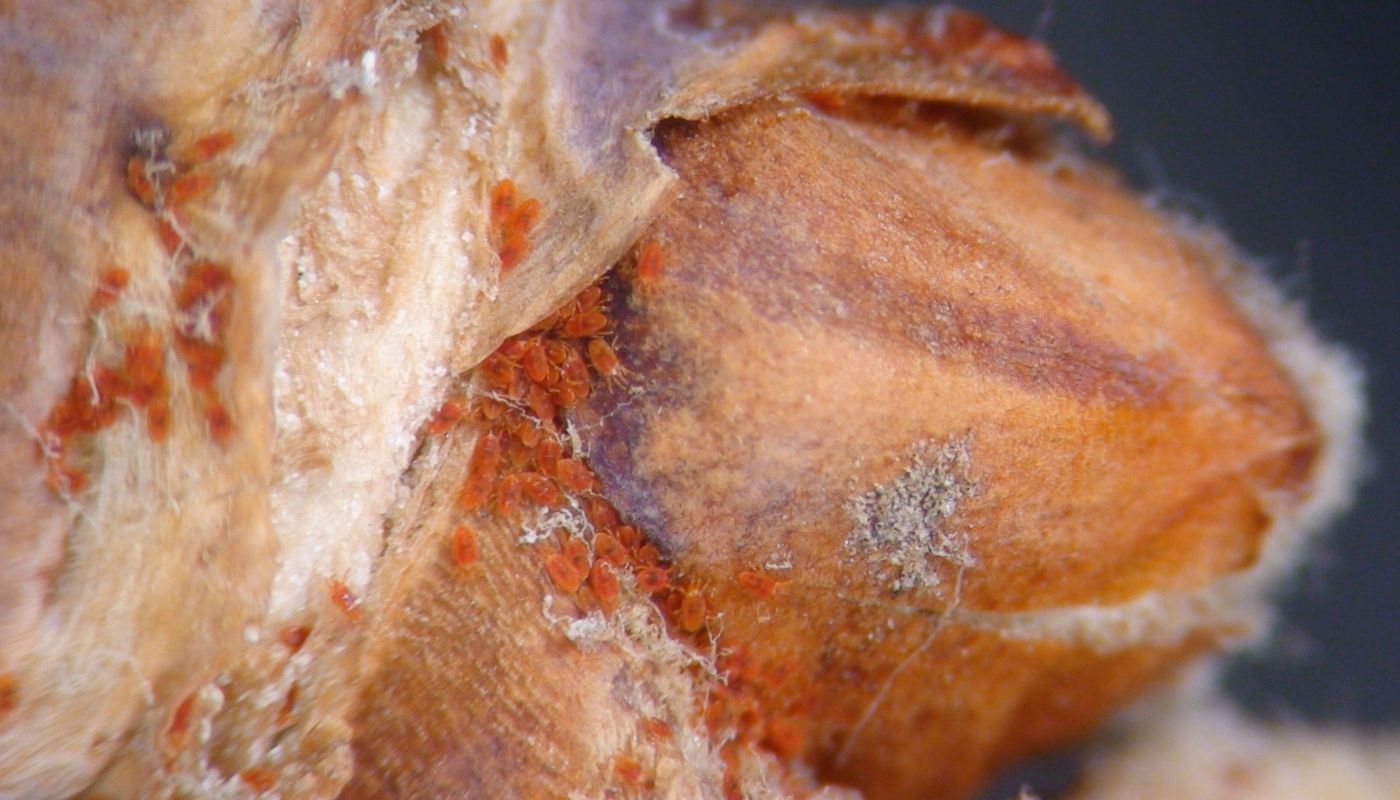
The most frequently found are Panonychus ulmi and Tetranychus urticae. However, last season Brevipalpus chilensis was detected. This species is native to Chile and is a quarantine pest for destination countries. Therefore, it is important to control it. It is much smaller, so monitoring for this pest must be very thorough, because sometimes they are so small that even with a magnifying glass, they are difficult to detect, especially the eggs. During this winter season, Brevipalpus chilensis can be found as a gravid female on the plant, located in wood cracks and/or at the base of buds. Panonychus ulmi, on the other hand, overwinters as an egg.
—What monitoring methodologies do you recommend to estimate the level of infestation and determine the need for control?
Since it is winter, pruning has already been done, there is no foliage, and no fruit. What can be done during this period is to focus on observing twigs, taking samples from different areas in each plot, obviously all labeled, and observing them under a magnifying glass, either field magnifiers or a stereoscopic microscope. The person in charge of monitoring must be able to recognize the pests. Otherwise, samples can be collected and sent to a laboratory for analysis.
Identifying pests is important. In the case of mites, during this period, you might find Panonychus ulmi eggs or Brevipalpus chilensis females, if present. This will tell you whether treatment is truly necessary. If they are only found in one area, there’s no need to treat the entire orchard. This reduces costs, so the key is to focus and only apply treatment when necessary and in the targeted area.
– What control alternatives currently exist for managing spider mite eggs, and which have shown the best results under field conditions?
In Chile, we have a wide range of acaricides with good control efficacy. The important thing is to follow the label instructions and the application timing.
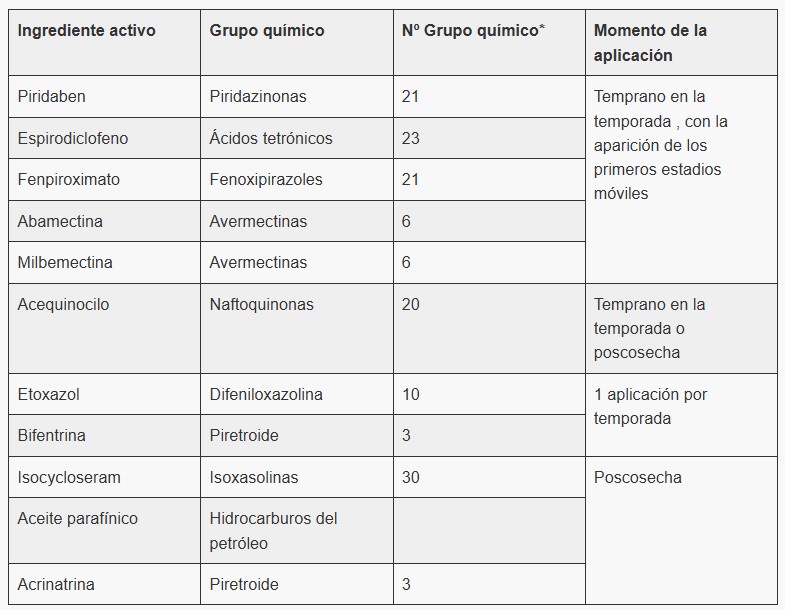
During this period, mineral oil can be applied to control spider mites, up until bud break. As mentioned previously, there is a wide range of acaricides that can be applied. Ideally, growers should rotate active ingredients and modes of action to avoid developing resistance.
Some alternatives are presented in the following table:
– Are there differences in management strategy based on the orchard’s history or the level of pest pressure?
Absolutely, it is very important to have a history of monitoring. If I know that I have spider mite outbreaks or their presence every year, it is crucial that monitoring be systematic and carried out by a trained person. The information generated should allow for informed decisions, such as whether chemical control is truly necessary.
It may happen that there is a very small infestation, and only that area is controlled. Spider mites are carried by the wind. So, if I have a small outbreak, I apply the treatment to that area to prevent its spread by wind to other parts of the orchard. The ideal is to control it initially.
Another factor that is tremendously important for successful pest control is related to machinery calibration. This is also part of the orchard management strategy, because you can apply the best product, but if the application quality is inadequate, it ultimately results in a waste of resources.
Control success depends 50% on the product itself and 50% on the quality of the application. This relates to the correct calibration of the machinery, which includes using the appropriate nozzles, the correct dosage, the forward speed of the tractor being used for application, and verifying wetting and coverage.
– How is egg control integrated into an integrated pest management (IPM) program?
Integrated pest management begins with monitoring; it’s the foundation of pest management. Monitoring generates information, which is analyzed and allows for informed decision-making. This is the basis of integrated management. The important thing is that the information generated doesn’t just remain on paper, but rather enables proactive decision-making. The other important thing is that it’s done at the right time. For example, now is a good time to take a branchlet sample for cherry trees. This will continue to be the case with different pests and the different phenological stages of the cherry tree. Later, during flowering, we might see a greater presence of thrips, or during bud break, aphids, and so on; each pest has its ideal time. In the case of spider mites, it’s during the winter.
Finally, it’s important to note that after applying a treatment, you must verify its effectiveness. You should monitor again a few days later to see if any dead mites are observed.
– Is there a risk of developing resistance when control strategies aren’t properly planned?
Of course, repeated applications of the same active ingredient can lead to resistance. That’s why we recommend applying different active ingredients with different modes of action.
The idea is to rotate different modes of action. And all of this can be verified on the modes of action page, available at: https://irac-online.org/mode-of-action/
– From your experience at Biocea, what advances or results have you observed in spider mite egg management that you could perhaps share with us?
For us, the best way to control spider mites is through oil applications during this period. One or two applications during the winter, all before bud break, are sufficient. That’s the best approach; oil applications not only control spider mites but also scale insects. Furthermore, there are several products that serve a dual purpose; the important thing is to read the label information.
– What recommendations would you give today to growers who are planning their crops?
To summarize, monitoring is essential during this period; that’s the number one recommendation. You need to take twigs from different areas, label them all, and examine them under a magnifying glass for eggs and adult mites. If necessary, send samples for analysis to determine which mite is present. Based on the monitoring data, schedule treatments. Oil applications work very well in winter. So I would say that oil applications are sufficient. Perhaps after bud break, we can use acaricides, but during this period, oil is sufficient. This will reduce the spider mite infestation.