
When to start irrigating? How much to irrigate? And how often to irrigate? These are the most frequently asked questions at the beginning of each irrigation season. The first is primarily determined by the last rainfall event along with the soil’s moisture retention capacity.
Moisture retention capacity plays an important role in the start of the irrigation season, as late rainfall in soils with a higher moisture retention capacity can significantly delay the first irrigations, along with the onset of plant sprouting. In combination with infiltration problems and constant saturation, it can also affect production and increase the incidence of plant diseases and mortality.
In practice, it has been observed that areas with soils that have a greater moisture retention capacity and that, for climatic or physical reasons, begin the season with levels close to saturation are directly related to sectors that present greater delays and/or heterogeneity in plant phenology.
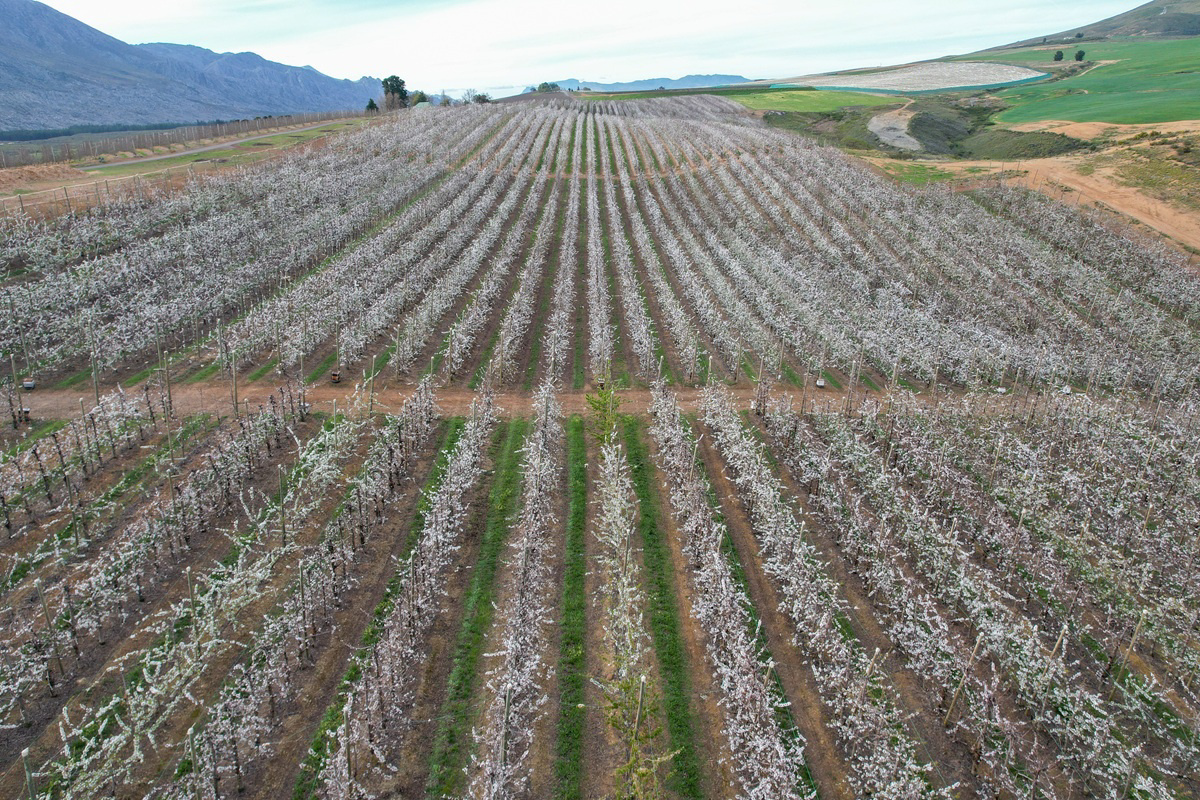
This can be identified in sectors with significant elevation differences (lower zones), and in most cases, this effect is even reflected in the plant’s vegetative growth throughout the season, these areas being identifiable through remote sensing tools.

When to start watering?
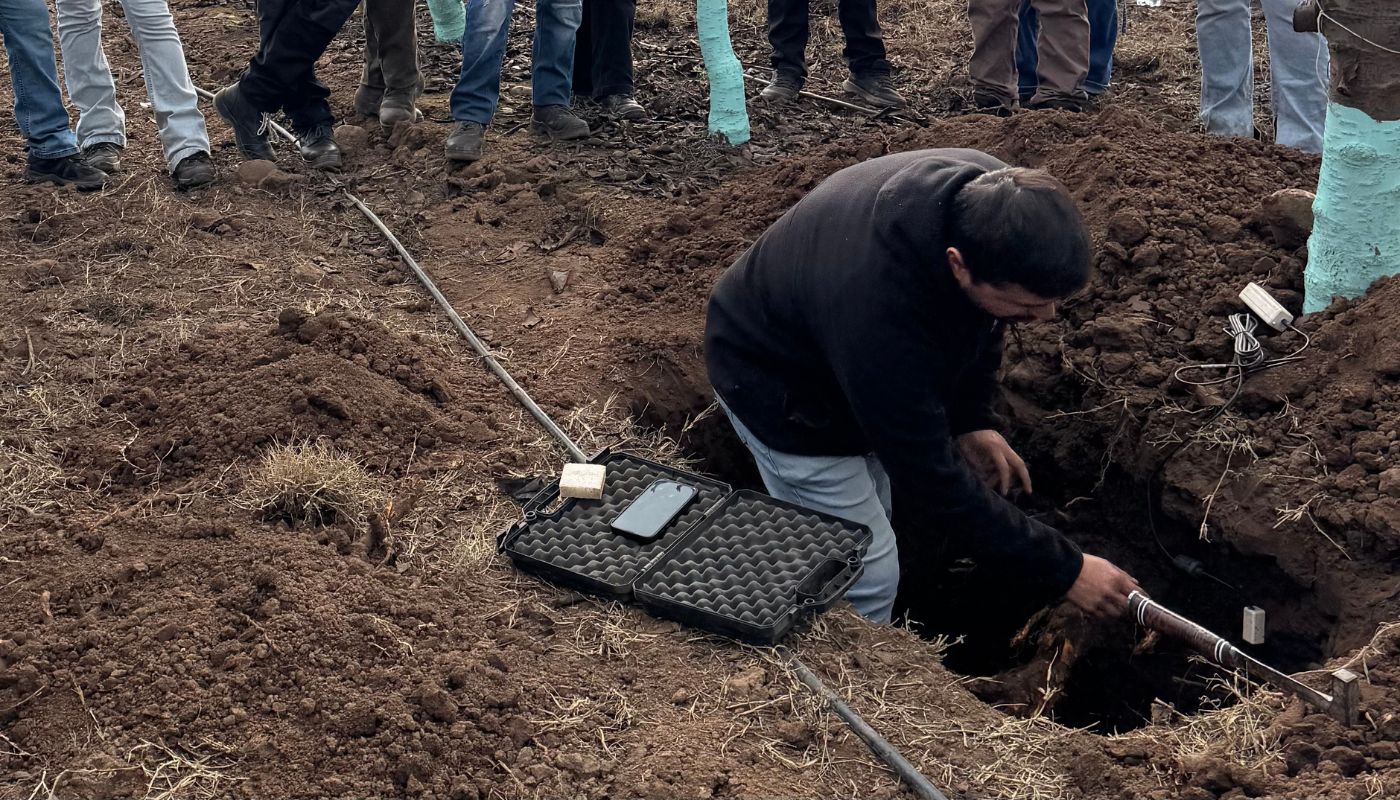
Before deciding when to begin watering, the soil should be monitored, either through test pits and/or sensors, to identify the moisture level and its distribution across the different horizons of the effective root depth. The beginning of the first flush of root growth occurs in soil temperatures close to or above 15°C, which can be affected by early irrigation. The physical properties of water and the plant’s limited water demand result in a decrease in soil temperature.
Other considerations to keep in mind for cherry trees when deciding when to begin the irrigation season include the variety/rootstock combination, the age of the orchard, and the use of mulches.
The timing of the first leaves beginning to unfold depends on the variety and rootstock, and how early/late the irrigation process can be, as well as the irrigation criteria to be used. On the other hand, starting the season in a productive orchard is not the same as starting it in one under development, since, ultimately, the leaf area and the plant’s capacity to transpire are very different. Finally, under cover, phenology is seen earlier; plant transpiration and soil evaporation are different.
The rootstock plays a key role in this decision, as it determines root distribution and water requirements. For example, the Colt, Gisela 6, and MaxMa 14 rootstocks: Colt has deep roots with extensive exploration and no growth problems in soils with moderate moisture levels; Gisela 6 tends to generate roots distributed mainly in the first horizons, tolerating moderate moisture; and MaxMa 14, despite its general root distribution tending to be “middle ground,” does not tolerate soils with higher moisture content well.
Therefore, determining when to begin watering is crucial because it requires continuous monitoring of soil moisture levels and a clear understanding of the irrigation criteria to be used, since all the other factors mentioned above will be directly reflected in what we observe underground.

How much to irrigate?
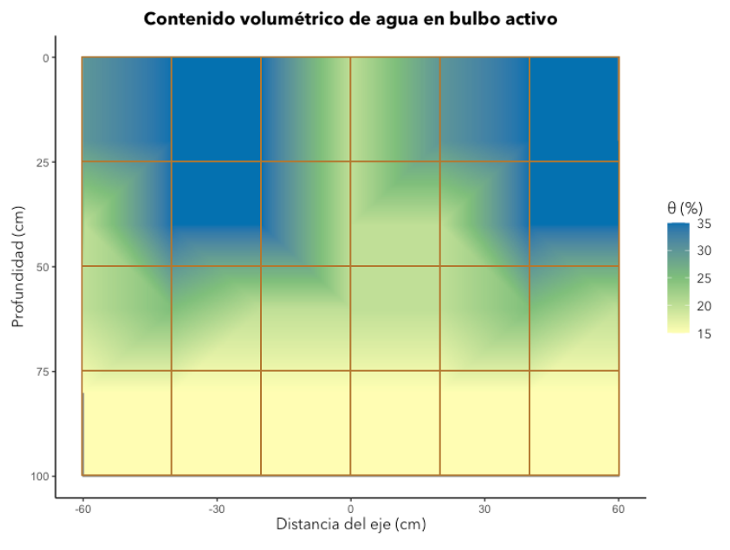
In simple terms, this directly depends on how the roots are distributed in the soil (wet bulb) and how long it takes to reach field capacity with the most even distribution possible over that wet bulb.
Irrigation time depends on the target wet bulb, which has dimensions and physical properties that allow us to estimate the volume of water, i.e., the “tank capacity.” This volume should be interpreted in units of measurement (mm), in order to match it with the effective rainfall of the irrigation system (mm/h).
In this way we can approximately determine the irrigation time (h), which must subsequently be evaluated using test pits and can be described numerically and graphically with the use of sensors (figure 1).
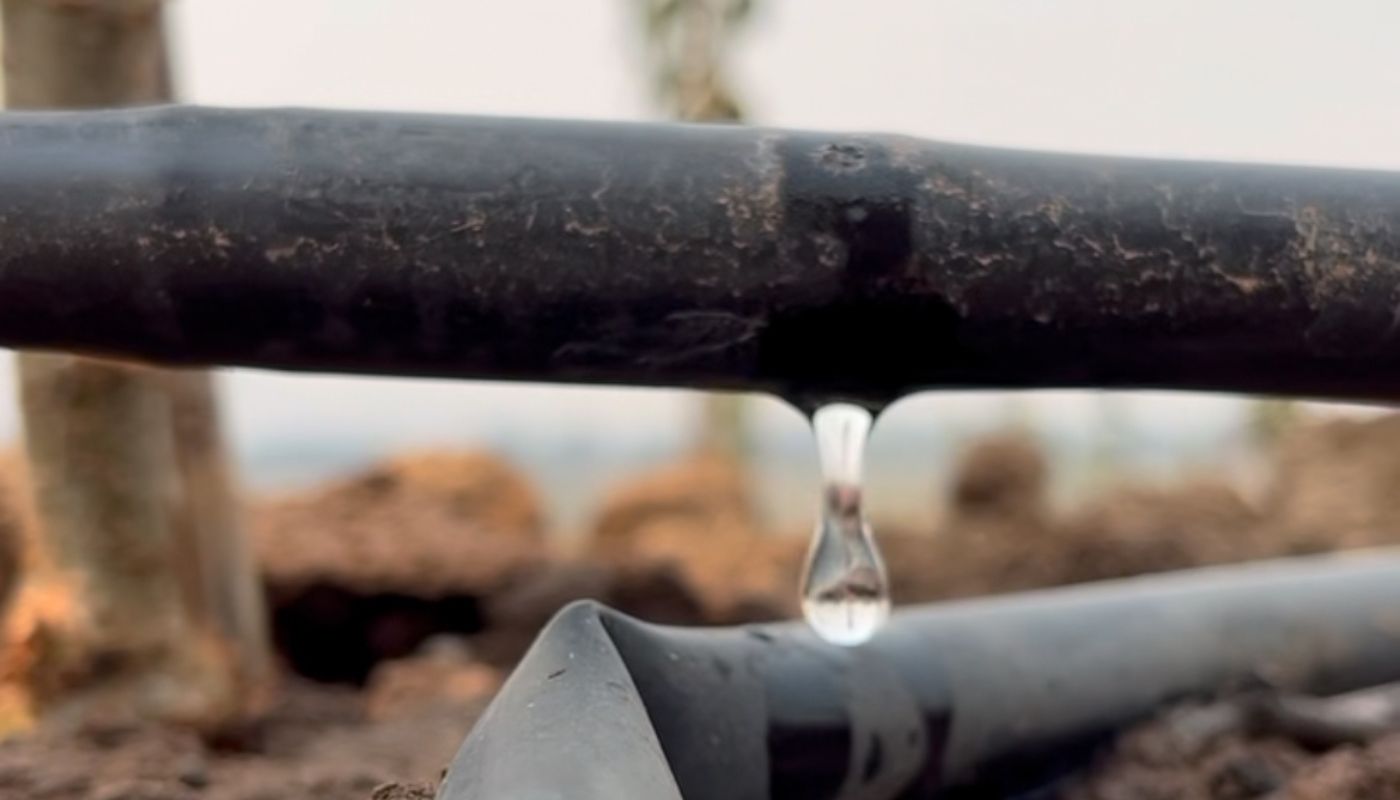
To do this, we must be aware of the equipment’s precipitation (data provided by the manufacturer). It is also very important to constantly update this information with the actual precipitation of the equipment, based on the precipitation from the emitters (gauging) and their respective uniformity (uniformity coefficient).
How often should we irrigate?
To answer the last question, it is important to know the atmospheric demand (ETo), the crop demand (Kc), the soil pond capacity (mm), the irrigation criteria (%), and the efficiency and uniformity of the irrigation system.
In this way, the “from” of the strategy is achieved by performing a water balance based on the reference evapotranspiration (ETo).
Gross crop demand:
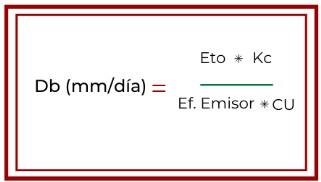
Where,
Eto: Reference evaporation (mm/day)
Kc: Crop coefficient.
Emitter Efficiency: Typically, an efficiency of 90% is used for drip irrigation and 75% for micro-sprinklers (%/100).
CU: Uniformity coefficient (%/100)
It is important to emphasize that Kc is a reference, and coefficients must be developed for each specific case.
Once the irrigation regime is in place for the season, it is important to correctly determine the water demand for fine-tuning each strategy, appropriately adjusting the frequency based on atmospheric demand, soil conditions, and key moments of plant phenology in line with production objectives.
In an irrigation regime, the use of test pits is essential for successful and efficient scheduling. This doesn’t mean that new technologies are being overlooked; on the contrary, they allow us to eliminate the subjective nature of touch, which is generally the domain of experience of a few and extremely difficult to convey from person to person.
The most commonly used types of soil moisture sensors currently are FDR (Frequency Domain Reflectometry) and TDR (Time Domain Reflectometry), which allow for estimating the volumetric water content in the soil by calculating the dielectric constant and various calibration models, generally included by the manufacturer.
These sensors are available in portable formats, as well as in typical fixed probes at different depths. These sensors project an electromagnetic field corresponding to a soil volume. This allows for direct estimation of the proportion of water volume to soil volume, i.e., volumetric content (%).
While sensors allow us to evaluate irrigation timing, their main application during the season is to evaluate frequencies. This allows crop coefficients previously defined in a water balance (Kc) to be adjusted and sensor-adjusted coefficients (Ks) to be recalculated throughout the season.
This allows for historical data collection and objective, numerically-based decisions to be made.