
Just as in medical jargon, orthopedics aims to correct certain postures by rehabilitating parts of the body, in fruit trees like cherry trees this task aims to achieve a homogeneous orchard and increase its productive potential.
In agronomic terms, it involves modifying the angle or position of the tree’s natural branches, with the goal of improving light capture to induce earlier and more abundant fruiting.
This induction is due to the acrotonous characteristics of cherry trees (with strong budding at the tip), as they naturally take many years to produce, and when left in a vertical position, often with certain rootstock combinations, they tend to be more vegetative. However, when planted horizontally, they can develop better.
According to technical advisor and cherry specialist Walter Masman, orthopedics in cherry trees seeks to position and balance fruit structures to optimize light interception and control branch vigor, promoting more balanced production, which translates into greater fruit yields and a long-term sustainable structure.
“Orthopedics has two main objectives: positioning fruit structures within the space defined by the tree’s training system and achieving balance among these structures. Positioning ensures optimal light interception for photosynthesis, while balance refers to controlling the vigor of daughter branches so they do not outgrow the parent branch, which is crucial for the tree’s productive sustainability”, he explained.
Why apply orthopedics?
The importance of this task lies in that it helps to “tame” excessive branch vigor and break apical dominance, allowing a vigorous branch to “fruit” or “bear” in a more balanced manner and be productive in the long term.
An orchard that doesn’t implement orthopedics can suffer significant production losses, so this task is essential to boosting productivity, which will later translate into a higher fruit yield.
Orthopedic Techniques and Systems
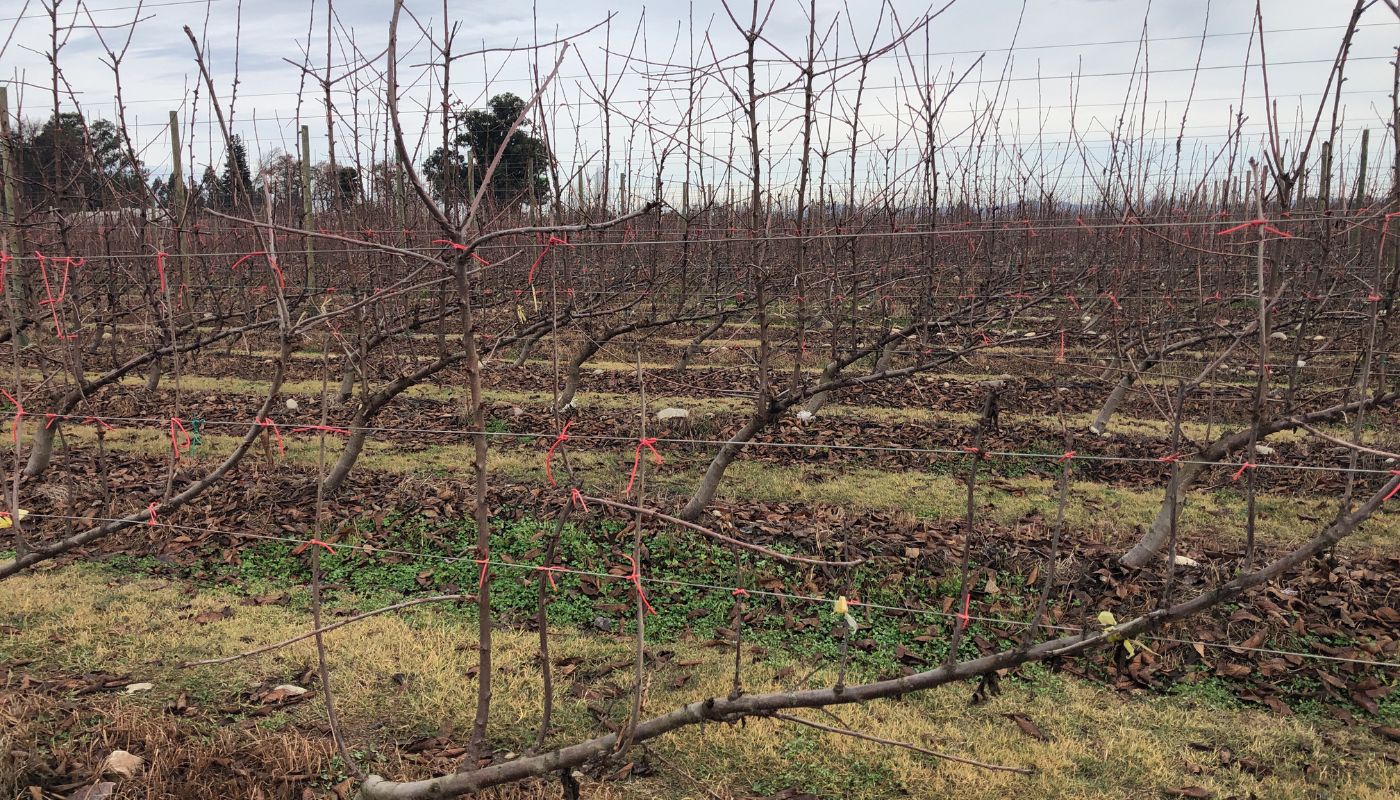
For Jordi Casas, advisor and consultant for deciduous fruit trees, orthopedics is done by tying branches to wires, stakes, or the tree itself, positioning them to cover spaces and optimize light capture.
Based on the above, he mentioned different training systems, such as the axis, where branches are spread out with ties, and V-shaped systems (vitrelis), which use wire or twine to position branches. He clarified that the horizontal position of branches in cherry trees promotes straightening, and orthopedics achieves precisely that effect.
When to Apply Orthopedics
When performing this task, the varieties being grown should be reviewed, as well as the rootstock and training system chosen. However, it is generally applied primarily during orchard formation, which can be from February to May, or after pruning in productive orchards, which is between July and August and always before flowering, as these need to position branches for renewal.
There are certain training systems, such as KGB, that do not require orthopedics, while varieties like Santina in Colt do require it to regulate vigor and maintain the renewal and sustainability of the orchard. There are also varieties with more drooping growth habits (“asusados”) that may require less orthopedics, as they self-align due to this shape.
Regarding frequency, Jordi Casas stated that “initial orthopedics is most intensive during the first two years of branching; subsequently, it is performed to a lesser extent on new branches for their renewal, and to reposition branches on older trees, especially to increase fruit-bearing wood in defensible positions within the row”.