
Smartcherry spoke with the agronomist, Master in Management Control, and fruit consultant about this management practice. He redefined the traditional concept, describing it as the optimal time to ensure that nutrients like calcium are concentrated in the flower bud and not diverted to unbalanced vegetative growth.
What is the main objective of summer pruning, and how does it influence cherry size and quality? The specialist explained this and much more in the following interview.
– What is the main objective of summer pruning in cherry orchards?
The first step is to understand some principles of cherry tree physiology. There are two main types of pruning that we perform at the orchard level. The first type of pruning is commonly called winter pruning, which is more production-oriented. There’s also summer pruning, which is light pruning. These are the more traditional terms used. From this perspective, there are two main effects. Summer pruning primarily limits the expression of vigor, while winter pruning promotes it. Now, when we talk about pruning, I think it’s much more appropriate to speak of vegetative balance pruning rather than light pruning or simply green pruning, because Chile has very high levels of solar radiation and intense sunlight. So, when we say “light pruning,” one might think it’s solely based on light. However, it’s a very important type of pruning from the perspective of carbon reserve balance. Therefore, when we talk about pruning at this time of year, I prefer to refer to it as vegetative balance pruning.
Summer pruning aims to balance the plant and prepare it with a good balance of reserves so it can process them during the winter. If I have a weak but well-lit or well-balanced orchard, can I skip summer pruning? It’s likely it doesn’t need it, and that’s very relevant in today’s context of prioritizing the essential tasks we need to perform. Summer pruning, or vegetative balance pruning, is primarily carried out in orchards that require this balance. Now, from the perspective of what type of material to remove or prune, it’s precisely that material that is causing the imbalance. For example, suckers, excessively vigorous shoots, very strong, poorly positioned growth that creates shade, and very vigorous branches or lateral shoots that are extracting nutrients rather than contributing fruit or balance.
In winter pruning, we categorize branches. That is, after observing different situations and segmenting productive branches, we typically find three types of productive branches and assign them a grade: category 1, category 2, and category 3. Category 3 is the weakest, and category 1 represents the most vigorous productive branches. Our ultimate goal is to maintain strong category 2 branches, and these are the ones where we primarily intervene in winter. We try to invigorate the less vigorous category 3 branches with winter pruning. And the thicker category 1 branches tend to produce more suckers. These unbalanced vegetative growths are what we intervene on most during this time. Therefore, it’s important to understand and explain this to the pruner or the pruning team, and we must try to be as simple as possible in the explanation without losing sight of the physiological context. The pruner must be familiar with concepts like twigs and suckers, and understand the type of branch they are pruning. In summary, the goal is vegetative balance, and this balance will lead to efficient use and the building of reserves within the plant. It’s important to understand that the cherry tree, as a species, is highly acrotonic. Therefore, with this acrotonic expression—its growth directed upwards—the cherry tree aims to reach a great height so that birds will come, eat its fruit, and disperse its seeds. This creates competition, and we must try to maintain these regulatory balances. So, what do we do? Essentially, we strive for that balance.
– In what cases is summer pruning recommended?
Primarily in orchards that tend towards vigor and in rootstocks that also tend towards vigor. The Col rootstock is a high-vigor rootstock, and when mixed with Santina, for example, these orchards typically require more intervention to stimulate growth and ensure nutritional balance in the flower buds. Not all plants, orchards, or even all plots are vigorous or require summer pruning. This is something we must pay close attention to, especially now in the challenging context of segregating plots. Within each plot, we are separating plants that do require pruning from those that don’t, or that are weaker. We can prune those that don’t, or that are weaker, as a last resort during winter pruning, but we shouldn’t do widespread pruning. I don’t recommend summer pruning in orchards that already have weaknesses or are well-sunlit. And yes, it is required in orchards that exhibit very strong vigor and imbalances that negatively impact nutrition and flower bud formation. There are Gisela rootstocks, for example, that have a tendency, from another perspective, such as phytosanitary ones. Some orchards have expressions of bacteria and wood-decay fungi that, clearly, at this time of year, tend to be much more amenable to pruning, such as limiting contamination by bacterial canker or other diseases. There are some cases where we can also recommend pruning in summer and under drier environmental conditions, and there are other cases where it is much better to do it now and leave the pruning for winter to invigorate the tree.
– In your opinion, what is the real impact of summer pruning, considering the upcoming fruit production?
The process of floral induction and differentiation is very important in cherry trees; understanding the timing, how they relate to each other, and how they are structured is crucial. If we talk about critical induction periods in November and December, this is highly variable, especially depending on the region. We’ve noticed that the differentiation period is shifting further and further towards February and January. It’s crucial at this time to maintain a good balance and optimal lighting conditions. If we perform a proper vegetative pruning during the summer, we’ll clearly direct the plant’s nutrition away from the vigorous vegetative growth and towards the development of the spur and flower bud. Therefore, the fruit for the next season will be nutritionally much healthier, with nutrients focused more on the flower bud and spur than on the rapidly growing vegetative shoots. Summer pruning is therefore one of the most important tasks. A plant with a good nutritional balance will start the following spring in excellent condition. We must build the fruit we’ll have next season now. If we don’t achieve a good balance, we leave the plant with tremendous vigor, continue fertilizing, and with little vegetative balance, much of the nutrition that is now being generated by the plant will be taken by these suckers, these unbalanced vegetative growths.

– Is it best to prune immediately after harvest or should we wait?
If the plant is absorbing nutrients now and has a very strong vegetative growth habit, it will always direct that nutrition towards the new growth. A classic element that has been important for us to study is calcium, precisely one of the most important elements for the cherry tree.
If I prune the orchard, for example, in December, that is, after the harvest, or in January, we have seen that the biggest problem arises from the regrowth generated by these prunings during the early months. We have a tendency to generate very high regrowth. This regrowth consumes the plant’s sugars, its reserves. Therefore, we try to get through this period of intense growth in December and January, with its high temperatures, before starting our pruning, mainly around February 15th or 20th. So, we are now starting the pruning season in earnest.
In some cases where we see very high levels of vigor, we can intervene earlier to avoid disrupting the floral differentiation process. In some instances, we can intervene earlier, but as a general rule, we try to start pruning after January, primarily around February 15th. If you start too early, you’ll have the greatest risk of generating new shoots, and to form those new shoots, the plant consumes reserves that could have been used for flower bud formation and fruit development for the following year. Therefore, the timing of pruning is crucial, and this is related to the type of cut made.
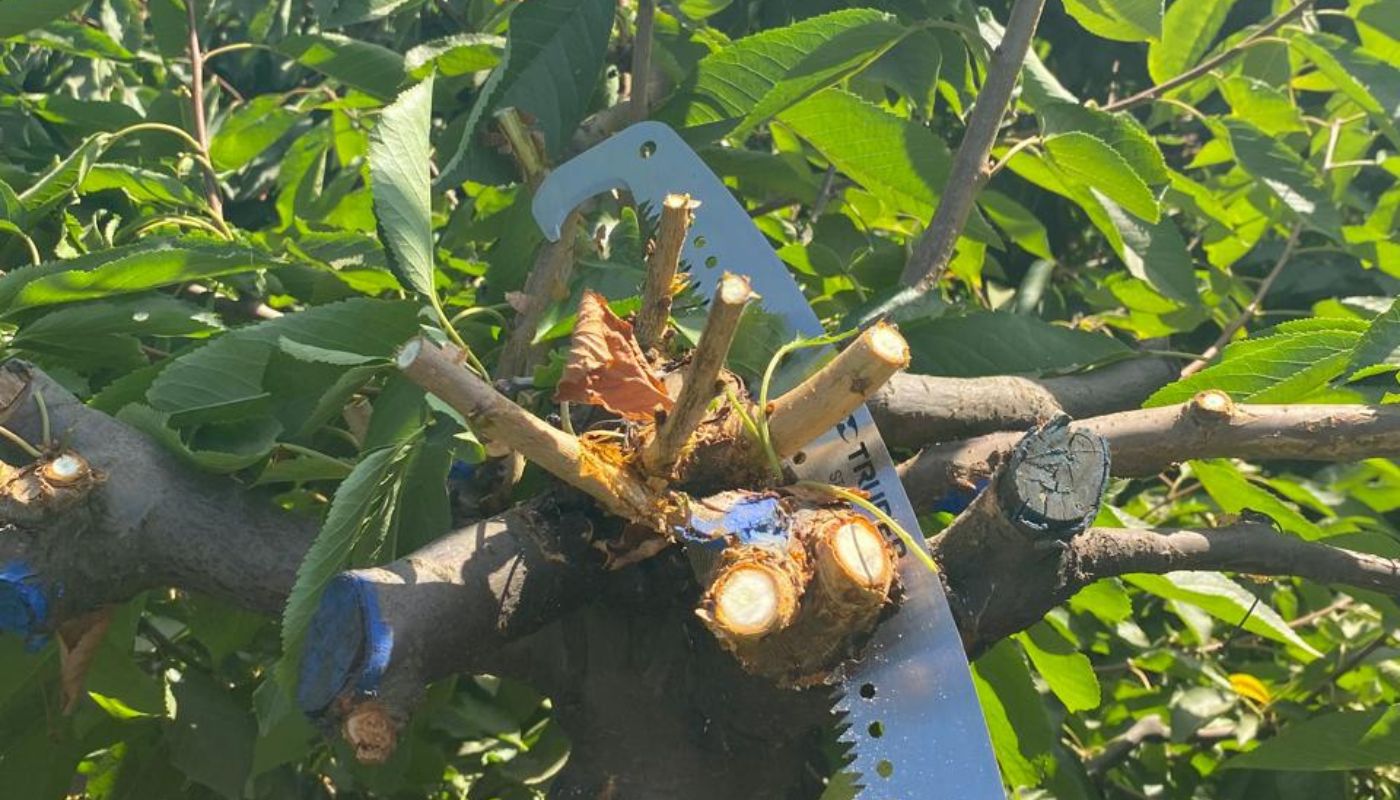
For example, if we use mechanical pruning in January, due to cost considerations, we’ll create a lot of stubs in the apical zone—that is, where the plant prioritizes growth. These stubs are essentially composed of primarily vegetative buds. Therefore, when they perform this mechanized cutting, they leave many stumps, and each of those stumps has an average of three new suckers. So, each of these stumps left by the mechanical cutting will generate new suckers. Therefore, we need to study this technique more, better evaluate the method and timing. In some cases, we are testing it, especially for pre-pruning, which is much cheaper. This is one of the risks that are occurring now, and people will try it to reduce costs, but in the long run, it’s a much more expensive pruning method.
Manual pruning has an estimated cost of between 400,000 and 700,000 pesos per hectare, while mechanized pruning can cost between 200,000 and 300,000 pesos. These mechanical prunings, when touched up by hand, end up costing much more. Therefore, it all comes down to the balance of energy within the plant. In my opinion, the right time to prune is when the plant’s growth rate is already beginning to slow, whether due to climatic or physiological factors. This period typically begins around February 15th.
We are right at the stage where we need to intervene in the trees to maintain a good vegetative balance. What we absolutely do not want is for the orchard to sprout again, resulting in orchards in a state of regrowth during March, and for the wood not to be properly lignified by winter. Therefore, very early pruning will stimulate regrowth. Another very important point, related to some pest-related factors, is the two-spotted spider mite. One of the most significant pests is the two-spotted spider mite. If I have an orchard that I pruned heavily in January, with a rather limited post-pruning vegetative growth, and I have a spider mite infestation, it will be left with a very low number of leaves to cope with the conditions that arise from the accumulation of reserves when the period of translocation of those reserves to the plant begins. Therefore, all these variables must be taken into account. And something key: we have observed through analysis the influence that vegetative growth has on the leaf temperature of the two-year-old branch. Then we have a one-year period in which a sucker, for example, also plays an important role in regulating the plant’s temperature. The leaves of the spur are the engine, and the leaves that cool this engine are those of the annual shoot. If I remove the radiator during the hottest period, the vegetative growth, leaving the spur leaf exposed to sunlight and high temperatures, causes the cherry tree to typically collapse around 28-29°C, as it begins to close its stomata. The plant stops photosynthesizing when it experiences excessive heat. Therefore, in our opinion, this vegetative growth during December and January also serves an osmotic regulation function within the plant. Consequently, removing this growth too early also leaves it exposed during January.
—Does summer pruning, whether due to the timing or the type of pruning, affect the varieties in each orchard?
There is clearly a correlation between certain varieties and higher productivity. Some varieties are much more vigorous, and others are much more affected by high temperatures. Kordia is a variety that is very sensitive to stress, so it needs to be managed carefully. It’s particularly stressed in summer, and a large part of the explanation for its low yields is also related to the abiotic stresses this variety is exposed to in areas where it shouldn’t be planted. Zoning is a huge issue. For example, in the north, if you prune very heavily early in the season, you leave the wood exposed to sunscald. So, there are clearly differences between varieties and especially between rootstocks, which is closely related to vigor. For example, the Gisela and Maxma rootstocks are rootstocks with less vegetative growth and vigor. These respond very well to winter pruning. And Col, for example, is very vigorous and clearly doesn’t behave the same way as a less vigorous rootstock. At the same time, Santina is a variety that tends towards greater vigor, while Lapins, due to its productive characteristics, tends towards less vigor. In other words, Santina is more vigorous, while Lapins tends to have less vigor because of its productive characteristics. It will depend heavily on soil conditions and the agroclimatic zone, but there are indeed significant changes and differences between varieties and especially between rootstocks.
– Within that same context, and considering aspects that are becoming relevant when marketing this fruit, does summer pruning influence or help improve the size and/or firmness of the fruit?
Absolutely. In what way? If we have a plant in an unbalanced state, where vegetative growth predominates over fruit production, and the plant’s energy sink is focused on these apical growths or vigorous growth, the plant will generate a lot of wood, a lot of vegetative growth, to the detriment of fruit quality, dry matter, sugar formation, and fruit development. If I have very strong vigorous growth, if I have many branches and suckers, the extraction of water from the soil will be much more powerful in volume and pressure. Therefore, if I have a lot of vegetative growth, I will generate greater water absorption, and this greater absorption of water volume and pressure could eventually cause the flower buds to begin sprouting again. If a flower bud sprouts again at this time of year, it will lose much of its potential to produce a flower and fruit. Therefore, proper summer pruning will help create balance, ensuring good nutritional and hormonal distribution in the fruit, in bud formation, and subsequently, flower and fruit development.
Proper pruning is crucial for ensuring good future fruit quality. And, returning to the importance of calcium as a cornerstone of our strategy, if I prune at the wrong time, during December or January, for example, causing new growth, or if I scratch the buds and produce new shoots, or if I prune incorrectly, the calcium will be diverted to where the plant can move it through the sylem and where there is greater evapotranspiration. I need that calcium to be positioned in the flower bud to produce better fruit. Therefore, good pruning management and vegetative balance are fully related to the formation of good quality future fruit, and a good condition of the cherry.