

As discussed in the first part, we will continue analyzing how leaves allow for an objective diagnosis of the plant’s nutritional status after harvest, when its elements are physiologically stable. This provides a tool for making the necessary adjustments to begin the next season, accumulating reserves and maintaining its elements within optimal ranges to ensure a successful start to the cherry production cycle, which begins with proper postharvest management.
When discussing postharvest, one might think of an extended period, which for some varieties can even last from November to March. This implies a continuous process once the fruit is harvested. However, in practical terms, we focus on the period from December to February, specifically aimed at replenishing the nutrients extracted by the fruit.
Because fertilization is generally understood as a method of balancing what is supplied to and what is extracted from the system, its effectiveness must be ensured, primarily in terms of the nutritional contribution to the soil of the units of each element per ton harvested. However, a thorough foliar analysis allows for supplementing soil fertilization or fertigation to correct deficiencies in certain macro or micro elements.
Figure 1. Optimal ranges for the main elements in the leaf.
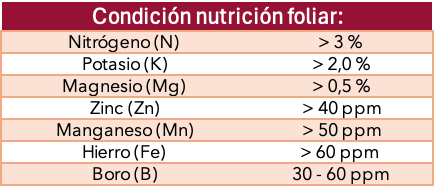
While there is a consensus on the nutritional ranges needed to ensure the health of cherry trees, the importance of correctly interpreting laboratory results and observing the plants in the field should not be overlooked, as this can provide complementary information for determining the best recommendations for corrective applications.
According to the information and experience gathered by the Avium team, an important variable to consider is the rootstock, since the sufficiency and demand of nutrients will vary depending on it.
While nitrogen is the most important element in plants due to its role in energy reserves, it is particularly relevant in weaker rootstocks such as Gisleas or MaxMa 14, whereas in Colt or MaxMa 60, special care must be taken to maintain a balance in their vigor. The visual symptom is a generalized pale green color across all leaves.
On the other hand, regarding potassium, its higher demand and availability in vigorous rootstocks like Colt must be considered. The visual symptom of deficiency is detected in mature leaves with slightly necrotic margins.
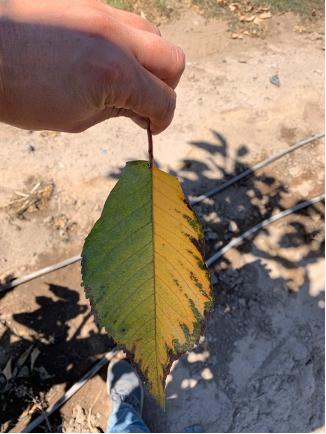
Magnesium, in turn, is key for rootstocks such as Mahaleb, Pontaleb, and its current evolution to MaxMa, as well as Gisela, though to a lesser extent. Magnesium deficiency is very common and can be observed in basal leaves of the current year’s growth, exhibiting interveinal chlorosis, as can be seen in the photos.
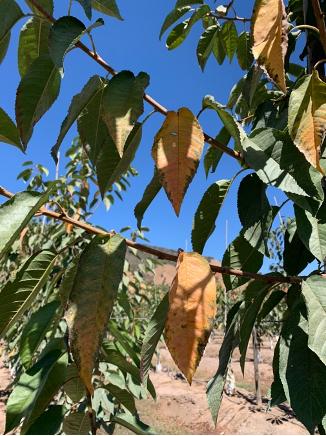
However, in the case of the entire Gisela or Acid series, which are lines or direct descendants of acidic cherry trees, zinc status is crucial for their optimal development. This can be identified at the tips of the current year’s growth as smaller, etiolated leaves.
In conclusion, it is essential to define what we must consider for a correct interpretation of foliar analysis results, in addition to the ranges for the species described in the literature or in laboratories. Even more important is the rootstock combination.
Foliar analyses also help us make decisions about the nutritional program, especially regarding nutrient recovery in orchards post-harvest. This is crucial for maintaining standards that allow the fruit, as the primary factor, to extract nutrients during the season and accumulate reserves before entering dormancy, thus ensuring proper bud break from a nutritional standpoint.