

Consulted by the Mendoza Cherry Chamber, and as a follow-up to their presentations at the IV International Seminar on Early Fresh Cherries, held in Mendoza in April 2025, agronomists Mariano Winograd and Claudio Barón conducted an analysis of the Argentine domestic market, which is detailed below.
Argentina produces cherries on 2,200 hectares, where approximately 14,000 tons are harvested, of which 50% is exported and the other 50% is sold in the domestic market.
Production is concentrated in the provinces of Mendoza, Río Negro, Neuquén, Chubut, and Santa Cruz, where the harvest extends from October to March, reflecting the growing interest in early production, which fetches better prices for both export and the domestic market.
Cherry production previously focused on early harvesting, though certainly without achieving the precocity recently attained through genetic improvements and agronomic techniques.
Over the last few decades, there has been an emphasis on late-season production, from December onward, with a focus on the Chinese market, mirroring what was happening simultaneously in Chile, thus shifting the production epicenter to Patagonia.
Recently, as a result of the efforts of Mendoza producers, agronomic research conducted in the province of Jujuy has identified an opportunity for early-season cherries, which are emerging as a viable production alternative in Argentina, while similar varieties are being cultivated in Chile, Peru, and even Brazil.
The province of Mendoza, with 700 hectares in production, is particularly well-suited for achieving extra-early harvests (starting in week 43-44 of the year). To this end, producers are focusing their efforts on testing varieties with lower chilling requirements, as well as selecting suitable ecological zones for early fruit development. As mentioned previously, the season started well, with good prices, which, as is typical, have been decreasing as supply volumes have increased.
The 2025/26 season offers a renewed opportunity for business exploration and innovation in fruit production. Adjustments in production techniques have allowed for the harvest start times of early varieties and new production areas to be adjusted each year.
Thus, this year, 2025, we began with the first harvest, still in the experimental stage, of cherries planted in the temperate valleys of Jujuy, as early as September 30th, with varieties from the Royal series, but still on an experimental scale.
The season begins, as every year, with shipments from the province of Mendoza, starting in October, with varieties such as Nimba, Royal Lee, Pacific Red, and Frisco, later joined by Brooks and then Royal Dawn.
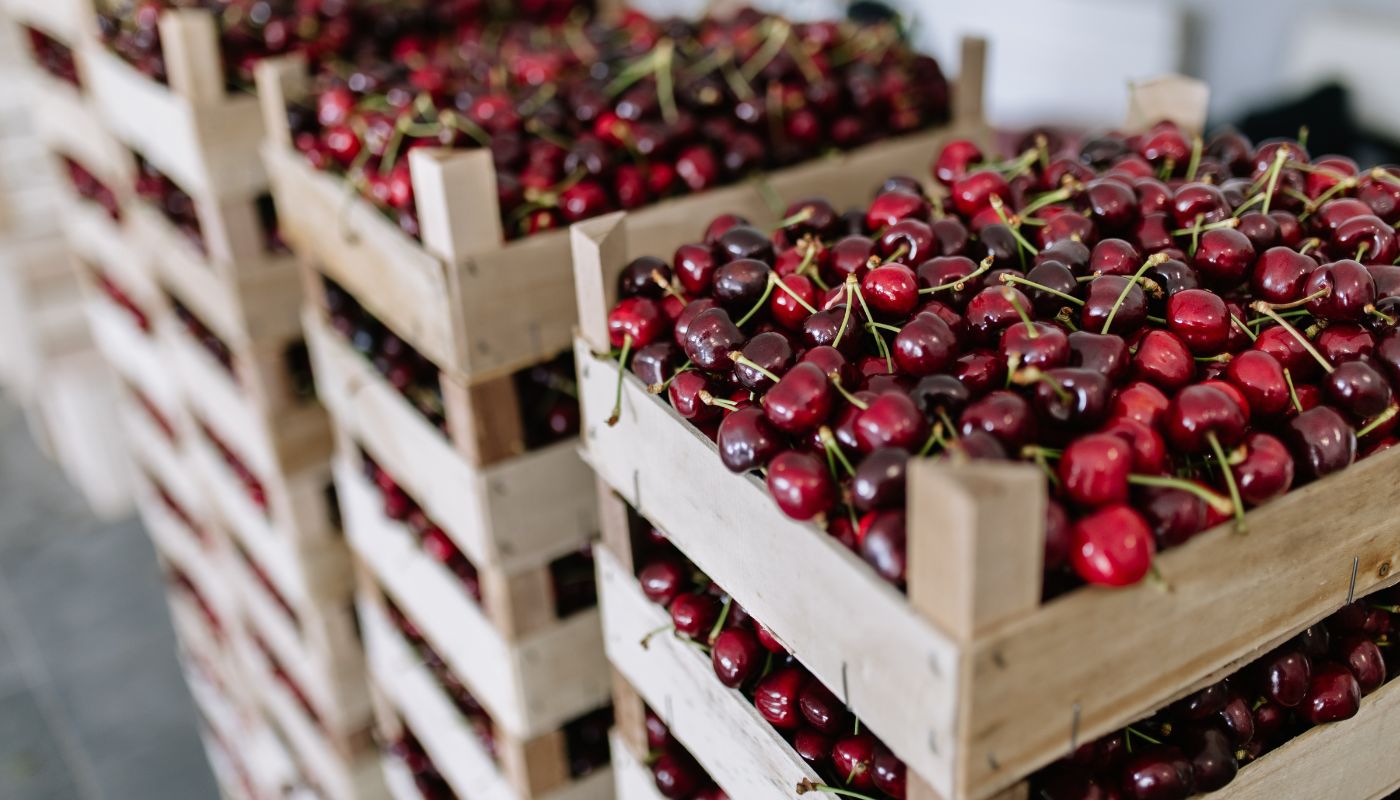
This year, the first shipments to the central market of Buenos Aires were registered on October 29th (week 44). These first boxes (Figure 1) were presented in 2.5 kg containers and were sold at prices reaching $80,000, that is, $32,000/kg, the equivalent of US$22/kg.

As Mendoza’s supply volumes increased, we also began receiving the first shipments from Río Negro province on November 7th. We hadn’t even gotten used to the presence of the domestic shipments when, to our surprise, we found that Chilean cherries began arriving and competing on November 14th. Unlike the previous season, Chilean cherries hadn’t appeared until December.
Argentine cherries are characterized by their high soluble solids content, large size, and dark color—three characteristics valued in both the domestic and export markets.
Predictions from various producer associations, especially those in the southern region of the country, indicate that the harvested volumes available for sale this season could be lower due to late frosts. We will have to see how the domestic supply evolves as the season progresses.
Meanwhile, a hailstorm and torrential rains hit Río Negro, and the intensity and extent of the storm have left a large portion of the cherry crop destroyed and/or with quality issues, which will likely impact the domestic market supply in the coming weeks.
Regarding price trends during this early fruit season, the graphs below show the price movements, which have begun very similarly to those of the 2024-2025 season.
Buenos Aires Central Market Cherries: Average daily wholesale prices in ARS/kg and USD/kg recorded during weeks 44, 45, 46, 47, and 48 of 2025.


As we mentioned when discussing the presence of Chilean fruit, this season’s statistics show an early arrival of fruit from our neighboring country in November, totaling 167 tons (a very high volume for this type of fruit). This situation surprised and worried Argentine producers because this early arrival (in previous years, Chilean fruit didn’t enter the market until December) led to an oversupply, causing a faster drop in prices and resulting in lower quality fruit compared to Argentine produce.
Faced with this season’s larger production and seeking to better balance its output (which is dependent on China), Chile has begun selling its early harvest to markets that weren’t as important to it in previous years, such as Europe and South America. Chilean fruit arrives in 5 and 10 kg containers and is being offered at lower prices than Argentine fruit.


On Friday the 28th, at the end of November, we already saw market prices for quality fruit falling below $10,000/kg in many cases (between $7,000 and $10,000).
A discussion about the context and its opportunities remains. The political changes that have occurred in Argentina since the 2023 elections, ratified by the electorate in the legislative elections at the end of October 2025, and the imminent resolution of the Chilean runoff election, will present us with new challenges and their corresponding SWOT analysis.
Let’s continue working as we have been doing in recent years.