

Dormancy in cherry trees should not be understood merely as a period of rest, but as a progressive and highly regulated physiological process, key to the productive expression of the following season.
Its proper establishment allows the plant to face winter in such a way that it can protect its sensitive structures and synchronize budbreak and flowering with favorable environmental conditions. From this perspective, dormancy is not simply a halt in growth, but an active stage of physiological, metabolic, and structural reorganization.
In practical terms, the onset of dormancy does not occur suddenly, nor should it be approached as an isolated event on the calendar. On the contrary, it develops progressively from post-harvest and throughout autumn, when the orchard begins to show clear signs of winter preparation. These include reduced growth, increased lignification, leaf drop, accumulation of reserves, and a general decrease in plant activity. Understanding this process from a physiological standpoint allows for a more accurate interpretation of the orchard’s condition and helps anticipate its subsequent behavior.
What is dormancy and why is it so important?
In deciduous species like the cherry tree, dormancy is an adaptive strategy that allows for survival in the face of unfavorable winter conditions. Its main function is to prevent buds from prematurely resuming growth during transient periods of mild temperatures, thus safeguarding the plant’s future vegetative and reproductive expression. From a physiological point of view, it is a temporary suspension of visible growth, although key internal processes related to transport, hormonal regulation, gene activity, and carbohydrate dynamics continue to occur (Fadón et al., 2020).
To interpret cherry winter dormancy from an agronomic perspective, it is especially useful to focus on three main stages: para-dormancy, endo-dormancy, and eco-dormancy. These phases allow us to organize the sequence of winter dormancy and understand how the plant transitions from the end of the growing season to the resumption of growth in spring.
Phase 1: Para-dormancy
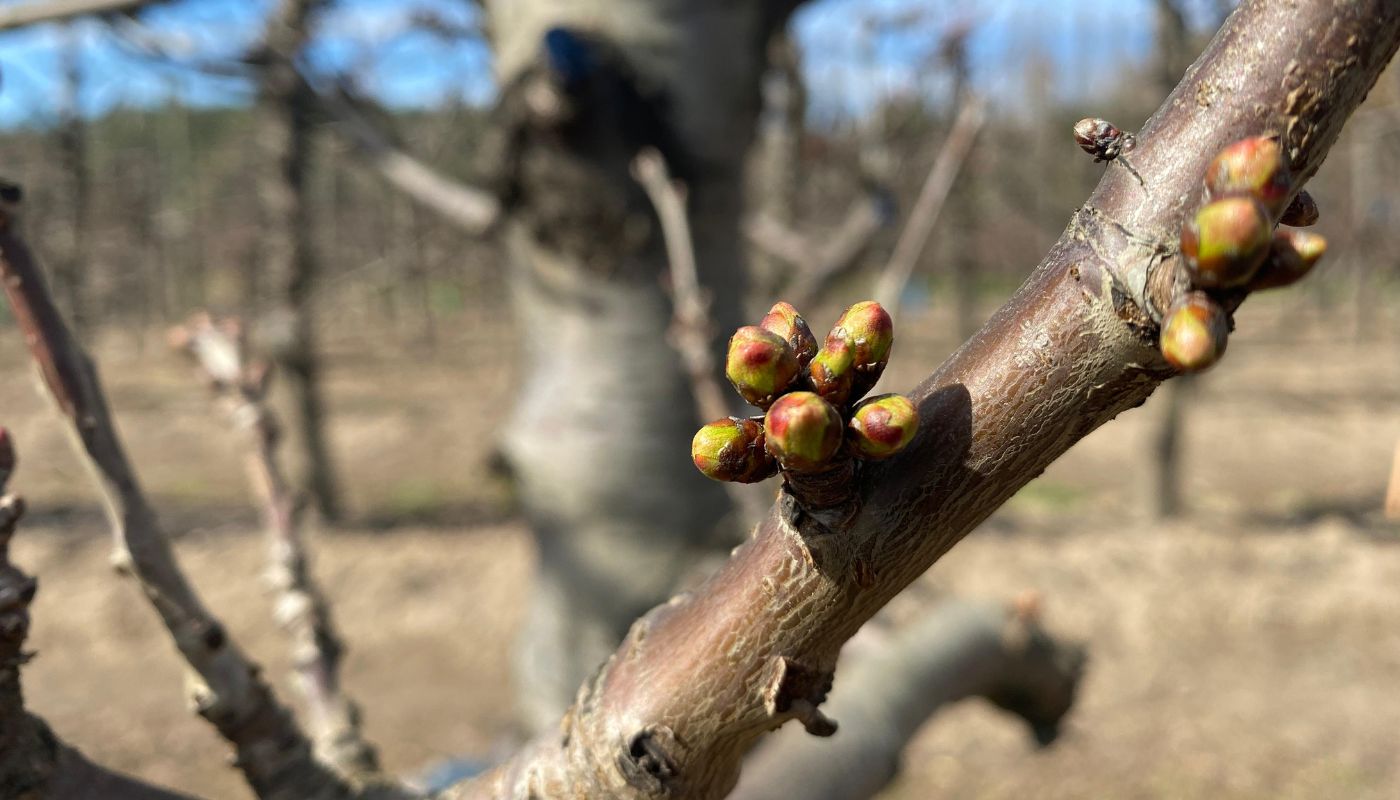
The first stage corresponds to the establishment or induction of dormancy. It occurs towards mid-to-late summer and during autumn, when the plant transitions from an active growth state to a dormant state. In this phase, shoot growth cessation, bud formation and closure, leaf senescence, and subsequent leaf fall are observed. Within the physiological framework described for temperate woody species, this stage coincides with the onset of winter dormancy, which may be associated with the beginning of leaf fall.
This transition is related to the progressive decrease in temperatures and also to the shortening of the photoperiod. Internally, this phase is accompanied by cold acclimatization, restriction of cell communication due to callose deposition, changes in vascular transport, predominance of inhibitory hormonal signals such as abscisic acid (ABA), and consolidation of carbon reserves (Fadón et al., 2020).
From a technical perspective, this stage is particularly critical, as it defines the orchard’s entry into winter. An orderly entry into dormancy is associated with well-lignified structures, slowed growth, adequate bud condition, and a natural transition to leaf fall.
During this period, management decisions should support the plant’s physiological closure, promoting proper winter preparation and avoiding interference with this process. In practical terms, at the end of this phase, at least 50% of the leaves should be fallen and/or completely yellow by early May for cherry orchards, as an objective physiological measure for calculating chilling in various methodologies.
Phase 2: Endo-dormancy
Endo-dormancy, also called “true dormancy,” corresponds to the phase in which the bud cannot resume growth, even when exposed to seemingly favorable conditions. During this period, the limitation is internal, so the plant needs to accumulate a certain amount of chilling to regain its ability to respond to environmental conditions. This phase fulfills a key adaptive function, as it prevents premature budding in response to transient temperature events during winter.
During endo-dormancy, the cherry tree maintains high levels of cold acclimatization and protects its vegetative and reproductive meristems within the buds. At the same time, relevant physiological processes continue to occur: an inhibitory predominance of ABA is maintained, the expression patterns of genes associated with dormancy are progressively modified, reserves are reorganized, and progress is made in restoring certain cell communication mechanisms in response to the accumulation of chilling.
It is noteworthy that, in flower buds, starch actively accumulates in the ovary tissue during winter, reflecting that dormancy is a physiologically active stage and not simply a state of immobility. This observation reinforces the idea that, during dormancy, the plant does not remain inactive, but rather reorganizes processes and reserves that will be fundamental for breaking dormancy and subsequent flowering.
In terms of production, this phase is crucial. If the chilling requirement is not adequately met, breaking dormancy can manifest as uneven budbreak, extended or unsynchronized flowering, and reduced reproductive efficiency. Therefore, endodormancy represents a critical stage both physiologically and in its agronomic interpretation.
Phase 3: Ecodormancy
Once endodormancy is broken, the buds enter ecodormancy. At this stage, the intrinsic growth capacity has already been recovered, but bud break has not yet occurred because the environment remains limiting. The restriction no longer originates from within the bud, but rather from the persistence of external temperatures insufficient to activate visible growth.
During this phase, a crucial physiological transition toward bud break takes place. Inhibitory signals such as ABA decrease, growth-related hormones increase, plant-level transport is gradually restored, and starch and sugar reserves are mobilized to support bud break and early floral development. As temperatures accumulate, the plant gradually loses its cold acclimatization and approaches the visible resumption of growth.
From a production standpoint, this phase is also sensitive, as it coincides with the period when the plant is approaching the resumption of its activity but may still face frost events or restrictive environmental conditions.
Therefore, understanding the transition between endo-dormancy and eco-dormancy is fundamental to interpreting the phenological behavior of the orchard and projecting the start of the season.
Figure 1. Conceptual framework of winter dormancy in deciduous trees (Adapted from Fadón et al. 2020).
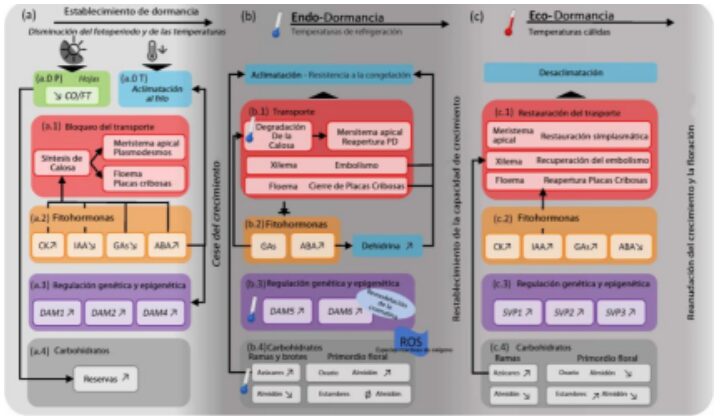
Figure 1 shows the three main phases distinguished by the establishment of (a) dormancy, (b) endo-dormancy, and (c) eco-dormancy. The processes for each phase are colored from light green to red, orange, purple, and gray, numbered 0 to 5 respectively. (0) The CO/FT module (fundamental genes in plant genetic control) acts to determine flower and leaf production through environmental stimuli.
The red rectangular figures correspond to plant-level transport through the phloem and xylem, as well as to the meristem/cellular environment (1). The interaction of different phytohormones and the dynamics of the response are represented in the orange figures (2), genetic and epigenetic regulation in the purple figures (3), and the dynamics of reserve sugars are represented in the gray rectangular figures (4).
Physiological Processes Underpinning Dormancy
One of the most relevant contributions is that dormancy is not explained solely by the accumulation of cold, but by the interaction of multiple physiological processes occurring at different scales. These include transport, phytohormones, genetic and epigenetic regulation, and carbohydrate dynamics (Figure 1).
Transport is profoundly modified during dormancy. At the cellular level, callose deposition blocks plasmodesmata and restricts cell-to-cell communication in the meristem; at the whole-plant level, phloem and xylem flow also decreases or is interrupted. During emergence from dormancy, these systems are gradually restored, allowing the reactivation of growth.
Phytohormones exert a central regulatory role in the process. ABA is associated with the induction and maintenance of dormancy, while gibberellins, auxins, and cytokinins participate in the recovery of growth capacity and the resumption of development. In this sense, dormancy can also be understood as the result of a dynamic balance between inhibitory and promoting hormonal signals.
Bibliographic References
- Fadón, E., Fernandez, E., Behn, H., and Luedeling, E. 2020. A Conceptual Framework for Winter Dormancy in Deciduous Trees. Agronomy, 10(2), 241.