
An old practice involves painting tree trunks, not only on cherry trees, but also on other fruit trees and even ornamental and forest trees. But what is its real purpose, and when is it necessary? These are two questions that, while difficult to answer with absolute certainty, will be addressed in the following article.
Climate change is undoubtedly a decisive factor in generating biotic stress in our plants and, at the same time, can become the key that pathogens need to penetrate the tissues and begin an infectious process that can end with the death of our tree.
Tree trunks, especially those of young trees, are exposed to two conditions that, while normal occurrences, have become abnormal with climate change due to their intensity, extent, and frequency: high temperatures (more frequent and extreme heat waves) and frosts (extremely low temperatures for the area and durations exceeding normal levels).
Both types of events create wounds in the bark, which ultimately become entry points for fungi and/or bacteria, depending on when the damage occurs.
Management practices can also increase susceptibility to trunk wounds. The pursuit of vigorous growth in the shortest possible time often involves management practices based on growth regulators and high fertilization. Both of these obviously cause rapid trunk development for which the tree is not physiologically prepared. While its genes have a response, there is a limit, resulting in bark that cannot keep pace with the development of the inner wood and eventually splits.
Another management practice that increases susceptibility to this type of wound is the use of training methods that expose a lot of wood. Summer, in particular, wreaks havoc in areas with high radiation and temperatures.

Based on the above, we can conclude that protecting or preventing these types of wounds is key to maintaining the health of our orchards and their long-term sustainability.
Reviewing international literature, we realize, or could assume, that the first studies on the use of trunk painting in fruit tree species to prevent bark cracking date back to the 1970s. These studies used analog instruments such as thermocouples, unlike more modern methods where infrared cameras are the key tool for understanding thermal changes without touching the tree.
But before the advent of painting, there is a precedent known since the early decades of the last century: species with lighter bark exhibit a better response to temperature changes during extreme winter conditions in relation to the cambium.
More recent studies suggest that white trunks are better adapted to temperate boreal environments, considering the characteristics of some birch and poplar species native to those forests. So, after a frost, if the trunk is exposed to the sun and is white or light-colored, the temperature change is much smaller, and the rate of warming is reduced by half, preventing sunburn.
We must consider that in radiative frosts, wood damage occurs due to the nighttime cold followed by the warming of the wood exposed to the sun, as the tree faces a completely clear day.
The wounds or cracks caused by these frosts are due to the fact that the outer layer of the tree trunk contracts rapidly during cooling, while the inner layer remains comparatively warm and shows less contraction. White or light-colored bark slows the rate of contraction between these two stages.
In a two-year experiment conducted in Yukon, Canada, on poplar trees, those painted brown had a higher incidence of wounds that appeared to be caused by sunburn (35%) than trees painted white (2.5%) and untreated trees (4.5%), which naturally have light-colored bark.
From a phytopathological perspective, one of the entry points for Cytospora and Calosphaeria in cherry trees is through extreme summer sunburn, which causes the bark to crack. This phenomenon differs from what occurs in winter, when temperatures are not as high, but the temperature difference can still cause damage.
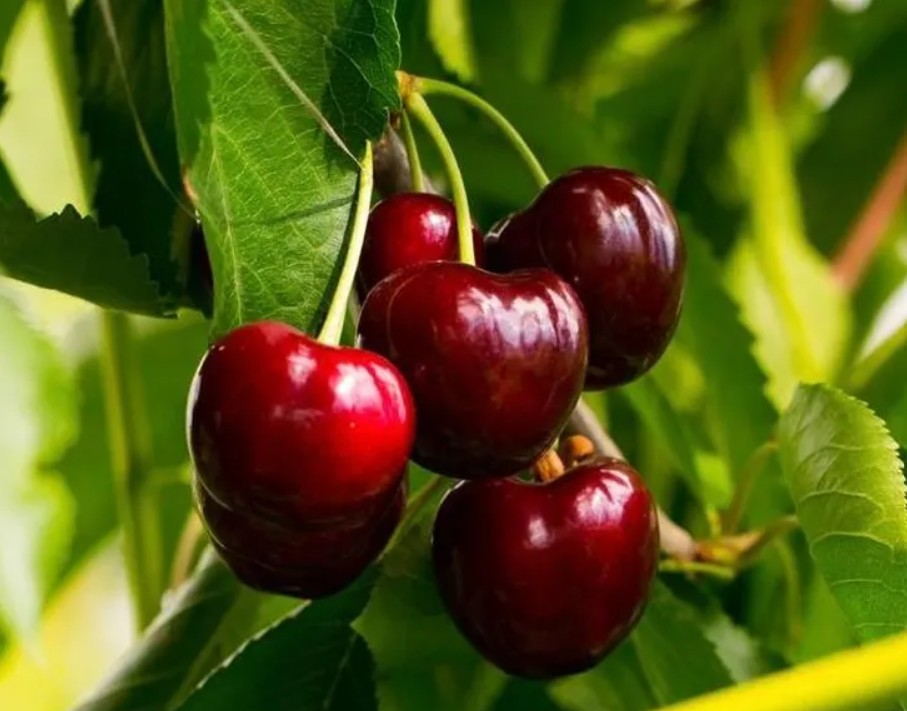
This problem is very common in orchards in central Spain, where training systems with a lot of wood exposed to the harsh summer sun are used (Photo 2).
In a study of wound-susceptible species conducted in Korea during the height of summer, thermographic images recorded differences of nearly 5°C between white-painted wood and untreated wood. In the same trial, brown and white wraps were used. While the light-colored wrap registered a lower temperature than the control, the dark-colored wrap, during the hottest times of the day, was almost identical to the control.

Final Considerations
Today, the general recommendation for paint use is to use water-based interior latex paint, since exterior paints contain a higher quantity of oils that could cause phytotoxicity.
The mixture should be 50% water and 50% latex; however, depending on the quality of the latex, this ratio may not be effective, resulting in poor coverage. Our goal should be to create a layer that truly protects the exposed plant tissue.
Painting should be done from late autumn to early winter. Ideally, dry, sunny days should be chosen for the task.
We generally recommend a maximum height of one meter from the ground, but this is also a guideline to be analyzed on a case-by-case basis, depending, for example, on the training system and irrigation. Furthermore, we could consider this practice almost mandatory for developing plants in the first 3 to 4 years (always considering the risk before making the decision), especially given the rapid trunk development resulting from current management practices.
It is common to mix paint with white glue and/or copper (e.g., Bordeaux mixture). However, there is little literature with well-supported studies to back up these practices, especially regarding copper, which would contribute its classic bactericidal effect.
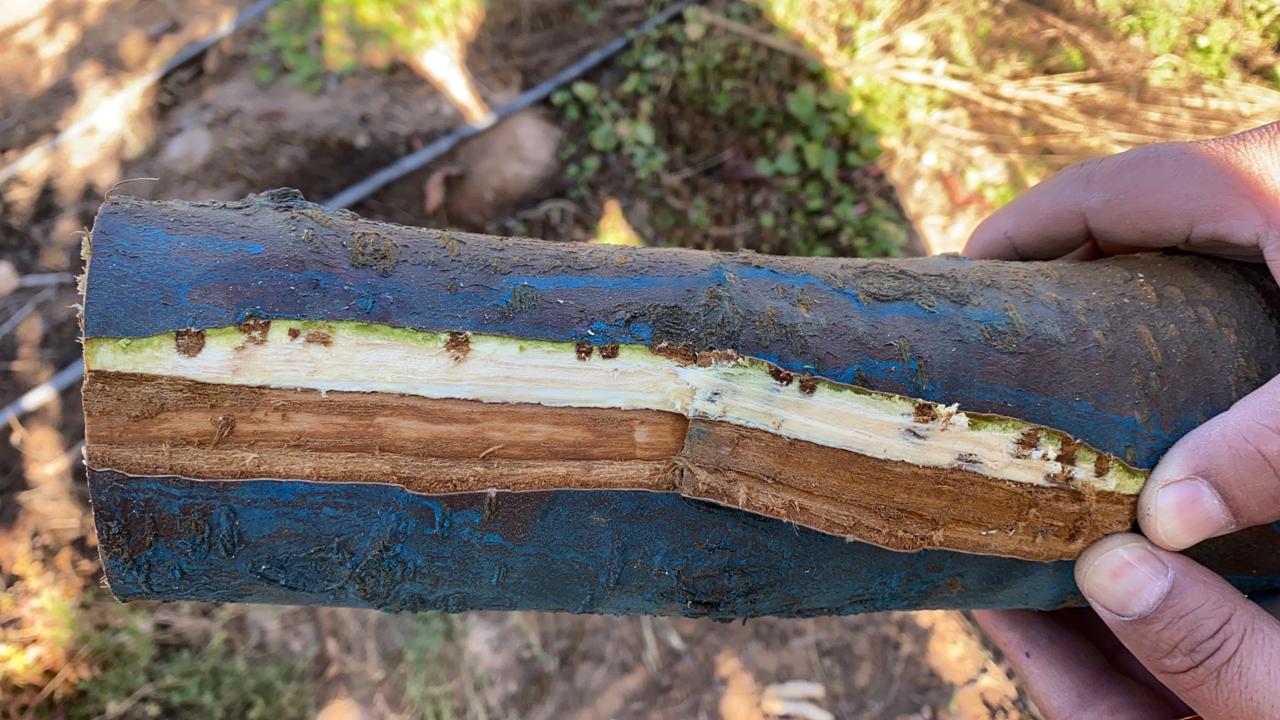
We must consider that we are going from a white paint, whose positive effect is known, to a blue paint, which logically would not have this property in a pronounced way as a first point of reference. A second point is that it is common to observe blue trees without a significant Pseudomonas load, but with Cytospora in a critical state (Photo 3), which is not well controlled by this mineral. Therefore, the use of copper should be evaluated on a case-by-case basis.

Finally, international studies and local experience indicate that the effect of the paint is primarily physical, resulting in a plant that is better able to withstand harsh weather and, consequently, pathogen attacks by minimizing extreme changes in trunk temperature. However, and this is crucial, the application must be carefully controlled. Each trunk must be coated patiently, and if the first coat is not applied correctly, a second coat should be applied.
Failure to follow these procedures constitutes poor management, which in many extreme cases will not help reduce the likelihood of wounds and subsequent infection. Therefore, quality control during the application process is essential for successful management.