

Senescence in humans carries a negative connotation because, as it progresses, it becomes the transition to death. In contrast, in deciduous plants, it is not simply “aging”, but a strategy to overcome a period of high stress, such as winter, aiming for survival and efficiency.
Because it is a delicate phase, where the plant will be subjected to an extreme process, other factors can take advantage of this moment and wreak havoc. Thus, infection by pathogens can be more prevalent during this period. Therefore, in the following article, we will describe some critical points that we must address to help our cherry trees remain healthy.
Senescence is a natural process where chloroplasts degrade, converting into nutrients and various byproducts, which are then distributed to other plant organs to support continued development, encapsulated in a seed or observed in the next budding cycle.
Thus, in annual plants, senescence is triggered at the end of the life cycle, with a large portion of the reserves directed towards the seeds, perpetuating the species. In perennials, this stage occurs as we approach autumn and is visualized through leaf fall. In both cases, it is an adaptive process that has been refined over many years of evolution, and along the way, many stimuli combine to align with a changing environment.
The senescence process is particularly significant for fruit-bearing species. Therefore, it is a stage we must carefully manage because it translates into the long-term sustainability of the orchard.
Leaf senescence involves a series of gradual changes, requiring a finely tuned, multi-level regulatory mechanism, which we will not explain in this article, but it is important to at least understand the underlying principles. When we observe premature leaf fall, the plant reacts poorly for the following season, production decreases, and aging is accelerated because dormancy and bud break occur on a plant that is not yet ready. This fact highlights the importance of this process in a species like the cherry tree.
Why is leaf fall considered a critical time for pathogen infection?
Two factors significantly increase the risk of infection during leaf fall: the environment and the presence of wounds. As autumn approaches, temperatures moderate, the peak of the maximum temperature is shorter, and humidity increases; precipitation may even occur. This scenario creates an environment conducive to the multiplication of bacteria and fungi, including Pseudomonas, Calosphaeria, and Cytospora, among other pathogens, which can significantly increase their presence.
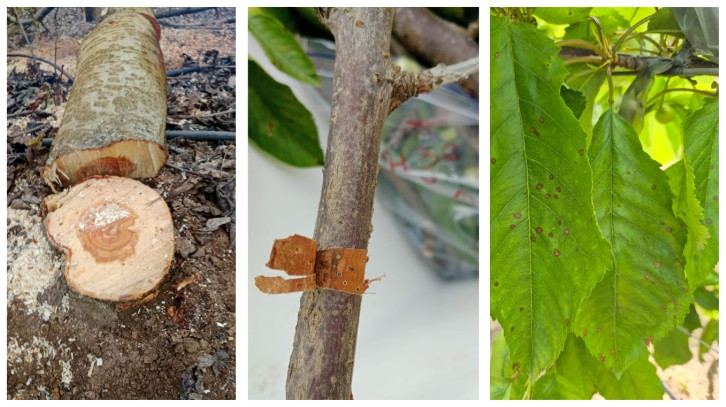
As expected, leaf fall leaves an open wound, which could become an entry point for a pathogen. The pathogen knows its moment, and the plant knows it must defend itself; therefore, both activate processes they have developed over thousands of years of co-evolution. Obviously, we must support the processes the plant has built for its defense.
In terms of general management, anything that creates imbalances must be eliminated. For example, excessive or late application of nitrogen could cause leaf fall to occur slowly, leaving highly susceptible tissues with slow healing processes, which ultimately allows for easier colonization by pathogens.
In terms of applications, we now have a range of products of various kinds that allow us to reduce the amount of inoculum or alter the populations of pathogens naturally present in our orchards.
Within this range of products, copper is probably one of our most frequently used active ingredients. We recommend starting with copper sulfate pentahydrate and finishing with particulate copper sulfates towards the end of the process. It’s important to remember that copper primarily controls bacteria; therefore, we should also use a fungicide, always checking labels and usage records.
This stage is also favorable for biocontrol. If pathogens thrive, competing bacteria and fungi also establish themselves optimally during this period, colonizing, disrupting virulent populations, and preventing them from developing properly.
In my opinion, the ideal approach is to use these types of products at the beginning of leaf fall, when the risk is just starting, and then finish with synthetic bactericides or fungicides. This way, we create mixed programs with less environmental impact and less selection pressure on the target populations, reducing the possibility of developing resistant isolates.
Another type of product is one that promotes the plant’s defenses. Since the tree will enter a metabolic “reversal” process, studies indicate that we shouldn’t apply treatments at a very advanced stage of senescence. Therefore, they should be scheduled close to the beginning of this stage.
All disease control, at this and other stages of cherry tree growth, aims to reduce the likelihood of infection. Therefore, it’s crucial to apply treatments when the probability of infection is highest. In the specific case of leaf drop, we need to understand the tree’s phenological development because we must alternate applications as the probability of infection increases. To do this, we must establish a monitoring plan, as we will describe below.
Monitoring the Leaf Fall Process
Ideally, you should establish an application schedule at 10-20%, 40-50%, and 80-90% leaf fall, but how do you know if your orchard is at each of these stages?
The answer is simple: you must establish and coordinate a leaf fall monitoring system. To do this, at different points in the orchard, select an appropriate number of plants based on the area, and mark four branches on each plant in different cardinal directions.
At the same time, count the number of leaves on each branch and record the count. Nursery suppliers offer practical marking strips for this purpose, which can be easily marked with permanent markers. Each plant should be recorded in terms of row and row position for the next step, which involves measuring those marked branches.
Now for the important activity. Each week, we must record the number of attached leaves and compare it to the number of fallen/senescent leaves, calculating the percentage and obtaining the current leaf fall rate. Each time I reach a branch to count, I must shake it to remove any leaves in the process of falling and then take the measurement.
With the data obtained, I must construct a progress curve, and each time I approach the application percentage, I plan my management, which is perfectly aligned with the period to be protected. It is important to remember that as the percentage of leaf fall increases, there is a greater risk of open wounds, so the level of control should be increased according to the progression of the phenology.
This activity not only helps me plan my applications accurately, but it is also mentioned in the literature that the moment of 50% leaf fall is when we should begin quantifying chill hours, which, as we should all at least speculate, plants do not have calendars where they fix this start to a particular date, but rather they read the environment and each year it must vary just as it does, for example, in the flowering or harvest date.