
The 2025/26 cherry export season marked a historic milestone for Argentine fruit farming: the province of Chubut consolidated its position as the country’s leading cherry exporter, displacing Río Negro, which had held the top spot for years in the international trade of this fruit.
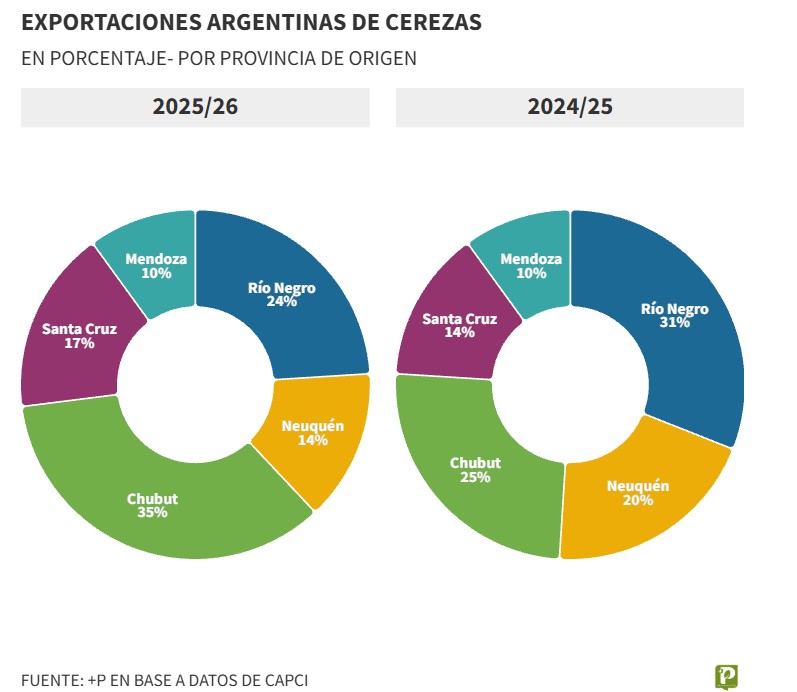
According to the season’s closing data, Patagonia once again accounted for the bulk of national exports, contributing 90% of the total volume exported. However, the most significant change occurred in the provincial distribution of supply, with Chubut reaching a 35% share of total exports, placing it first in the national ranking.
Behind Chubut came Río Negro with 24% of exports, followed by Santa Cruz with 17%, Neuquén with 14%, and Mendoza with 10%. This new scenario reflects a profound reorganization within the Argentine cherry industry, marked by significant production declines in several of the country’s producing regions, as shown in the latest report from the Argentine Chamber of Integrated Cherry Producers (CAPCI).
The export season began during week 45 of 2025, with the first shipments from Río Negro, and concluded in week 9 of 2026 with shipments originating in Santa Cruz. Specifically, exports began on November 4, 2025, and ended on February 23, 2026.
According to the report, the season was characterized by significant disruptions to the production calendar. The weather conditions resulted in highly uneven flowering and ripening, especially in northern Patagonia, causing delays and disruptions to the usual harvest dates. In some areas, the traditional schedule was maintained, although in others, significant changes were recorded in the development of the orchards.
Lower production and a drop in exports
The total exported volume reached 4,984.94 tons, generating revenue of US$16.8 million. The average declared FOB value was US$3.37 per kilogram exported.
However, the harvest fell far short of the levels achieved during the previous cycle. The exportable surplus fell by 38.47% compared to the 2024/25 season as a consequence of a sharp decrease in national production. The greatest losses were recorded in Río Negro, Neuquén, and the Colonia Sarmiento area in Chubut, affected by various adverse weather events.
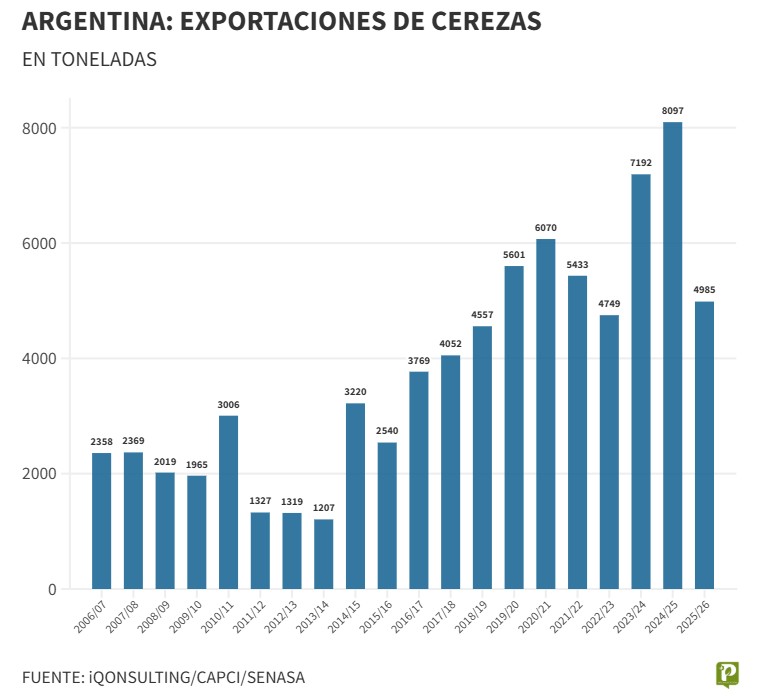
National production was estimated at around 8,600 tons, a figure that highlights the impact of adverse weather conditions on the sector. The losses affected production facilities in Mendoza, Río Negro, Neuquén, and Chubut to varying degrees, significantly reducing the availability of fruit for export. Even so, the exportable surplus represented 57.9% of the total production obtained during the season.
The United States maintains its leading position among export destinations
Regarding export destinations, the United States consolidated its position for the third consecutive season as the main buyer of Argentine cherries. The North American market absorbed 30.75% of exports, once again surpassing China, which received 21.66% of the shipped volume.
Spain completed the top three destinations, accounting for 16.7% of exports. Further behind were the United Kingdom with 8.2%, the United Arab Emirates with 7.25%, Singapore with 2.93%, and Canada with 2.8%, according to the CAPCI study.
The comparative analysis with the previous season shows significant changes in market composition. The United States saw a 4.5% decrease in its market share, while China’s share fell by 26.3%, Spain’s by 22.7%, and the United Kingdom’s by 36.4%. Conversely, shipments to Canada grew significantly, with Canada increasing its purchases by 75%, Singapore by 46.5%, and the United Arab Emirates by 36.8%.
Furthermore, Argentina maintained its presence in emerging markets such as Egypt, Estonia, and Ireland, further diversifying the Argentine fruit market.
International price pressure
Despite production challenges, Argentine cherries continue to show a balanced distribution among the world’s main markets. However, the season was also affected by a marked drop in international prices. This phenomenon was closely linked to the oversupply of Chilean cherries, which increased competition in destination markets and exerted strong downward pressure on prices.
In this challenging context, Chubut’s leading position represents one of the highlights of the 2025/26 season. The province managed to increase its export prominence and position itself as the main source of Argentine cherries destined for the international market, marking a turning point in the production and commercial landscape of one of Patagonia’s most dynamic regional economies.
Images: Courtesy of Más Producción
Source: Más Producción